PART 1 — The Mother They Thought They Could Silence
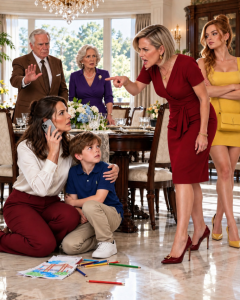
My sister pointed at my eight-year-old son in front of our entire family and shouted, “Get him away from my daughter! Children from your kind of life don’t belong at our table!”
The dining room fell silent.
My son, Noah, stood beside my chair with tears gathering in his eyes, clutching a small handmade birthday card he’d spent three evenings creating for his grandmother. His little fingers trembled as he looked from my sister’s angry face to mine, silently wondering what he’d done wrong.
I was sitting in my parents’ enormous dining room, surrounded by crystal glasses, polished silverware, expensive flowers, and relatives who had spent years reminding me that I was the family disappointment.
Across the room, my older sister, Vanessa, wore a fitted crimson dress and a diamond necklace our father had purchased for her fortieth birthday. Her long blonde hair fell perfectly over her shoulders, and her expression suggested that everyone in the room existed to obey her.
Beside her stood her seventeen-year-old daughter, Madison, who was watching Noah with an irritated smile.
My father, Richard, sat at the head of the table. My mother, Eleanor, stood near the fireplace, nervously twisting the bracelet around her wrist.
Nobody defended my son.
Nobody asked why Vanessa was shouting at an eight-year-old boy.
And nobody seemed to care that Noah was trying desperately not to cry.
I slowly placed my napkin beside my plate.
“Vanessa,” I said quietly, “he hasn’t done anything to you.”
She laughed bitterly.
“Oh, please, Claire. Don’t start pretending you’re some perfect mother. Your son walked near Madison’s designer handbag, and now you’re acting like we’ve committed a crime.”
Noah immediately shook his head.
“I didn’t touch her bag, Aunt Vanessa. I was just giving Grandma my card.”
He held up the little envelope.
Inside was a drawing of our family standing beneath a big tree. He had drawn my mother with silver hair, my father with a brown jacket, and Vanessa wearing a bright red dress. Even Madison had been included.
He’d spent hours making sure nobody was left out.
But Vanessa snatched the card from his hand.
“Look at this mess,” she said, holding it between two fingers. “You expect your grandmother to appreciate something a little child scribbled with cheap crayons?”
Noah’s eyes filled with tears.
“Please give it back. I made it for Grandma.”
Vanessa dropped the card onto the floor.
Then she deliberately stepped on it with her high heel.
The paper crumpled beneath her shoe.
My son stared at the ruined drawing as if someone had broken something far more valuable than a piece of paper.
“Mommy,” he whispered, “I worked really hard on that.”
Something inside me went still.
For twelve years, I had tolerated my family’s insults. I’d allowed them to believe I was an unsuccessful woman who had made poor choices, struggled to support herself, and never achieved anything worth celebrating.
I’d listened when my father praised Vanessa’s business while dismissing my work as an ordinary office job.
I’d smiled when my mother explained that Vanessa’s expensive holidays proved she had made something of her life.
I’d stayed quiet when relatives asked why I couldn’t be more like my sister.
I had done all of that because I wanted Noah to grow up knowing his grandparents, aunts, uncles, and cousins.
I wanted him to have the family I had always hoped for.
But watching Vanessa crush his handmade birthday card while everyone stood silently around us, I finally understood something painful.
I had been protecting the illusion of a loving family at the expense of my son’s dignity.
And I was finished doing that.
I stood up and moved Noah gently behind me.
“Pick up the card,” I told Vanessa.
She raised an eyebrow.
“Excuse me?”
“You heard me. Pick it up, apologize to my son, and stop humiliating him.”
Vanessa burst out laughing.
“Are you giving me orders in my own parents’ house?”
“This is your parents’ house,” I replied. “And Noah is their grandson.”
My father slammed his palm against the table.
“Claire, sit down! You’re embarrassing everyone.”
I looked directly at him.
“Dad, she’s just destroyed something her nephew made for Grandma. Why are you angry with me instead of her?”
“Because you always turn little things into major problems!” he snapped.
My mother hurried forward.
“Claire, sweetheart, please. It’s your mother’s birthday dinner. Don’t ruin the evening.”
I glanced at the untouched birthday cake on the sideboard.
“Mom, Noah hasn’t even been allowed to give you his present.”
She looked at the crumpled card on the floor, then at Vanessa.
For one brief moment, I thought she might finally say something.
Instead, she sighed.
“Perhaps you should take him outside until he calms down.”
Noah tightened his grip on my hand.
I felt his small fingers trembling against mine.
That was the moment I made my decision.
I wasn’t going to shout. I wasn’t going to insult Vanessa. And I wasn’t going to reveal my accomplishments just to make my relatives regret how they had treated me.
I was simply going to leave.
I bent down, carefully picked up Noah’s damaged card, and placed it inside my handbag.
Then I helped him put on his little jacket.
Vanessa folded her arms.
“Where do you think you’re going? We haven’t even served dessert.”
I looked at her.
“Somewhere my son doesn’t have to beg adults to treat him with basic kindness.”
Her smile disappeared.
My father stood up.
“If you walk out of that door, Claire, don’t expect me to help you when you come crawling back.”
I paused beside the doorway.
For years, those words would have frightened me. My father had built his entire identity around money, influence, and the belief that everyone in the family needed his approval.
He assumed I needed him just as much as he needed to feel important.
But he had never understood the truth about my life.
I didn’t need his money.
I didn’t need his connections.
And I certainly didn’t need his permission to protect my child.
I took Noah’s hand and walked out.
Behind me, Vanessa called after us.
“Don’t bother coming back! You and your little boy are no longer welcome here!”
I didn’t turn around.
Outside, the evening air was cold. Noah climbed into the passenger seat of my car, wiped his cheeks with his sleeve, and stared down at his shoes.
After several minutes, he finally spoke.
“Mommy, does Aunt Vanessa hate me because we’re poor?”
My heart broke.
I turned toward him and gently brushed his hair away from his forehead.
“No, sweetheart. Her behavior is her responsibility, not yours. And being kind is worth far more than having expensive things.”
He looked at me uncertainly.
“Then why didn’t Grandpa stop her?”
I didn’t have an answer that could make sense to an eight-year-old.
So I pulled him into my arms and held him until his breathing settled.
Then I started the car.
As we drove away, my phone began vibrating repeatedly.
My sister sent the first message.
Vanessa: You owe me an apology for humiliating me in front of everyone.
Then my father sent one.
Dad: You have until tomorrow morning to call your sister and make this right.
My mother followed.
Mom: Please don’t make me choose between my daughters.
I read the messages at a red light, then placed my phone facedown.
They still believed the problem was my reaction.
They had no idea what had happened during the twelve years I had spent building a life far beyond their narrow expectations.
They didn’t know about the company I had helped establish with two university friends.
They didn’t know that the little consulting office where I supposedly worked was actually the headquarters of a technology and financial services group operating across several states.
And they certainly didn’t know that, after years of careful investment and hard work, I had become the majority owner of a business worth more than the combined value of my father’s real estate holdings and my sister’s company.
I had never hidden those facts because I wanted revenge.
I had hidden them because I had learned that the people who genuinely loved me never needed a financial explanation to treat me with respect.
My husband, Daniel, knew everything. He had stood beside me through the long nights, the failed contracts, the frightening loans, and the early years when success seemed impossible.
But my relatives had never asked enough questions to discover any of it.
They had simply decided who I was.
And I had allowed them to keep believing their own assumptions.
That night, after Noah fell asleep, I sat alone in my home office and opened my laptop.
An email from my company’s legal department was waiting.
The subject line read: Final Review — Westbridge Development Partnership.
Westbridge was my father’s largest real estate company.
For months, his executives had been negotiating with my investment group over a substantial financing and redevelopment agreement. The deal would provide the capital needed to rescue several stalled projects and protect the company’s future.
My father had spoken proudly about the partnership at every family gathering.
He had told everyone that the agreement was practically guaranteed.
He had even bragged that the investors were fortunate to have someone as experienced as him leading the negotiations.
What he had never realized was that the investment group was controlled by the woman he called a failure.
I opened the email and read the final paragraph.
The agreement was ready for review, subject to the usual independent financial, legal, and compliance checks.
I leaned back in my chair.
I could have ordered the entire deal canceled out of anger.
I could have made one phone call and turned my father’s confidence into panic.
But I knew that would make me no better than the people who used power to punish anyone who disappointed them.
So I closed the email without taking action.
The business would proceed according to its documented terms, not my personal feelings.
My family would have to face the consequences of its own behavior without my interfering in a legitimate transaction.
Then I looked at the photograph beside my desk.
It showed Noah sitting on Daniel’s shoulders at the beach, laughing so hard his eyes were closed.
I remembered why I had worked so hard.
It wasn’t to impress my father.
It wasn’t to defeat my sister.
It was to give my son a life where he never had to measure his worth by someone else’s approval.
I picked up my phone and typed a message to my family’s group chat.
“I will not apologize for leaving after Noah was humiliated. If anyone wants to discuss what happened, we can do so honestly and respectfully. Until then, please give us space.”
I pressed send.
Then I silenced the conversation and went to bed.
I thought the worst of the evening was over.
I was wrong.
Because the following morning, my father discovered that I had left the family gathering without accepting his authority.
And for a man who had spent his entire life believing every problem could be solved by controlling the people around him, my silence was something he could not tolerate.
At 8:17 a.m., he made a phone call that would change the future of our family forever.
PART 2 — The Secret Behind the Woman They Called a Failure
At 8:17 that morning, my father called me seven times.
I ignored the first six calls because I was helping Noah get ready for school. When the seventh call came, I answered.
“Claire, what exactly do you think you’re doing?” he demanded.
I could hear the fury in his voice.
“Good morning, Dad.”
“Don’t play games with me! Your sister says you left the dinner threatening everyone, and now you’re refusing to answer your mother.”
“I didn’t threaten anyone. I left because Vanessa humiliated my son.”
“Oh, for heaven’s sake! She stepped on a piece of paper. Are you seriously destroying this family over a child’s drawing?”
I looked through the kitchen doorway.
Noah was sitting at the table, carefully coloring a new picture. He had decided to make another birthday card for his grandmother, even though she hadn’t called to ask whether he was okay.
That hurt more than I wanted to admit.
“Dad,” I said, “if someone destroyed something you had spent three evenings making, would you call it meaningless?”
“I’m not discussing children’s drawings with you.”
“Then why are you calling?”
There was a long pause.
Finally, he said, “Your sister needs you to apologize before this situation becomes more embarrassing.”
I almost laughed.
“Why does Vanessa need an apology?”
“Because you made her look terrible in front of everyone.”
“She managed that herself.”
My father inhaled sharply.
“Listen carefully, Claire. You have always been jealous of your sister. She built a successful company. She has a beautiful home, a wonderful daughter, and a husband who supports her. Meanwhile, you spend your life hiding behind some insignificant office job.”
I glanced at the framed photograph of Daniel and me standing outside our company’s headquarters.
My father had passed that building dozens of times without realizing who owned it.
“Is that really what you believe about my life?” I asked.
“It’s the truth.”
“No, Dad. It’s what you’ve chosen to believe.”
He lowered his voice.
“Your sister has been working on an important business arrangement. She doesn’t need you causing trouble. If you want to remain part of this family, you’ll call her today and apologize.”
I looked at Noah again.
He had finished his drawing. This time, he had written a message across the bottom in uneven blue letters.
Grandma, I still love you.
I swallowed the lump in my throat.
“Dad, I will never teach my son that love means accepting humiliation.”
Then I ended the call.
For the rest of the morning, I focused on my work.
At nine o’clock, I joined a meeting with our executive team. We discussed a new regional expansion, a pending acquisition, and the final review of several investment agreements.
Nobody in that conference room cared what kind of car I drove to my parents’ house.
Nobody judged my worth by my clothing.
And nobody needed me to pretend to be less successful so that another person could feel more important.
When the meeting ended, my chief operating officer, Marcus, remained behind.
“Claire, are you all right?” he asked.
I hesitated.
“Family problems.”
He nodded sympathetically.
“Anything that could affect the Westbridge negotiations?”
“No. The review will proceed exactly as scheduled. Our personal lives must not influence the team’s assessment.”
“Understood.”
He gathered his documents, then paused.
“One more thing. Westbridge’s finance director requested an urgent meeting. Their board is concerned about the revised financial disclosures.”
“Have the analysts review everything independently,” I instructed. “If the numbers are sound, the deal can proceed. If they’re not, we follow the evidence.”
Marcus left.
I turned toward the window.
My father had spent years telling people he could recognize a successful person simply by looking at them.
He was about to learn how little appearances could reveal.
Meanwhile, across town, Vanessa was preparing her own version of the story.
By lunchtime, she had contacted several relatives.
According to her, I had arrived at the family dinner in a terrible mood, deliberately provoked her, and then threatened to use my professional connections to ruin her reputation.
None of it was true.
But she knew how to tell a story that made herself the victim.
My aunt called me first.
“Claire, your sister says you’re trying to sabotage her business because you’re jealous.”
“I haven’t sabotaged anything.”
“Then why did you storm out?”
“Because she humiliated my son.”
“She says he was touching Madison’s belongings.”
“He wasn’t.”
“Well, I don’t know what to believe anymore.”
I took a deep breath.
“You don’t have to believe me blindly. You can ask what happened, listen to everyone involved, and decide for yourself.”
My aunt went quiet.
Then she said, “Your father thinks you should apologize.”
“My father has made his position clear.”
She sighed and ended the call.
By the afternoon, my phone had become a collection of accusations.
Some relatives told me I was selfish.
Others claimed I was trying to make Vanessa look bad.
One cousin even suggested that I should be grateful my family had invited me at all.
I didn’t answer.
Instead, I picked Noah up from school and took him to his favorite little restaurant.
We ordered pizza and chocolate milk.
For the first time since the dinner, he laughed freely.
“Mommy,” he said, “can I make Grandma another card?”
“Of course.”
“Maybe she’ll like this one.”
I smiled gently.
“You can make one if you want to, sweetheart. But you never have to keep giving someone presents just to convince them to love you.”
He thought about that for a moment.
“Do you think Grandma loves me?”
I reached across the table and held his hand.
“I hope she learns to show you that she does.”
That evening, something unexpected happened.
My mother called.
Unlike my father, she sounded uncertain.
“Claire, your father is very upset.”
“I know.”
“Vanessa says you embarrassed her in front of Madison.”
I closed my eyes.
“Mom, did you see what happened?”
“Yes.”
“Did you see Noah give you his card?”
A pause.
“Yes.”
“Did you see Vanessa step on it?”
Another pause.
“Yes, Claire. I saw it.”
“Then why haven’t you called Noah to see how he’s doing?”
I heard her begin to cry.
“Because I didn’t know what to say.”
“You could have said you were sorry.”
“I know.”
For a moment, neither of us spoke.
Then my mother whispered, “Your father has always wanted Vanessa to succeed. He thinks she needs more support than you do.”
I stared at the kitchen counter.
“I never asked you to support my career, Mom. I only wanted you to treat your grandchildren fairly.”
“I know,” she repeated.
Then she added something that surprised me.
“Your father is going to the Westbridge meeting tomorrow. He says the investors will approve the agreement, and once the financing comes through, everything will be better.”
I felt a chill move through me.
“Why are you telling me this?”
“Because he said something strange this morning. He told Vanessa that if the agreement failed, he might lose everything.”
I remained silent.
My father had never admitted weakness to anyone.
His confidence had always been a performance built around the assumption that he controlled every situation.
“Mom,” I said carefully, “if Dad is worried about his company, he needs to speak honestly with his business partners. I can’t solve that problem for him.”
“I understand.”
Before ending the call, she whispered, “I’m sorry about Noah.”
It wasn’t enough to erase what had happened.
But it was the first sincere apology I had heard from anyone in my family.
The next morning, the Westbridge board convened for its scheduled review.
My investment group had agreed to consider financing several major redevelopment projects. The potential agreement was substantial, but our analysts had identified questions that needed to be answered before any commitment could be made.
The questions concerned projected revenue, outstanding obligations, and discrepancies between several financial documents.
My father arrived carrying a leather folder and wearing his most expensive suit.
Vanessa accompanied him.
She was there because her own company had been seeking a subcontract connected to one of the redevelopment projects.
Neither of them expected to see my name on the meeting materials.
The meeting began with the usual introductions.
Our finance director presented the findings.
Westbridge’s representatives were asked to explain several differences in their submitted figures.
My father insisted the discrepancies were minor accounting issues.
Vanessa attempted to redirect the conversation toward the company’s impressive property portfolio.
But the analysts continued asking questions.
Finally, our board chair turned to the final page of the presentation.
“The principal investor has requested that the review remain independent and that no personal relationships influence the decision.”
My father nodded impatiently.
“Of course. I have nothing to hide.”
Then he glanced at the name printed beneath the statement.
Claire Bennett — Majority Owner and Managing Director.
His face went completely still.
He read the name again.
Then he looked up.
“No,” he whispered.
Vanessa leaned toward him.
“What’s wrong?”
He turned the document toward her.
She stared at the page.
For several seconds, neither of them moved.
Then Vanessa laughed nervously.
“This has to be a mistake. Claire works in an office.”
The board chair calmly replied, “Ms. Bennett founded the investment group with her partners and currently holds the controlling ownership interest.”
My father gripped the edge of the table.
“How long has this been going on?”
The board chair looked puzzled.
“Her appointment as managing director was announced internally several years ago. Her ownership has been documented throughout the negotiations.”
My father looked as though the room had tilted beneath his feet.
He had spent years telling everyone that I was unsuccessful.
Now he was sitting before the leadership of a company controlled by the daughter he had dismissed.
But the most painful discovery wasn’t my title.
It was the realization that I had never needed to prove anything to him.
And I had never used my success to demand his approval.
Vanessa’s face reddened.
“This is ridiculous,” she said. “Claire wouldn’t be involved in a deal concerning our family.”
The board chair answered firmly.
“Ms. Bennett has followed the established review procedures. The agreement will be evaluated on its merits, not on family relationships.”
My father swallowed.
“Can we speak to Claire privately?”
“Any questions concerning the transaction should be directed through the appropriate business channels.”
The meeting continued.
The agreement was not approved that day. The outstanding financial questions still needed to be resolved, and the board made it clear that the review would continue independently.
No special treatment.
No secret favors.
No revenge.
Just business.
Afterward, my father called me.
This time, his voice was different.
“Claire, we need to talk.”
“About what?”
“About Westbridge.”
I waited.
He cleared his throat.
“I didn’t realize you had become so successful.”
I looked at the photograph on my desk.
“Would it have changed anything if you had?”
He didn’t answer.
And for the first time in my life, I realized that the silence coming from my father was not a punishment.
It was the beginning of his understanding.
But Vanessa had not accepted the truth.
That evening, she arrived at my house without warning.
She stood on my doorstep in a cream-colored coat, holding a designer handbag and wearing the expression she usually reserved for people she considered inferior.
“Claire, we need to settle this.”
I stepped aside but did not invite her in.
“What do you want?”
She looked around my living room.
For the first time, she seemed to notice the photographs, the books, the awards, and the framed newspaper article about the company’s expansion.
“You’ve been lying to everyone,” she said.
I frowned.
“About what?”
“About your life. You’ve let us believe you were struggling while you secretly built this enormous business.”
“I never told you I was struggling. You simply never asked.”
She opened her mouth, then closed it.
I continued.
“You never asked what I did every day. You never asked about my company. You never asked what Daniel and I were building. You were too busy explaining why your life was better than mine.”
Her expression hardened.
“Don’t pretend you were innocent. You enjoyed making us look foolish.”
I shook my head.
“I never wanted to make you look foolish. I wanted you to treat my son with kindness.”
Vanessa’s eyes flashed.
“And now you can destroy my future with one decision.”
“No. Your future depends on your own decisions. The company review is independent, and I won’t interfere with it.”
She stared at me.
Then she said something I would never forget.
“If you really cared about family, you would make sure Westbridge gets that investment.”
I looked directly at her.
“If you really cared about family, you wouldn’t have crushed your nephew’s birthday card.”
Her mouth fell open.
I closed the door gently.
Through the glass, I watched her stand motionless on the porch.
Then she walked away.
I thought she had finally understood.
But the next morning, I received a message from my mother that made my stomach tighten.
Claire, please call me immediately. Your sister has done something terrible, and your father doesn’t know how to stop her.
And when I learned what Vanessa had done, I realized the family dinner had been only the beginning.
PART 3 — The Truth That Finally Silenced Them All
I called my mother immediately.
“What happened?”
Her voice trembled.
“Vanessa went to your father’s office last night. She told him that if you refused to help Westbridge, she would make sure everyone knew you had secretly used family information to build your business.”
I stared at my phone.
“That isn’t true.”
“I know, sweetheart. But she’s angry. She says you’re responsible for all the problems at her company.”
I sat down.
“Mom, I haven’t interfered with her business.”
“I believe you.”
Those three words caught me off guard.
For most of my life, my mother had avoided taking my side whenever Vanessa and I disagreed.
Hearing her say she believed me was something I had wanted since childhood.
But she wasn’t finished.
“There’s more,” she said quietly. “Your father told Vanessa that she needed to stop. She refused. Then she told him something about the Westbridge contracts that frightened him.”
“What did she tell him?”
“She said she had promised a subcontract to a business associate before the financing was approved. She also admitted that she had used some of the expected money to cover expenses at her own company.”
I closed my eyes.
That explained why Vanessa had been so desperate for the agreement to succeed.
She hadn’t simply wanted a business opportunity.
She had made commitments based on money that had not yet been secured.
“Mom, does Dad know whether the contracts were properly authorized?”
“I don’t know. He was furious, but he said he needed to review the documents.”
I took a slow breath.
“Then he needs to review them carefully and speak with his lawyers.”
“Can’t you help?”
“I can make sure our review is fair. I can’t make the outcome favorable just because we’re related.”
My mother began crying again.
“I understand.”
After the call, I contacted our legal and compliance teams through the established channels.
I disclosed the family relationship and requested that the appropriate safeguards remain in place. The team confirmed that the Westbridge review would continue independently, with any potential conflict handled according to company policy.
I would not decide the outcome.
I would not privately influence the analysts.
And I would not use my position to punish my sister.
The evidence would speak for itself.
Over the following days, the review uncovered additional questions about Westbridge’s financial projections and certain commitments associated with its redevelopment projects.
Some discrepancies were explained by ordinary accounting adjustments.
Others required further documentation.
The financing decision remained on hold until the necessary information could be verified.
My father grew increasingly anxious.
He called me every evening.
At first, he asked whether there was anything I could do.
Then he began asking whether I could arrange a meeting.
Finally, he stopped talking about business altogether.
One night, he said, “Claire, I need to ask you something.”
“Go ahead.”
“Why didn’t you ever tell us how successful you were?”
I looked across the room at Noah, who was building a tower from wooden blocks.
“Because I didn’t think my success would change how you treated me.”
My father sighed.
“That isn’t fair.”
“No, Dad. It isn’t.”
He went quiet.
I continued.
“When I earned my scholarship, Mom asked me not to talk about it because Vanessa felt uncomfortable. When I graduated from law school, you asked whether I could help your company with paperwork. When I started my first business, you told me I should find a stable job instead.”
“I was trying to protect you.”
“From what?”
He had no answer.
I leaned back in my chair.
“I spent twelve years believing that if I became successful enough, you would finally be proud of me. Then I realized that you had never been waiting for me to succeed. You had already decided who I was.”
My father began to speak, but I continued.
“I don’t need you to admire my company. I don’t need you to understand my investments. And I don’t need you to compare me with Vanessa anymore. I only needed you to care when your grandson was hurt.”
For a long time, I heard nothing but his breathing.
Finally, he whispered, “I should have stopped her.”
“Yes,” I said. “You should have.”
He didn’t ask me to forgive him.
For once, he simply acknowledged the truth.
The following week, my mother requested to visit us.
I agreed, but I made one condition.
She had to come because she wanted to see Noah, not because she wanted me to repair the family’s reputation.
She arrived on Saturday morning carrying a small box of art supplies and a children’s book.
Noah opened the door.
“Grandma?”
My mother knelt in front of him.
“Hello, sweetheart.”
He looked at the box in her hands.
“Is that for me?”
“Yes. But first, I owe you an apology.”
Noah glanced at me.
I gave him a small nod.
My mother sat on the sofa and explained that she was sorry for not protecting him when he was hurt and for allowing the adults to argue instead of helping him.
She did not blame Vanessa.
She did not make excuses.
And she did not tell him to forget what had happened.
When she finished, Noah studied her face.
“Grandma, did you like my first picture?”
My mother began to cry.
“I did, sweetheart. I should never have let anyone destroy it.”
He thought about that for a moment.
Then he said, “I made you another one.”
He ran to his bedroom and returned with a drawing of a little house surrounded by flowers.
This time, he had included only three people.
Himself.
Me.
And Daniel.
My mother looked at the picture for a long time.
“It’s beautiful,” she whispered.
Noah smiled.
“You can keep it if you want.”
She hugged him gently.
Watching them, I felt something loosen inside my chest.
I wasn’t ready to pretend the past hadn’t happened.
But I was willing to let someone earn their way back into our lives.
That afternoon, my father arrived.
He stood outside the doorway for several seconds before knocking.
When I opened the door, he looked older than I remembered.
“Claire,” he said, “may I come in?”
I stepped aside.
He entered slowly, carrying no expensive gifts, no folder, and no list of demands.
He sat at the kitchen table while Noah played in the living room.
“I owe you an apology,” he began.
I folded my hands.
“I’m listening.”
“I treated you differently from Vanessa for years. I convinced myself that she needed more help because she was more fragile, more ambitious, or more deserving of support.”
He shook his head.
“None of those excuses made it right.”
I remained silent.
He continued.
“When Noah fell, I was worried about the neighbors, the police, and what people might say. I should have been worried about my grandson.”
His voice cracked.
“I failed him. And I failed you.”
I had imagined this conversation many times when I was younger.
In those imaginary conversations, I always delivered a powerful speech that made my father understand everything at once.
But now that the moment had arrived, I discovered that I didn’t need to win an argument.
I needed to decide what kind of relationship I was willing to have with him in the future.
“Dad,” I said, “an apology is a beginning. It doesn’t erase what happened.”
“I know.”
“You can’t expect me to forget years of favoritism just because you’ve finally admitted it.”
“I don’t expect that.”
“And if you want to be part of Noah’s life, you must treat him with the same respect you would give any other child in this family.”
My father nodded.
“I understand.”
He looked toward the living room.
“May I speak with him?”
I called Noah over.
My father knelt in front of his grandson.
“I’m sorry I didn’t help you when you were hurt.”
Noah studied him.
“Are you going to let Aunt Vanessa be mean to me again?”
My father’s face crumpled.
“No, sweetheart. And if anyone treats you badly, I will speak up.”
Noah didn’t immediately hug him.
He simply nodded and returned to his toys.
My father watched him go.
For the first time, he seemed to understand that forgiveness wasn’t something he could demand.
It was something he would have to earn.
Meanwhile, the Westbridge review reached its conclusion.
The analysts completed their independent assessment and presented their findings to the investment committee. The proposed financing was not approved in its original form because several material concerns remained unresolved.
The committee offered Westbridge the opportunity to submit revised documentation and pursue a smaller, more carefully structured arrangement if the outstanding requirements could be satisfied.
The decision was based on financial risk and documented evidence.
It had nothing to do with my sister’s behavior at the family dinner.
My father was disappointed, but the company was not immediately destroyed. Its board began reviewing the projects, renegotiating commitments, and exploring other options.
Vanessa’s subcontract proposal was also subjected to the required review. Her company was not guaranteed a contract, and she was asked to provide additional documentation concerning its financial position.
For the first time, she had to face questions that money, confidence, and family connections could not automatically make disappear.
She blamed me.
Of course she did.
She sent a long message accusing me of humiliating her, destroying her business opportunities, and turning our parents against her.
I read every word.
Then I replied with a single sentence.
“I did not make your decisions for you, Vanessa, and I will not take responsibility for their consequences.”
She never answered.
Weeks passed.
My father began visiting Noah on weekends, always asking permission first. My mother called regularly and stopped expecting me to resolve every disagreement between her daughters.
They still had a long way to go.
And I still refused to return to the old family gatherings where cruelty was excused as a joke and silence was treated as loyalty.
Then, three months after the birthday dinner, an invitation arrived.
My parents were hosting another family gathering.
The message included a short note from my father.
Claire, I know things have changed. I would like you and Noah to come, but I understand if you’re not ready. There will be no pressure, and nobody will be expected to tolerate disrespect.
I read it twice.
Daniel stood beside me.
“Do you want to go?”
I thought about Vanessa.
I thought about the crumpled card.
And I thought about the little boy who had asked me whether his family hated him because we were poor.
“Yes,” I finally said. “But we’re going because we choose to, not because anyone can order us to.”
On the day of the gathering, Noah wore his favorite blue shirt and carried a new sketchbook.
When we arrived, my father greeted us at the door.
He crouched to Noah’s height.
“I’m glad you’re here, buddy.”
Noah smiled cautiously.
“Grandpa, I brought my drawings.”
“I’d love to see them.”
Inside, the dining room had been rearranged. The table was smaller, and the chairs were positioned so everyone could speak without shouting across the room.
My mother had placed a little stand beside the window for Noah’s artwork.
When he noticed it, his face brightened.
“You made that for me?”
My mother nodded.
“I thought your drawings deserved a proper place.”
He immediately began arranging his pictures.
Then the front door opened.
Vanessa entered with Madison.
For a moment, the room became silent.
Vanessa looked at me, then at Noah, and finally at the drawings displayed beside the window.
Her expression was difficult to read.
She approached the table.
“Claire,” she said quietly, “can we talk?”
I followed her into the hallway.
She looked exhausted.
“My company lost two major clients,” she admitted. “Madison is angry with me, Dad barely speaks to me, and everyone seems to think I’m the villain.”
I waited.
She swallowed.
“I know I behaved terribly at the dinner.”
Those words surprised me more than anything else she had said in years.
She looked down at her hands.
“I was angry that Noah got so much attention. I thought you were trying to make me look bad. When you stood up to me, I felt as though you were challenging everything I’ve spent my life building.”
I studied her face.
“And what did you think Noah was feeling when you stepped on his card?”
She closed her eyes.
“I don’t know.”
“He was eight years old, Vanessa. He wanted to make Grandma happy.”
“I know.”
“Do you?”
She began to cry.
“I was wrong.”
For years, I had imagined hearing those words.
But I didn’t feel victorious.
I felt tired.
I had spent too much of my life waiting for Vanessa to acknowledge what she had done.
Now that she finally had, I understood that her apology could not change the past.
Only her future behavior could show whether she meant it.
“I appreciate you saying that,” I told her. “But you need to apologize to Noah yourself. And you need to understand that I won’t allow anyone to humiliate him again.”
She nodded.
“I understand.”
We returned to the dining room.
Vanessa approached Noah, who was showing my father a drawing of a treehouse.
She knelt beside him.
“Noah, I owe you an apology. I was cruel to you, and you didn’t deserve it. I destroyed your picture when you were trying to give Grandma a gift. That was wrong, and I’m sorry.”
Noah looked at her for several seconds.
“Why did you do it?”
Vanessa wiped her eyes.
“Because I was angry, and I handled my feelings in a terrible way. But being angry doesn’t make it okay to hurt someone.”
Noah thought about her answer.
Then he nodded.
“Okay.”
He didn’t rush to hug her.
He didn’t tell her everything was fine.
He simply returned to his drawing.
And that was enough for that day.
As dinner began, my father stood beside the table and raised his glass.
“I want to say something,” he announced.
Everyone turned toward him.
“For years, I believed that success meant money, influence, and being admired by other people. I thought I was protecting this family by keeping its problems private.”
He looked at me.
“But I was wrong. A family’s reputation means nothing if the people inside it cannot treat one another with kindness.”
He paused.
“I judged Claire without understanding her life. I failed to appreciate her accomplishments, and I failed to protect my grandson when he needed me.”
His voice shook.
“I cannot change those mistakes. But I can change how I behave from this day forward.”
Nobody applauded.
Nobody needed to.
The room remained quiet, allowing his words to stand on their own.
Then Noah climbed onto his chair and held up his newest drawing.
It showed a large table surrounded by people.
This time, every person in the picture was smiling.
Above them, he had written a sentence in bright blue letters.
Family means nobody has to feel small.
My mother covered her mouth.
My father bowed his head.
And I felt tears slipping down my cheeks.
Because that was the lesson I had wanted my family to learn all along.
Not that I was wealthier than Vanessa.
Not that my business was more successful than my father’s company.
Not that the people who had underestimated me were finally forced to recognize my achievements.
The lesson was much simpler.
A person’s worth is never measured by their bank account, their job title, their clothes, or the family they come from. It is measured by how they treat people who have less power than they do.
I had spent twelve years building a successful business.
But the most important thing I had built was the courage to stand between my child and the people who believed they had the right to hurt him.
As the evening ended, Noah slipped his hand into mine.
“Mommy,” he whispered, “are we going to come back next time?”
I looked around the room.
The family was still imperfect. Old habits would not disappear overnight, and trust would take time to rebuild.
But for the first time, nobody was demanding that I sacrifice my son’s dignity to preserve their comfort.
“We’ll see, sweetheart,” I told him. “We’ll come back whenever it feels right for us.”
He smiled.
Then he took my hand, and we walked toward the door together.
My father followed us outside.
“Claire,” he said, “I’m proud of you.”
I looked at him for a moment.
Once, those words would have meant everything to me.
Now, I understood that I could appreciate them without needing them.
“Thank you, Dad.”
He hesitated.
“I wish I’d said it sooner.”
“So do I.”
I hugged him briefly, then climbed into the car beside Noah.
As we drove home, my son fell asleep against the window, his sketchbook resting in his lap.
I reached over and gently covered him with his jacket.
For the first time in years, I felt no need to prove anything to anyone.
My sister could keep her designer clothes.
My father could keep his business connections.
And my relatives could believe whatever they wanted about my success.
I had something far more valuable.
A son who knew he deserved kindness.
A husband who loved me without comparing me to anyone else.
And the freedom to walk away from people who confused family loyalty with unquestioning obedience.
I had once believed that becoming successful would finally make my family respect me.
I was wrong.
The day I truly changed my life was not the day I became wealthy. It was the day I stopped allowing other people’s opinions to determine what my son and I deserved.