PART 1 — THE PROMISE THAT HAUNTED ME
My wife died giving birth to our twin daughters, and for three months, her mother treated me like a man she could never forgive.
Every Sunday, I sent her pictures of the girls.
Every Sunday, she replied with the same two words.
“Thank you.”
No questions about whether they were sleeping.
No asking if they had started smiling.
Not even a simple message wishing them a good night.
I couldn’t blame her.
Because when the doctors asked me which lives they should fight to save, I had looked at my wife, squeezed her hand, and made the decision that would haunt me for the rest of my life.
“Save our daughters,” I whispered.
My name is Daniel, and before that terrible night, I believed I understood what it meant to love someone.
My wife, Emily, had been my best friend since we were twenty-two.
She was the kind of woman who sang badly while cooking, cried at children’s movies, and left little notes inside my lunch bag even when we were both too busy to have lunch together.
When we discovered we were expecting twins, she cried for nearly ten minutes.
Then she laughed and said, “Two babies, Daniel. You’re going to need to learn how to braid hair.”
“I can barely comb my own hair.”
“Then you’d better start practicing.”
We spent the following months arguing over names, painting the nursery, and buying far too many tiny clothes.
Emily insisted on keeping the babies’ names a secret until they were born.
She said she had a surprise for me.
I never got to hear it.
The morning she went into labor, she was sitting on our bed, folding two little pink blankets.
She looked up at me and smiled.
“Promise me something.”
“Anything.”
“If something goes wrong, don’t spend the rest of your life punishing yourself for a decision you made because you loved us.”
I frowned.
“Why would you say something like that?”
She shrugged, but her smile faded.
“Just promise me.”
I kissed her forehead and promised.
By sunset, we were in a hospital room filled with hurried footsteps and unfamiliar voices.
The twins arrived earlier than expected.
One cried immediately.
The other needed help breathing.
And Emily was getting weaker.
I remember a doctor standing in front of me, speaking carefully, as if choosing the right words might somehow make them less terrible.
He explained that Emily had suffered a severe complication.
The medical team was doing everything possible, but they feared they might not be able to save all three.
I stared at him.
“Then keep trying.”
“We are,” he said gently. “But we need to understand your wishes if her condition deteriorates further.”
My knees felt too weak to hold me.
Then Emily opened her eyes.
She was pale, exhausted, and surrounded by machines, but when she saw me, she managed to move her fingers toward mine.
“Daniel?”
“I’m here, sweetheart.”
“The girls?”
“They’re here. They’re beautiful.”
Tears slipped down the sides of her face.
“Good.”
I tried to tell her that everything would be fine.
I tried to promise that we would go home together, that she would hold our daughters, that we would spend the rest of our lives laughing about the names we almost chose.
But she looked at me with an expression I had never seen before.
“Listen to me,” she whispered.
“If they make you choose, save our babies.”
I shook my head.
“Emily, don’t ask me to do this.”
She squeezed my hand with what little strength she had left.
“Please, Daniel. Let them have the life we dreamed about.”
I wanted another answer.
I wanted someone to walk into that room and tell us there was a way to bring everyone home.
Instead, the doctors asked me again.
And I gave them the answer my wife had begged me to give.
“Save the girls.”
Hours later, a nurse placed two tiny babies in my arms.
One had a small patch of dark hair.
The other kept scrunching her face as if the world had personally offended her.
I laughed through my tears.
Then I looked toward the empty space beside me.
“Emily,” I whispered, “you should be here.”
But she wasn’t.
The following morning, I carried our daughters out of the hospital without their mother.
At home, everything remained exactly as she had left it.
Her slippers were beside the bed.
Her half-finished cup of tea was still on the kitchen counter.
Two baby name books lay open on the sofa, with little handwritten notes beside the names she liked.
I couldn’t bring myself to close them.
For the first few weeks, I barely slept.
I learned to prepare bottles with one hand while holding a crying baby against my shoulder with the other.
I changed diapers at three in the morning and sang songs I didn’t know the words to.
Sometimes, when both girls finally fell asleep, I sat on the nursery floor and cried so quietly that even I could barely hear myself.
Everyone told me I was brave.
I didn’t feel brave.
I felt like a man who had been given two precious lives while losing the one person who made his own life feel complete.
And then there was Margaret, Emily’s mother.
She had been at the hospital that night.
She had heard the doctors explain what was happening.
She had watched me sign the papers.
But after the funeral, she stopped answering my calls.
When I visited her house, she opened the door only far enough to tell me she wasn’t ready to see me.
Three months passed.
Then, on a rainy Thursday evening, someone knocked on my door.
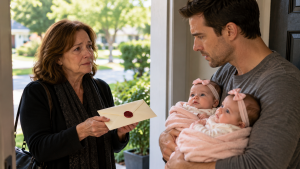
Margaret stood outside, holding a thick envelope against her chest.
She looked older than I remembered.
Her eyes were swollen, and her hands trembled.
“May I come in?” she asked.
I stepped aside.
She walked into the living room and saw the girls sleeping in their bassinets.
For the first time since the funeral, she smiled.
Then she began to cry.
I offered her a cup of tea, but she shook her head.
“Daniel, I owe you an apology.”
I stared at her.
“You don’t owe me anything.”
“Yes, I do.”
She sat down slowly and placed the envelope on the table.
“I didn’t stay away because I hated you.”
My throat tightened.
“Then why?”
She looked toward the nursery.
“Because Emily made me promise that if anything happened to her, I would give you something only when I was certain you were ready to hear it.”
I looked at the envelope.
My wife’s name was written across the front in her familiar handwriting.
Margaret pressed her fingers against her lips before speaking again.
“There is something about my daughter you don’t know, Daniel. Something she hid from you because she was afraid it would destroy the family she was trying so hard to protect.”
My stomach dropped.
“What are you talking about?”
Her eyes filled with tears.
Then she pushed the envelope toward me.
“Before you read that letter, you need to understand why Emily was so afraid of what might happen after the babies were born.”
I opened the envelope.
And the first sentence made my hands go cold.
“Daniel, if my mother is giving you this letter, it means I never got the chance to tell you the truth about our first daughter.”
I looked at Margaret.
“Our first daughter?”
She covered her mouth.
And suddenly, the two sleeping babies in the next room seemed connected to a story I had never known existed.
PART 2 — THE SECRET EMILY LEFT BEHIND
I read the sentence again.
“Our first daughter.”
The twins were our only children.
At least, that was what Emily had always told me.
I turned toward Margaret, waiting for her to explain, but she only lowered her head.
“Please,” I said. “Tell me what this means.”
She took a shaky breath.
“Read the letter first. Emily wanted you to hear it in her own words.”
My fingers trembled as I unfolded the pages.
The letter began with an apology.
My darling Daniel,
If you’re reading this, I am sorry I left you with questions I should have answered while I was still alive.
There is something about my past that I never found the courage to tell you.
Before I met you, I had a baby girl.
I was nineteen, frightened, and living in a house where every mistake was treated like a family disgrace.
Her father left before she was born.
My own father insisted that raising a child would ruin my future, and my mother was too afraid to stand up to him.
I was told the baby would be placed with another family.
I was told I would never have to think about it again.
But I thought about her every single day.
I stopped reading.
Emily had never mentioned a pregnancy before me.
We had shared our childhood memories, our worst mistakes, and the secrets we were embarrassed to tell anyone else.
How could she have carried something this enormous without telling me?
I continued.
I was nineteen when I gave birth to her.
I named her Anna.
I held her for less than an hour before they took her away.
My mother was there.
She knew where Anna went.
And for years, she helped me believe that knowing nothing about my daughter was the price I had to pay for giving her a better life.
I looked up.
Margaret was crying silently.
“You knew?”
She nodded.
“I knew from the beginning.”
“And you never told me?”
“Emily begged me not to.”
I stood up and walked toward the window.
For three months, I had imagined every possible reason Margaret might hate me.
I thought she blamed me for Emily’s death.
I thought she believed I should have fought harder.
I had never imagined that the woman who refused to look me in the eyes was carrying a secret that had begun decades before I entered Emily’s life.
I turned back.
“Did Emily find her?”
Margaret wiped her face.
“Yes.”
“When?”
“About eight months before the twins were born.”
My heart began pounding.
“Eight months?”
“She found an old document among her father’s belongings after he died. It contained the name of the agency that arranged the adoption.”
“Why didn’t she tell me?”
“Because she was afraid.”
“Of me?”
“No,” Margaret whispered. “Of what she might discover.”
She explained that Emily had spent months trying to locate Anna.
At first, she received nothing but unanswered letters and closed doors.
Eventually, she hired a professional searcher who helped her locate a woman living several states away.
The woman had been adopted as a newborn.
Her name was Anna.
And she had grown up believing that her birth mother had voluntarily given her away and never wanted to see her again.
Emily wrote to her.
Anna agreed to meet.
Their first meeting lasted less than an hour.
Anna had questions Emily couldn’t answer.
Why had she given her up?
Why had she never searched for her?
Why had she waited so long?
Emily came home that night and cried in the bathroom because she didn’t know how to explain that she had been a frightened teenager with almost no control over her own future.
Over the following months, the two women exchanged messages.
They met for coffee.
They spoke on the phone.
Slowly, carefully, they began building a relationship.
And Emily had wanted to tell me.
But every time she tried, she became afraid that I would look at her differently.
I sank onto the sofa.
“Margaret, I loved her. I would never have thought less of her.”
“I know that now,” she said. “But Emily spent most of her life believing that if people knew her whole story, they would eventually leave her.”
I looked down at the letter again.
Daniel, I need you to understand something.
Anna is not a replacement for our daughters.
She is not a mistake I am trying to repair.
She is my child, and she has spent her entire life wondering whether her mother ever wanted to know her.
When the twins were born, I wanted to tell you everything.
I wanted us to meet her together.
I wanted our daughters to grow up knowing they had an older sister.
But I was afraid that once I told you, I would lose the peaceful life we had built.
I pressed the letter against my forehead.
Emily had been preparing to bring someone into our family.
Someone who had spent years believing she had been unwanted.
Someone who had no idea that her biological mother had spent decades wondering whether she was safe, happy, and loved.
Then I reached the final paragraph.
If I don’t get the chance to introduce you, please don’t let Anna believe I abandoned her twice.
I have already asked her to give me time to explain everything.
She knows about the twins.
She knows they were born.
But she doesn’t know what happened to me.
Please find her, Daniel.
Not because you owe me anything.
Because she is your daughters’ sister.
I lowered the letter.
“Where is she?”
Margaret opened her handbag and took out another envelope.
Inside was a handwritten address and a telephone number.
“She lives in a small town in Ohio,” she said. “Emily was planning to visit her after the babies were born.”
I stared at the address.
Then Margaret said something that made me look up sharply.
“There’s one more thing.”
I felt as though I had been standing at the edge of a cliff for hours.
“What now?”
“Anna called Emily the night before she went into labor.”
I froze.
“What did she say?”
Margaret looked toward the bassinets.
“She told Emily that she wanted to meet the babies.”
My eyes burned.
“Did Emily answer?”
“Yes.”
“What did she tell her?”
Margaret reached into her handbag again and pulled out a folded piece of paper.
It was a note in Emily’s handwriting.
I told Anna that when the girls were born, I would bring them home, put them in their little beds, and then we would begin again.
I promised her that this time, no one in our family would be left outside the door.
I couldn’t speak.
For three months, I had been fighting the belief that I had failed my wife by surviving her.
Now I was discovering that she had left behind a daughter who might believe she had been abandoned all over again.
Margaret stood and walked toward the nursery.
She watched the twins sleeping for a long time.
Then she turned to me.
“Emily didn’t want her first daughter to spend another lifetime feeling unwanted.”
I looked at the letter.
Then at my daughters.
And I realized that the promise I had made to Emily in that hospital room had never been only about keeping our babies alive.
It had also been about giving them the family she had dreamed of.
That night, after Margaret left, I sat beside the girls until sunrise.
I kept thinking about Anna.
Did she have Emily’s smile?
Did she laugh the same way?
Had she spent her whole life wondering why her mother had never come looking for her?
At six in the morning, I picked up my phone.
I dialed the number Margaret had given me.
A woman answered after four rings.
“Hello?”
I nearly hung up.
Then I remembered Emily’s final request.
“Anna?”
There was a long silence.
“Who’s asking?”
“My name is Daniel.”
Another silence.
Then her voice changed.
“Are you Emily’s husband?”
I closed my eyes.
“Yes.”
I heard her take a breath.
“Is she finally ready to meet me?”
My throat tightened.
I looked at the two little girls sleeping beside me.
And I realized I was about to tell a stranger that the woman she had waited her entire life to meet was never coming.
“Anna,” I whispered, “there’s something you need to know about your mother.”
She didn’t speak.
I could hear her breathing on the other end.
Then she asked a question I will never forget.
“Did she change her mind about me?”
I couldn’t answer immediately.
Because the truth was that Emily had never changed her mind.
She had simply run out of time.
PART 3 — THE DAUGHTER WHO CAME HOME
“Anna, your mother never stopped wanting you.”
I said the words slowly, fighting to keep my voice steady.
“She searched for you. She found you. She loved you. And she was planning to bring you into our family.”
Anna didn’t respond.
I heard a small, broken sound on the other end of the line.
Then she whispered, “So why didn’t she come?”
There was no answer I could give that would make the truth hurt less.
I told her about the complications during childbirth.
I told her about the twins.
I told her that Emily had died in the hospital before she could keep her promise.
When I finished, Anna was crying so hard that I could barely understand her.
For a moment, I thought she might hang up.
Instead, she asked, “Did she mention me?”
I looked at the letter on the table.
“Every time she was afraid of telling me the truth, she wrote about you instead.”
I told her about the letter.
I told her that Emily wanted us to meet.
I told her that she had a place in our family, even if none of us knew exactly how to begin.
Anna was quiet for a long time.
Then she asked, “Can I see the girls?”
I looked toward the nursery.
“Whenever you’re ready.”
She arrived two days later.
I spent the entire morning cleaning the house, although it was already clean.
I changed the girls’ clothes three times.
I put fresh flowers on the kitchen table because Emily always liked flowers.
Then I stood by the window, watching every car that passed.
When the doorbell finally rang, my hands went cold.
Anna stood on the porch wearing a gray coat and holding a small overnight bag.
She looked to be in her early thirties.
She had Emily’s eyes.
Not just the same color.
The same way of looking at someone as if she were trying to understand what they were afraid to say.
“Hi,” she whispered.
“Hi.”
Neither of us moved.
Then she looked past me into the house.
“Are they here?”
I stepped aside.
“They’re sleeping.”
She walked into the living room as if she were afraid the floor might disappear beneath her feet.
When she saw the bassinets, she stopped.
The twins were awake now.
One was waving her arms.
The other was staring at the ceiling with an expression of complete seriousness.
Anna approached slowly.
“Hello, little ones.”
Her voice broke.
I watched her reach out, then stop before touching the blanket.
“May I?”
I nodded.
She gently touched one baby’s hand.
The tiny fingers curled around hers.
Anna covered her mouth and began to cry.
“I missed everything,” she whispered.
I sat beside her.
“You missed things you should never have had to miss.”
She shook her head.
“I missed her first.”
For the first time, I understood the shape of Anna’s grief.
She wasn’t only mourning the mother she had just found.
She was mourning the childhood she had spent wondering why she hadn’t been wanted.
She was mourning the birthdays Emily had missed, the questions she had never been able to ask, and the ordinary moments that other daughters took for granted.
I wanted to tell her that none of it was her fault.
But I knew that words couldn’t give her those years back.
So I stayed beside her.
We spent the afternoon talking about Emily.
Anna told me about their first coffee together.
Emily had arrived twenty minutes early and ordered the wrong drink because she was too nervous to pay attention.
She had brought a list of questions but forgotten to ask half of them.
At the end of their meeting, she had asked Anna whether she could hug her.
Anna had said yes.
“She held on for so long,” Anna told me. “I thought she was never going to let go.”
I smiled through my tears.
“That sounds like Emily.”
Then Anna told me something I hadn’t known.
During their second meeting, Emily had brought a tiny knitted blanket.
She said she had made it for Anna before the adoption, but it had never been given to her.
Anna had kept it ever since.
She reached into her bag and took it out.
The blanket was yellow, with uneven stitches and one corner that had clearly been repaired.
“I think she made this when she was still a teenager,” Anna said.
I recognized the way Emily tied knots.
I had seen her use the same technique when she repaired our daughters’ blankets.
Anna placed the little blanket beside the twins.
“I don’t know how to be your sister,” she whispered to them. “But I would like to learn.”
I looked away, unable to hold back my tears.
Over the following weeks, Anna began visiting regularly.
She learned how to warm bottles and soothe the girls when they cried.
She brought groceries when she noticed I had forgotten to buy them.
She sat with me late at night while I talked about Emily.
Sometimes we laughed.
Sometimes we cried.
And sometimes we sat in silence, each of us missing a different part of the same woman.
Margaret began visiting too.
At first, she seemed uncertain whether she was welcome.
But Anna reached for her hand one afternoon and said, “I’m not ready to forgive everything, Grandma.”
Margaret nodded, tears filling her eyes.
“I understand.”
“But I don’t want to lose you, too.”
Margaret broke down.
They hugged beside the kitchen table while I stood holding one of the babies.
For the first time since Emily’s funeral, the house felt less like a place where someone had disappeared and more like a place where the people who remained were learning how to stay.
Still, I carried my guilt.
Some nights, I woke convinced I could hear Emily calling my name.
I would rush to the nursery, check the girls, and then stand in the hallway remembering the hospital.
I kept asking myself whether I should have fought harder.
Whether I should have demanded another option.
Whether a different decision could have saved her.
One evening, Anna found me sitting on the nursery floor.
The girls were asleep.
I hadn’t realized I was crying until she sat beside me.
“I keep thinking I should have found her sooner,” she said.
I stared at the carpet.
“And I keep thinking I should have saved her.”
Anna was silent for a moment.
Then she said, “Do you know what Mom told me the last time we spoke?”
I shook my head.
“She said she had spent most of her life believing that love meant carrying every mistake alone.”
Anna looked toward the cribs.
“She told me she didn’t want me to inherit that habit.”
I wiped my face.
“She told me something similar the morning the girls were born.”
Anna took my hand.
“Then perhaps we should listen to her.”
For the first time, I let myself consider that surviving Emily wasn’t a betrayal.
It wasn’t proof that I hadn’t loved her enough.
It was the only thing left I could do for her.
Raise our daughters.
Give Anna the family Emily had dreamed of.
And stop punishing myself for a decision made in a room where there were no easy answers.
Months later, on the twins’ first birthday, we gathered in the backyard.
Margaret brought a cake.
Anna brought two small gifts wrapped in yellow paper.
I set three chairs around the table, then caught myself looking at the empty fourth space where Emily should have been.
Anna noticed.
She walked over and squeezed my shoulder.
“We can miss her and still celebrate,” she said.
So we did.
The girls smeared cake across their faces.
Margaret laughed so hard she had to sit down.
Anna held one twin while I held the other, and for a brief moment, I imagined Emily standing beside us, shaking her head at the mess.
I could almost hear her saying that we had bought far too much cake.
That evening, after everyone had gone home, I found one final page tucked inside Emily’s letter.
I hadn’t noticed it before.
At the top, she had written:
For Daniel, when he is ready to stop blaming himself.
I sat on the sofa and unfolded it.
My love,
If you are reading this, you have probably spent months asking yourself whether you could have changed what happened.
I know you.
I know you will replay every second, searching for a different answer.
But you must remember that I asked you to protect our daughters because I wanted them to live.
I did not ask you to spend the rest of your life believing you killed me.
You were my husband, not my doctor.
You were the man holding my hand, not the person who controlled what happened in that room.
I needed you to love me enough to hear my wishes, even when they broke your heart.
And I need you to love yourself enough to keep living after mine stops beating.
Please tell our girls about me.
Tell them I laughed too loudly, burned the toast, and danced in the kitchen when I thought nobody was watching.
Tell them they have an older sister who was loved long before they were born.
And tell Anna that giving her up was never the same as not wanting her.
If there is one thing I hope our daughters learn from my life, it is that the truth may arrive late, but love should never have to spend forever outside the door.
I love you, Daniel.
I always will.
I folded the letter carefully and held it against my chest.
For the first time in three months, I cried without asking myself whether I deserved to.
The next morning, I put Emily’s letter in a small wooden box beside the girls’ birth certificates.
Not because I wanted to keep her sadness alive.
But because one day, our daughters would be old enough to understand that their mother had loved them fiercely, that their older sister had spent years searching for her, and that a family could be broken by secrets without being beyond repair.
And when they finally asked me what happened on the night they were born, I would tell them the truth.
I would tell them that their mother made a choice out of love.
That I honored it, even though it cost me the person I loved most.
And that I spent a long time confusing grief with guilt.
Then I would tell them about Anna.
About the sister who came home carrying years of unanswered questions.
About their grandmother, who had finally found the courage to open a door she had kept closed for far too long.
And about the letter that taught me something I wish I had understood sooner.
Sometimes, the hardest part of loving someone isn’t making an impossible choice.
It’s learning to live afterward without turning your grief into a life sentence.