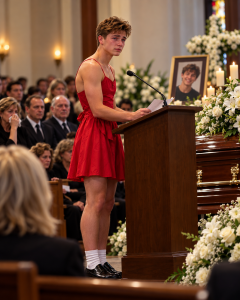
PART 1 — THE BOY WHO WALKED INTO THE CHAPEL WEARING RED
The morning of my son’s funeral, I thought nothing could hurt me more than seeing his name engraved on a coffin. I was wrong. Nothing prepared me for the moment his best friend walked through the chapel doors wearing a bright red dress, white socks, and polished black shoes while every other person in the room stood dressed in black.
My husband, Daniel, immediately rose from his seat, his jaw tightening with anger. I grabbed his wrist before he could take a single step.
“Please, Daniel. Whatever you do, don’t make a scene today.”
He stared at me with eyes swollen from three nights without sleep.
“Our son is lying in that coffin, and that boy thinks this is the appropriate time to dress like that?”
I had no answer. All I could do was watch the young man we had loved like a second son walk slowly down the aisle, holding a folded piece of paper against his chest as though it were the only thing keeping him standing.
His name was Theo Bennett, and he had been part of our family since he was seven years old.
He lived four houses away from us, in a small blue house where the curtains were almost always closed and arguments could sometimes be heard through the front door.
His parents had separated twice before finally divorcing, and neither seemed to know how to help a little boy who spent most evenings sitting alone on the steps outside his home.
The first time I invited him to dinner, he was standing in our driveway watching my son, Jack, ride his bicycle.
Jack was eight then, with scraped knees, untidy hair, and a smile that could make even the worst day feel manageable.
“Mom, can Theo eat with us?” he asked.
I looked at the boy standing behind him. Theo lowered his eyes and whispered, “I don’t want to be a bother.”
Jack laughed.
“You’re always a bother. That’s why you’re my best friend.”
Theo smiled for the first time that afternoon, and I knew we would be seeing a lot more of him.
Before long, Theo had his own toothbrush in our bathroom, his own blanket on our couch, and a drawer in the bedroom we originally called the guest room.
He celebrated three Christmases with us when his parents could not agree on where he should spend the holidays.
He learned to bake cookies with me, helped Daniel repair the garden fence, and sat beside Jack during thunderstorms because Jack was terrified of lightning but too embarrassed to admit it to anyone else.
When the boys turned thirteen, Daniel built them a treehouse in our backyard.
They spent entire weekends inside it, arguing about video games, sharing headphones, and making ridiculous plans for their future.
Jack wanted to become a doctor. Theo said he wanted to become a fashion designer, though he only admitted it after making Daniel promise not to laugh.
Daniel never laughed.
He simply handed the boy a pencil and told him that every great designer had to start somewhere.
Then, when Jack was sixteen, everything changed.
He began losing weight, complaining about exhaustion, and sleeping through his favorite weekend activities.
At first, we blamed school stress and growing pains.
When he developed persistent pain that kept him awake at night, we took him to the hospital.
Tests followed, then more tests, then a specialist appointment that seemed to last forever.
I remember the doctor sitting across from us with his hands folded on the desk.
I remember Daniel asking him to repeat the diagnosis because he could not believe what he was hearing.
I remember Jack staring at a small crack in the wall while the doctor explained that our son had an aggressive illness that had already progressed further than anyone had realized.
The doctors began treatment immediately, and for a while, we clung to every hopeful sentence they offered.
We counted good days, celebrated small improvements, and learned to recognize the difference between a tired smile and a smile that meant Jack was genuinely happy.
But after months of treatment, the doctors finally told us that there were no curative options left.
Fourteen months after the diagnosis, our son died at seventeen years old.
Those fourteen months changed everyone in our family, but they revealed something extraordinary about Theo.
He never treated Jack like a dying boy.
He treated him like Jack.
He still complained when Jack beat him at video games, still brought him ridiculous snacks from the corner shop, and still argued with him about which superhero would win in a fight.
On difficult days, when Jack could barely sit upright, Theo would lie on the carpet beside his bed and tell stories until my son laughed.
Sometimes he stayed overnight because Jack was frightened of waking up alone.
Other times, I would discover Theo sitting outside the hospital room long after visiting hours, his head resting against the wall because he had promised Jack he would stay nearby.
I once found him crying in our kitchen.
When I asked what was wrong, he wiped his face quickly and said, “Nothing, Mrs. Harris. I’m just tired.”
I knew he was lying, but I let him keep his dignity.
I put a plate of food in front of him and sat beside him until he was ready to speak again.
Six months before Jack died, something happened that I did not understand until the day of the funeral.
Theo began asking unusual questions.
He asked me whether I believed people should be allowed to choose how they were remembered.
He asked Daniel whether a promise still mattered if keeping it made other people uncomfortable.
He even asked me whether I would be angry with someone who did something strange for a person they loved.
I assumed the boys were discussing one of their private jokes, and I never pressed them for an explanation.
Jack had always been thoughtful, especially after his diagnosis, and sometimes he talked about things that made my heart ache.
I thought Theo was simply trying to understand how to help his friend.
I had no idea that my son had asked him to carry a secret into the future, a secret that would eventually bring our entire family to its knees.
Now, standing inside the funeral chapel, I watched Theo take a seat in the last row.
His red dress stood out against the sea of black suits and dark coats.
People whispered behind their hands.
Jack’s aunt leaned toward another relative, and I caught the words, “Some people just need attention.”
I wanted to tell her to be quiet, but grief had made even speaking feel impossible.
Daniel leaned close to me.
“I’m going to ask him to leave before the service begins.”
I tightened my grip on his arm.
“He was Jack’s best friend. He stayed with him when we were all falling apart. Please remember that.”
Daniel looked toward the coffin, then toward Theo.
His eyes filled with tears, and for a moment I thought he would sit down.
Instead, he whispered, “I don’t know what to do anymore.”
Neither did I.
The officiant began the service, speaking about Jack’s kindness, his humor, and the future that had been stolen from him.
Photographs played on a screen beside the altar.
There was Jack holding a birthday cake with frosting on his nose, Jack standing in the rain beside Theo, and Jack sitting in a hospital bed with a ridiculous paper crown on his head.
The final photograph showed the two boys at fifteen, their arms around each other, laughing at something outside the frame.
I covered my mouth as the image appeared.
Daniel bowed his head.
Somewhere behind us, a young woman began to cry.
Then the officiant announced that Theo had prepared a few words about his friend.
I felt Daniel stiffen beside me.
Theo rose slowly, smoothing the front of the red dress with shaking hands.
For a moment, he looked as if he might turn around and run.
Instead, he walked toward the podium.
Every eye followed him.
He adjusted the microphone, unfolded the paper he had been carrying, and stared at it without speaking.
His lips trembled.
Then he looked at the coffin and whispered, “Jack, I told you I would do this. I’m sorry it took me so long to be brave enough.”
He raised his eyes toward the congregation.
“I know some of you are wondering why I came here dressed like this. I know some of you think I’m disrespecting Jack, or his parents, or everyone who came to say goodbye.”
His voice cracked.
He took a deep breath and touched the red fabric at his waist.
“But Jack knew I would be wearing this today. In fact, he made me promise him I would.”
The entire chapel fell silent.
Daniel’s hand loosened beneath mine.
Theo swallowed hard and continued.
“Six months ago, my best friend asked me to do something for him. He said that if I truly loved him, I would stand in front of everyone who came to his funeral and tell them the one thing he had been too afraid to tell them himself.”
Then Theo looked directly at us.
“And before I tell you what he said, I need you to understand something about your son. Jack was not afraid of dying nearly as much as he was afraid of leaving people behind who believed they had never truly known him.”
PART 2 — THE PROMISE JACK MADE IN HIS BEDROOM
Theo gripped the edges of the podium, and the paper in his hands trembled so violently that he had to place it on the wooden surface.
“I met Jack when I was seven,” he began.
“I was the kid who never knew whether his parents would be speaking to each other when he woke up. I was the kid who sometimes pretended he had already eaten dinner because he didn’t want anyone to know there wasn’t enough food at home.”
Jack never asked me to explain any of it.
He just opened the door and said, ‘Come inside. My mom made too much food again.’”
A few people laughed softly through their tears.
I remembered those afternoons perfectly.
Jack had never thought of Theo as someone who needed saving.
He simply thought of him as his friend.
Theo continued, “The Harris family gave me a place where I could breathe. But Jack gave me something even more important. He made me believe that I could be myself without apologizing for it.”
My heart began to pound.
I glanced at Daniel, who was watching Theo with an expression I had never seen before.
It was no longer anger.
It was fear mixed with the realization that there was something about our son we had never fully understood.
Theo told the congregation about a rainy afternoon six months earlier, when Jack had asked him to come into his bedroom and close the door.
Jack had been weaker that day.
His hair had begun to thin, and he had spent the morning sleeping.
When Theo arrived, Jack was sitting against his pillows, holding a photograph of the two of them from their first day of school.
“Do you remember what you told me when we were ten?” Jack had asked.
Theo had laughed and replied, “I said you were the worst soccer player in the neighborhood.”
Jack smiled.
“You said you would always be my friend, even if I turned into the weirdest person alive.”
Theo told him that he had not turned weird.
He had turned into an old man who complained about hospital food.
For a few seconds, they laughed together.
Then Jack’s expression changed.
He looked down at the photograph and said, “Theo, I need you to promise me something, and I need you to hear me before you say no.”
Theo had immediately become serious.
“Anything.”
Jack shook his head.
“Don’t say that yet. You don’t know what I’m going to ask.”
According to Theo, Jack then opened a drawer beside his bed and removed a small envelope.
Inside was a folded page covered with handwriting, a photograph of a red dress, and a short list of things he wanted people to remember about him.
Theo stared at the dress photograph and asked whether Jack was planning a costume party.
Jack laughed so hard that he began coughing.
When he finally caught his breath, he explained that the dress belonged to a character in one of his favorite films, a story about a young person who was terrified of being seen as different but eventually learned that hiding himself was more painful than facing the world.
Jack had watched that film dozens of times during his treatment.
He and Theo had discussed its characters late into the night, talking about courage, identity, and the strange ways people judge one another.
But Theo still did not understand why Jack had included a picture of a dress in the envelope.
“Do you remember when we were kids and I told you that one day I wanted to be a doctor?” Jack had asked.
Theo nodded.
“You said you wanted to design clothes.”
Jack smiled.
“And you said it so quietly that I almost couldn’t hear you.”
Theo had looked away, embarrassed even after all those years.
“I was afraid you’d laugh.”
Jack told him he had never laughed because there was nothing funny about wanting to create something beautiful.
Then he said something that Theo would never forget.
“You keep waiting for permission to be yourself. You think if you make everyone comfortable enough, they’ll eventually let you be who you are. But some people will never be comfortable. That doesn’t mean you have to spend your whole life hiding.”
Theo admitted that he had spent years trying to become the kind of person his classmates expected him to be.
He wore the clothes his father preferred, avoided talking about his dream of studying fashion, and pretended not to care whenever someone made cruel jokes about boys who liked dresses.
Jack listened without interrupting.
Then he reached for his friend’s hand.
“I’m not asking you to prove anything to anybody,” he said.
“I’m asking you to stop believing that being different makes you less worthy of love.”
At the podium, Theo paused and wiped his cheeks.
“I wish I could tell you that I understood him immediately. I didn’t. I was scared. I was scared of what my parents would say, what people at school would think, and what would happen if I stopped pretending.”
Jack never told me I had to change overnight.
He just kept reminding me that I deserved a life that belonged to me.”
Then Theo explained that, a few weeks later, Jack had made his request.
He wanted Theo to wear a red dress at his funeral.
Not because he wanted to shock the guests, not because he wanted to make his parents uncomfortable, and certainly not because he wanted anyone to turn his funeral into a spectacle.
He wanted Theo to wear it because red had become a symbol of their friendship.
During one of Jack’s worst hospital stays, Theo had arrived wearing a red jacket that he had borrowed from his older sister, Emma.
Jack had been in so much pain that he had barely spoken all day.
But when Theo entered the room, Jack had looked at the jacket and smiled.
“You look like a superhero who lost a bet,” he had said.
Theo had laughed, and for the first time in days, Jack had asked to watch a movie.
From that afternoon on, whenever Jack felt frightened or hopeless, Theo would bring something red into the room.
A scarf.
A blanket.
A pair of ridiculous socks.
Anything that reminded Jack that there was still room for laughter.
“The last time we talked about it,” Theo continued, “Jack told me he didn’t want his funeral to be remembered only for the sadness. He said everyone would come wearing black because that’s what people do when they lose someone. But he wanted one person to wear red, just to remind everybody that his life wasn’t only about the way it ended.”
I began to cry so hard that the photographs in my lap blurred.
I remembered how Jack used to brighten whenever Theo arrived.
I remembered the red paper crown, the red socks, and the little red toy car Theo had placed on Jack’s bedside table.
I had seen all of them, but I had never understood their meaning.
Daniel bowed his head and pressed his fingers against his eyes.
Theo looked at us again.
“Jack made me promise that I wouldn’t explain the dress until after everyone had a chance to see it. He said he wanted people to ask themselves why they were angry before they decided I had done something wrong.”
Then Theo unfolded the final page of Jack’s letter.
“There was one more thing he asked me to say.”
His voice dropped to a whisper.
“He told me that his parents might be angry when they saw me. He said his dad might stand up, and his mom might try to stop him. He said that wouldn’t mean they were bad people. He said they would be hurting, and hurting people sometimes mistake unfamiliar things for disrespect.”
Daniel suddenly lifted his head.
The words had struck him harder than any accusation could have.
Theo looked toward him.
“Jack said, ‘If my dad gets angry, tell him I know he loves me. Tell him I’m not asking him to understand everything immediately. I just want him to listen before he decides.’”
My husband began to shake.
His shoulders rose and fell as he struggled to hold back the sobs that had been building since the service began.
Theo reached into his pocket and removed a second envelope.
“Jack wrote this for both of you. He told me to give it to you after I finished speaking. He said there were things he wanted to tell you, but he didn’t want the letter to become another thing you had to worry about while he was still alive.”
He looked at the envelope for a long time before continuing.
“I asked him why he didn’t just tell you himself. He said he was afraid that if he told you everything he had been thinking, you would spend the rest of his life worrying about whether you had done enough.”
He didn’t want his final months to become a list of apologies.
He wanted them to be full of ordinary things.
Breakfast together.
Bad television.
Your dad telling the same story for the hundredth time.
His mom pretending not to notice when he stole food from her plate.”
A painful laugh moved through the chapel.
I covered my mouth because I could almost hear Jack saying those exact words.
Theo held out the envelope toward us, and Daniel stood slowly.
This time, he wasn’t standing to throw someone out.
He was standing because his legs could no longer support the weight of his grief.
My husband walked toward the podium.
I followed him, afraid he might collapse before he reached it.
When he stood in front of Theo, he stared at the red dress, then at the young man’s tear-streaked face.
“I thought you came here to make a statement,” Daniel whispered.
Theo shook his head.
“I came because I promised him I would.”
Daniel’s face crumpled.
He reached out and pulled Theo into his arms.
For a second, Theo stood rigid with surprise.
Then he broke down, clinging to my husband as though he were still the frightened seven-year-old who had once stood in our driveway, wondering whether anyone would invite him inside.
Daniel held him tightly.
“I’m sorry,” he whispered again and again.
“I’m so sorry.”
The chapel was silent except for the sound of people crying.
I joined them, wrapping my arms around both of them, and for the first time since Jack’s death, I felt that a small part of our broken family had found its way back to one another.
But the letter remained unopened in Daniel’s hand, and I knew there was still something our son had wanted us to understand.
PART 3 — THE LETTER THAT CHANGED HOW WE REMEMBERED OUR SON
We waited until the chapel had emptied before opening Jack’s letter.
The three of us sat in the front row, surrounded by white flowers, folded programs, and the quiet that follows a room full of grief.
Theo had taken off his shoes and tucked his feet beneath him, just as he used to do when he sat on our living-room couch as a child.
Daniel held the envelope for several minutes without opening it.
His hands were shaking.
“I don’t know if I can read this,” he admitted.
I rested my hand over his.
“Then we’ll read it together.”
He finally slid his finger beneath the seal and unfolded the pages.
Jack’s handwriting was uneven, especially toward the end, but every word was unmistakably his.
The first line made me gasp.
“Mom and Dad, if you’re reading this, Theo has probably done something that made half the room uncomfortable. Please don’t be angry with him. He is braver than he thinks, and I asked him to do it.”
Daniel let out a broken laugh that turned into a sob.
I pressed my hand against my chest and tried to breathe.
The letter continued.
Jack wrote that he had spent much of the previous year thinking about what people leave behind when they die.
At first, he had worried about the things he would never get to do: finish school, travel somewhere far away, fall in love, or grow old enough to complain about his knees.
But gradually, he had begun to think about something else.
He wanted to know whether the people he loved would remember his laughter or only his illness.
He wanted his friends to remember the games they played, not just the hospital rooms where they sat.
He wanted his parents to remember the times he had been happy, not only the nights they had held him while he cried in pain.
“I know you tried everything to save me,” he had written.
“I know you would have traded places with me if you could. Please don’t spend the rest of your lives believing you failed because I died. You were my parents, not my doctors. You gave me a home, and you made me feel safe. That was never a small thing.”
I could barely see the page through my tears.
Daniel stopped reading and pressed the letter against his forehead.
“I should have told him more often how proud I was of him,” he whispered.
“I should have asked him more questions.”
I took his hand.
“We both should have done a thousand things differently. But he knew we loved him.”
Theo sat beside us, quietly crying.
Then Daniel resumed reading.
Jack wrote about Theo’s dream of becoming a fashion designer and how much it hurt him to see his friend hide the parts of himself that made him happy.
“Dad, you always taught me that being a man meant standing up for people who couldn’t stand up for themselves. I hope you understand that sometimes people need someone to stand beside them while they learn how to stand on their own. Theo doesn’t need me to rescue him. He needs people who love him to let him be himself.”
Daniel lowered the page.
For a long time, he said nothing.
Then he turned toward Theo.
“I should have known how much you were carrying.”
Theo shook his head.
“You were taking care of Jack. You had enough to worry about.”
My husband wiped his face.
“That doesn’t mean I couldn’t have listened.”
The next paragraph explained why Jack had chosen the red dress.
He had written that he wanted his funeral to contain one small reminder that grief was not the only thing worth feeling.
Red was the color of the jacket Theo had worn on the day he made Jack laugh again after a terrible hospital stay.
Red was the color of the paper crown they had worn at Jack’s last birthday party.
Red was the color of a small ribbon Jack had tied around his wrist before one of his most frightening procedures, after Theo told him it was a superhero’s secret weapon.
“I know people may think the dress is strange,” Jack wrote.
“That’s okay. I spent too much of my life worrying about what people thought. If one red dress makes someone ask why they judge people so quickly, then maybe something good can come out of a terrible day.”
I looked at Theo, and suddenly I understood why he had chosen that particular dress.
It was not simply red.
It was the same dress he had borrowed from Emma during Jack’s final weeks, the one Jack had seen in the hospital room when he told Theo that courage was not the absence of fear.
It was the decision to do something meaningful even when your hands were shaking.
Then we reached the final page.
Daniel read the first few lines aloud, but his voice broke before he could finish.
I took the letter from him and continued.
“Mom, Dad, there is one last thing I need you to know. I didn’t tell Theo to wear the dress because I wanted him to prove something to the world. I asked him because I wanted him to know that I saw him.”
I saw the boy who sat outside our house pretending he wasn’t lonely.
I saw the teenager who made jokes whenever he was frightened.
I saw the person who wanted to create beautiful things but kept waiting for permission.
And I saw my best friend, who stayed beside me even when he couldn’t make anything better.
If you remember anything about me, please remember this: love is not always about knowing what to say or finding a way to fix everything.
Sometimes love is just staying.
Sometimes it’s opening a door.
Sometimes it’s wearing a ridiculous red dress because your best friend asked you to, even when you’re terrified of what everyone will think.”
The letter ended with a final message to Daniel and me.
“Please keep inviting people in. Keep making too much food. Keep the guest room ready, even when nobody needs it. There are other people in this world who are going to feel lonely, and I hope you will make them feel welcome the way you welcomed Theo.”
Don’t let my room become a place you can’t enter because you’re afraid of missing me.
Go in there.
Open the curtains.
Laugh when you remember something funny.
Cry when you need to.
And when you see something red, please think of me as I was before I got sick.
I love you both more than I know how to explain.
Your son, Jack.”
I folded the letter carefully and held it against my heart.
Daniel was crying openly now, with no attempt to hide it.
Theo leaned against my shoulder, and I wrapped my arms around him.
We sat together for a long time, grieving the boy we had lost while discovering how much of him remained in the words he had left behind.
In the weeks that followed, people continued talking about the red dress.
Some had been uncomfortable when Theo first walked into the chapel, and several admitted that they had judged him before hearing his speech.
Others told us that his words had reminded them of people they had misunderstood or friendships they had taken for granted.
Theo did not suddenly become fearless.
He still worried about what his classmates thought, and he still struggled to tell his parents about his plans for the future.
But something had changed.
He applied to a design program he had been too frightened to consider, and Daniel helped him prepare his portfolio at our kitchen table.
When Theo was accepted, my husband was the first person to hug him.
“Jack would have been unbearable about this,” Daniel said, laughing through his tears.
“He’d have spent the entire day telling everyone he knew you were going to be famous.”
Theo smiled.
“He probably would have designed the ugliest outfit imaginable just to make sure I had something to improve.”
For a moment, the house filled with the kind of laughter we had feared we would never hear again.
On the first anniversary of Jack’s death, Theo returned to our house carrying three small boxes.
He had made a red ribbon for each of us, stitched by hand from fabric left over from the dress.
He tied one around Daniel’s wrist, one around mine, and one around his own.
Then he asked whether we would visit Jack’s grave with him.
We drove there together, carrying flowers and the letter in a protective envelope.
At the graveside, Theo placed a small sketchbook against the stone.
Inside were drawings of clothes he had designed during his first year of study.
On the final page, he had drawn three boys standing beneath a treehouse: one with messy hair, one wearing a red dress, and one holding a toolbox.
Beneath the picture, he had written, “For Jack, who taught me that being seen is not something to be ashamed of.”
Daniel stood quietly beside me, holding my hand.
Then he turned toward Theo and said, “You will always have a place in our family. Not because Jack asked us to take care of you, but because you are part of us.”
Theo began to cry.
So did I.
We remained there until the afternoon sun began to fade, sharing memories of the boy who had brought us together.
I still think about that morning in the funeral chapel, when I mistook my son’s final act of love for something inappropriate.
I remember the whispers, the stares, and my husband’s anger.
I remember how quickly grief had made us suspicious of something we did not understand.
Most of all, I remember Theo standing at the podium in that bright red dress, trembling as he tried to keep a promise to his best friend.
He could have chosen an easier path.
He could have worn black, kept Jack’s secret, and avoided every uncomfortable glance.
But he understood something that the rest of us had forgotten: the day we say goodbye to someone should not erase everything that made them extraordinary.
Jack had been more than his diagnosis, more than his hospital bed, and more than the coffin at the front of the chapel.
He had been a son who loved his parents, a friend who made a lonely boy feel welcome, and a young man who wanted the people he loved to live without hiding.
Now, whenever I see a red dress in a shop window or a red ribbon tied around someone’s wrist, I think of my son.
I think of the promise his best friend kept, and I remember that the most meaningful acts of love do not always look the way we expect them to.
Sometimes they arrive dressed in a color nobody else dares to wear.
And sometimes, when we finally stop judging long enough to listen, they teach us how to keep loving someone long after we have said goodbye.