PART 1 — The Rank Star on the Ground
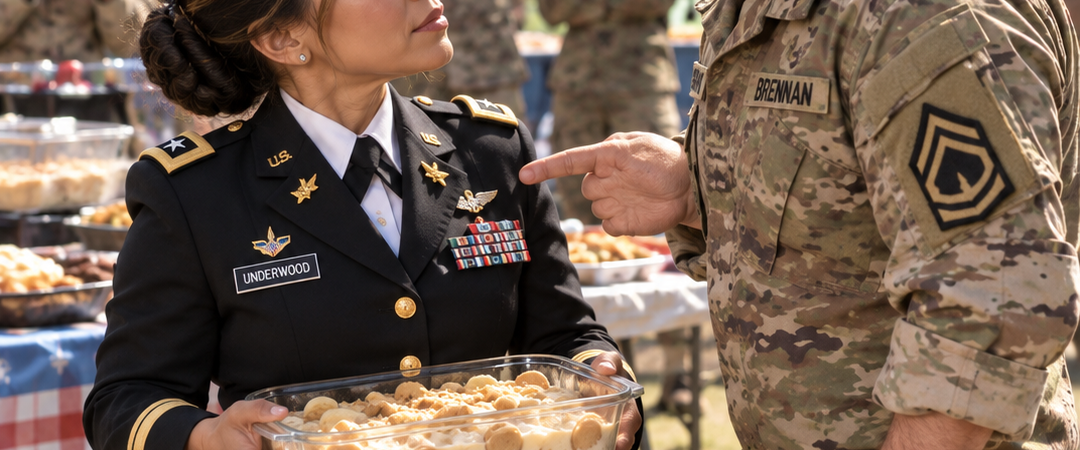
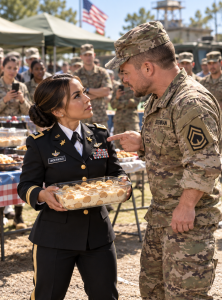
I arrived at the base barbecue carrying a glass dish of homemade banana pudding.
I drove an old pickup, wore a neatly pressed dress uniform, and had no interest in making an entrance.
I was a dwarf woman, and after decades in the military, I had learned something important:
You don’t need to announce your accomplishments.
Your record speaks for you.
I had graduated from West Point, served overseas, commanded soldiers, and eventually earned the rank of brigadier general.
But that afternoon, I wasn’t there to inspect anyone.
I was there because the base was hosting a family barbecue, and I had promised to bring dessert.
I parked my old truck near the visitor area and walked toward the gathering.
Music played.
Soldiers laughed.
Children ran across the grass.
I carried the banana pudding in both hands.
Then a voice stopped me.
“Hey!”
I turned.
A senior enlisted soldier was walking toward me.
He looked at my uniform.
Then at my height.
Then back at my insignia.
His expression changed.
“You lost, ma’am?”
“No.”
He stared at my stars.
“Those real?”
“Yes.”
He laughed.
A few soldiers nearby looked over.
“You expect me to believe you’re actually wearing general’s rank?”
I remained calm.
“Yes.”
He stepped closer.
“What’s your name?”
I gave it to him.
He shook his head.
“You’re telling me you’re a brigadier general?”
“Yes.”
He laughed again.
“This is ridiculous.”
I noticed several soldiers pulling out their phones.
One of them started recording.
The sergeant pointed at my shoulder.
“Take those off.”
I looked at him.
“No.”
His expression hardened.
“I said take them off.”
“I heard you.”
He stepped forward.
Then his hand reached toward my uniform.
Before I could move, he grabbed the rank insignia from my shoulder.
The metal star fell onto the pavement.
The sound was surprisingly loud.
The entire barbecue went silent.
I looked down at the insignia.
Then back at him.
“Sergeant,” I said quietly.
“You have about five seconds to step away from me.”
He laughed.
“Or what?”
I didn’t answer.
He demanded my military identification.
“I want to see your credentials.”
I reached toward my jacket.
He immediately said:
“Slowly.”
Several soldiers looked uncomfortable.
One whispered:
“Something’s wrong.”
The sergeant didn’t listen.
“You’re either impersonating an officer or somebody has made a huge mistake.”
Then he grabbed my arm.
I looked directly into his eyes.
“Release me.”
He tightened his grip.
“I’ll decide when—”
A voice suddenly came from behind the crowd.
“Sergeant!”
Everyone turned.
A colonel was walking toward us.
The sergeant released me immediately.
But it was too late.
The colonel had already seen the fallen star.
He looked at my uniform.
Then at me.
His expression changed completely.
“General?”
The entire crowd froze.
The sergeant’s face went pale.
I bent down and picked up my insignia.
“Yes, Colonel.”
The colonel immediately stood at attention.
“Ma’am.”
Every soldier nearby suddenly became silent.
The sergeant stared at me.
“You’re…”
I looked at him.
“Yes.”
His confidence disappeared.
But the worst was still coming.
Because the colonel looked toward the phone recording the incident.
Then he said:
“General, would you like me to call the base commander?”
I glanced at the sergeant.
“Yes.”
“Immediately.”
PART 2 — The ID
The atmosphere changed within seconds.
The soldiers who had been laughing earlier were now standing silently.
The sergeant looked at the ground.
His friend slowly lowered his phone.
The colonel approached me.
“Are you injured?”
“No.”
“Did he remove your insignia?”
“Yes.”
The colonel’s expression hardened.
He turned toward the sergeant.
“Step away.”
The sergeant obeyed.
Then he tried to explain.
“Sir, I thought she was impersonating an officer.”
The colonel interrupted.
“You thought?”
“Yes, sir.”
“Did you verify her identity?”
“No, sir.”
“Did you contact Military Police?”
“No, sir.”
“Then why did you put your hands on her?”
The sergeant had no answer.
I reached into my jacket.
Then I pulled out my official identification card.
I handed it to the colonel.
He examined it.
Then immediately returned it.
“Thank you, General.”
The sergeant stared at the card.
I could see the realization spreading across his face.
He hadn’t grabbed an impostor.
He had grabbed a general.
In front of dozens of soldiers.
And someone had recorded everything.
The base commander arrived several minutes later.
He walked directly toward me.
“General, I apologize.”
I shook my head.
“This isn’t about an apology.”
He nodded.
“I understand.”
I looked at the sergeant.
“I want an investigation.”
The sergeant immediately spoke.
“Ma’am, I didn’t mean—”
I raised one hand.
He stopped.
“You made an assumption based on my appearance.”
He looked embarrassed.
“You decided that someone who looked different from what you expected a general to look like couldn’t possibly hold the rank.”
Nobody spoke.
I continued.
“Then you escalated that assumption into physical contact.”
The base commander looked at the sergeant.
“Is that accurate?”
The sergeant swallowed.
“Yes, sir.”
The colonel pointed toward the soldier holding the phone.
“Do you have the entire recording?”
“Yes, sir.”
“Secure it.”
The soldier nodded.
Then something unexpected happened.
A young private stepped forward.
“Sir?”
The base commander turned.
“Yes?”
“I saw what happened before the recording started.”
The sergeant looked at him.
The private continued.
“She told him several times to step away.”
Another soldier nodded.
“She did.”
Then another.
“So did I.”
One by one, soldiers began confirming what they had seen.
The sergeant stood alone.
His earlier confidence was gone.
Then the base commander asked me:
“Would you like to make a formal statement?”
“Yes.”
I looked around at the soldiers.
“I also want everyone here to understand something.”
They listened.
“Rank doesn’t make someone better than anyone else.”
I paused.
“But neither does someone’s appearance make them less capable.”
Several soldiers nodded.
I continued:
“If you don’t recognize someone’s authority, verify it.”
“Don’t invent a story.”
“Don’t humiliate them.”
“And don’t put your hands on them.”
The base commander nodded.
“Understood.”
The sergeant looked at me.
“General, I’m sorry.”
I studied him for a moment.
“I accept the apology.”
He looked relieved.
Then I added:
“But accepting an apology doesn’t erase an incident.”
His expression fell again.
The investigation began that afternoon.
The recording was reviewed.
Witness statements were collected.
And the sergeant was removed from his duties pending the investigation.
But there was one more problem.
The soldier who had livestreamed the confrontation approached me privately.
“General?”
“Yes?”
He looked nervous.
“I think you should know something.”
“What?”
He showed me his phone.
Before the confrontation, he had recorded a conversation between the sergeant and another soldier.
The sergeant had apparently joked that he was going to “teach the fake general a lesson.”
I watched the recording.
Then I handed the phone back.
“Preserve that.”
“Yes, ma’am.”
I walked away.
The barbecue continued without me.
But by the end of the afternoon, almost everyone on the base knew what had happened.
Then the base commander asked me to attend a private meeting.
When I entered the conference room, several senior officers were waiting.
The commander stood.
“General, we reviewed your service record.”
I sat down.
He placed a folder on the table.
“There is something we didn’t realize.”
“What?”
He opened the folder.
“Your current assignment.”
I looked at him.
He smiled slightly.
“You aren’t here as a visitor.”
I said nothing.
He continued:
“You’ve been appointed to conduct the command inspection scheduled for tomorrow.”
The room became silent.
And suddenly, the sergeant’s mistake had become much bigger than anyone realized.
Because the person he had publicly humiliated…
was the officer scheduled to inspect his entire unit the next morning.
PART 3 — The Inspection
The next morning, I arrived at the base before sunrise.
No barbecue.
No family members.
No dessert.
Just a uniform, a clipboard, and my official orders.
The unit assembled on the parade ground.
The sergeant stood among them.
He looked nervous.
I walked toward the formation.
The base commander stepped forward.
“General, the unit is ready.”
I nodded.
“Begin.”
The inspection lasted several hours.
I reviewed training records.
Equipment logs.
Safety procedures.
Personnel documentation.
Vehicle maintenance.
Emergency protocols.
I treated everyone exactly the same.
The sergeant wasn’t singled out.
He wasn’t publicly humiliated.
I simply did my job.
Eventually, I reached his section.
He stood straight.
“General.”
“Sergeant.”
I reviewed his paperwork.
Then I looked up.
“Your training documentation is incomplete.”
His face tightened.
“Yes, ma’am.”
“Several required entries are missing.”
“Yes, ma’am.”
“Why?”
“I don’t have an explanation.”
I nodded.
“Then provide one in writing.”
“Yes, ma’am.”
I continued down the line.
After the inspection ended, the base commander gathered the senior staff.
The investigation into the barbecue incident was complete.
The evidence showed that the sergeant had:
- falsely accused me of impersonating an officer,
- physically grabbed me,
- removed my insignia,
- ignored repeated instructions to step away,
- and encouraged another soldier to record the confrontation.
The military disciplinary process would determine the consequences.
I wasn’t there to decide his punishment.
I was there to make sure the facts were documented.
Before leaving the base, I asked to speak to the sergeant privately.
He entered the room.
For several seconds, neither of us spoke.
Finally, he said:
“I was wrong.”
“Yes.”
“I judged you before I knew anything about you.”
“Yes.”
“I shouldn’t have touched you.”
“No.”
He looked down.
“I embarrassed myself.”
I shook my head.
“That isn’t the lesson.”
He looked up.
“Then what is?”
I answered:
“You embarrassed the uniform.”
He became silent.
“You were entrusted with authority. You used it based on an assumption instead of facts.”
I paused.
“That’s the part you need to remember.”
He nodded.
“Yes, ma’am.”
I stood.
Then I walked outside.
The same soldiers who had witnessed the confrontation were gathered near the training field.
Some looked at me respectfully.
Others simply watched quietly.
I stopped near the group.
“I want to say one thing.”
They stood straighter.
“I’ve spent most of my career being underestimated.”
Nobody moved.
“Sometimes because of my size.”
I glanced down briefly.
“Sometimes because of my gender.”
“And sometimes because people decide what I’m capable of before I ever speak.”
I looked across the formation.
“But I’ve learned something.”
“Being underestimated isn’t an insult if you don’t allow it to determine what you become.”
The soldiers listened.
“Your responsibility is not to judge people by what you expect them to be.”
“Your responsibility is to find out who they actually are.”
Then I turned toward my old pickup truck.
The banana pudding was still sitting inside.
I opened the passenger door and carefully lifted the glass dish.
The young private who had witnessed the incident smiled.
“General?”
“Yes?”
“Is that the banana pudding?”
I laughed for the first time all day.
“Yes.”
He smiled.
“Did you bring it back?”
“I did.”
A few soldiers laughed.
The tension finally broke.
I carried the dish toward the dining area.
And that afternoon, instead of being remembered as the dwarf woman a sergeant tried to expose as a fake officer, I became something else to the people who had witnessed it.
A reminder that authority isn’t always obvious.
Leadership doesn’t always look the way people expect.
And sometimes the person everyone underestimates is the very person standing closest to the top.
I had arrived at the base carrying homemade banana pudding.
I left carrying the same empty glass dish.
But the silver star that had fallen onto the pavement that afternoon?
I placed it back on my uniform.
And I never forgot the lesson it represented.