My Son’s Wife Moved Into My House and Declared, “This Is My House Now!”—So I Made One Phone Call That Changed Everything
PART 1 — The Night My Daughter-in-Law Tried to Throw Me Out
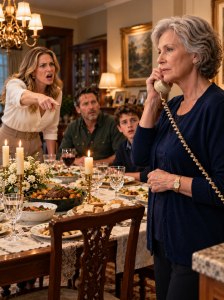
At 6:48 on a Thursday evening, my daughter-in-law pointed toward the back door of the house I had owned for thirty-two years and ordered me to take my dinner outside.
She believed I was an old widow who had nowhere else to go.
She had no idea whose number I was about to call.
My name is Margaret Wilson, and I was sixty-eight years old when I discovered that the people you love most can sometimes be the ones who mistake your kindness for weakness.
My husband, Anthony, and I bought our Chicago brick house when our son, Edward, was only five years old.
We were both public school teachers, and we spent decades saving every spare dollar to pay off the mortgage.
We drove an old car until its engine practically begged for retirement, packed our lunches instead of eating at restaurants, and postponed vacations whenever something needed repairing.
But we never complained.
That house was more than a building to us.
It was where Edward learned to ride his bicycle, where Anthony taught him to play chess, and where we celebrated every birthday with homemade cake and too many candles.
When Anthony died three years ago, the house became my sanctuary.
I kept his favorite armchair beside the living room window, planted roses along the front walkway, and continued making his Sunday beef stew even though I was often the only person eating it.
Then, one Tuesday morning, Edward called me.
“Mom, I’ve lost my job.”
His voice sounded defeated.
He explained that his company had eliminated several positions, including his, and that the family was struggling to keep up with their expenses.
His wife, Linda, had been complaining about their rent for months.
Their twelve-year-old son, Dylan, had begun asking whether they might have to change schools.
“Can we stay with you for a little while?” Edward finally asked.
I didn’t hesitate.
“Of course, sweetheart.”
I cleared out the guest bedroom, bought Dylan’s favorite cereal, and made room in the hallway closet for their coats.
I even told Edward he didn’t need to contribute toward groceries until he found another job.
“You’re my son,” I reminded him.
“You don’t have to earn a place in your mother’s home.”
Linda arrived that Saturday with three suitcases, six storage boxes, and an expression suggesting she had been forced to move into an inconvenient hotel.
She inspected the guest bedroom.
“It’s smaller than I expected.”
She examined the bathroom.
“There’s barely any counter space.”
Then she walked into my bedroom, looked around, and announced, “This room would make much more sense for Edward and me.”
I stared at her.
“Excuse me?”
“Your room is bigger, Margaret.”
“It’s also my room.”
She smiled thinly.
“I’m sure we’ll work something out.”
I should have recognized the warning in her voice.
Instead, I convinced myself she was simply stressed about losing their home.
For the next several days, Linda behaved as though she were conducting a takeover.
She rearranged my kitchen cupboards without asking.
She replaced the curtains I had chosen with expensive gray ones.
She told Dylan that certain rooms were now private family spaces, even though those rooms had belonged to me long before she entered the picture.
When I objected, she sighed dramatically.
“Margaret, you need to learn to share.”
I swallowed my frustration because I wanted Edward to have the space to recover from his job loss.
I also wanted Dylan to feel safe.
But the situation changed on Thursday evening.
I had spent the afternoon preparing the beef stew Edward loved as a child.
The bread was warm, the candles were lit, and the dining table was set with the good china Anthony and I had received as a wedding gift.
Dylan sat beside me, telling me about a science project.
Edward looked tired but seemed grateful for the meal.
For a few minutes, everything felt almost normal.
Then Linda placed her spoon beside her plate and folded her hands.
“We need to establish some rules.”
Edward glanced at her.
“What kind of rules?”
“Household rules.”
She looked directly at me.
“Since we’re living here now, I think it’s time everyone understood who’s in charge.”
I blinked.
“Who’s in charge?”
Linda sat straighter.
“I’m the woman of this household now, and I intend to run it properly.”
Edward shifted uncomfortably in his chair.
He said nothing.
Linda pointed toward the back door.
“And if you don’t like how things are done, Margaret, you can take your plate outside and eat with your friend.”
My fork stopped halfway to my mouth.
“My friend?”
She gave a mocking little laugh.
“The neighbor you keep inviting over for coffee.”
I looked at my son.
Edward stared down at his dinner.
He didn’t defend me.
He didn’t tell his wife that she was sitting in the home his father and I had worked our entire lives to buy.
He simply remained silent.
That silence hurt more than Linda’s insult.
For years, I had mistaken keeping the peace for protecting my family.
I had swallowed rude comments, apologized when I wasn’t wrong, and pretended that my son’s wife’s behavior didn’t bother me.
But that evening, something inside me finally changed.
I placed my fork on the table.
Then I smiled.
Linda looked almost amused.
“What are you smiling about?”
“Nothing, dear.”
I stood, walked into the kitchen, and picked up the telephone.
Edward finally raised his head.
“Mom, who are you calling?”
I dialed a number I had saved for years.
The woman on the other end answered immediately.
“Gabriella speaking.”
I looked through the doorway at Linda, who was still sitting at my dining table with the confidence of someone who believed she had already won.
“Gabriella,” I said calmly, “it’s time.”
There was a brief silence.
Then Gabriella asked one question.
“Margaret, are you absolutely certain you want me to activate the agreement tonight?”
Linda’s smile disappeared.
Because for the first time since she had entered my house, she realized there was something about my life she knew absolutely nothing about.
And when Gabriella explained what would happen next, my son dropped his fork.
PART 2 — The Agreement My Husband Left Behind
“Activate what agreement?” Edward demanded.
I didn’t answer him immediately.
I was listening to Gabriella, my attorney, explain that the documents were ready and that she could come to the house within the hour.
“Yes,” I told her.
“Please come.”
I hung up.
Linda rose from her chair.
“What have you done?”
I returned to the dining room and picked up my napkin.
“I’ve made a phone call.”
“Don’t play games with me!”
Her voice was so loud that Dylan flinched.
I immediately turned toward my grandson.
“Sweetheart, why don’t you take your dinner into the living room and finish your science project?”
He looked at his father, then at me.
“Am I in trouble?”
“Not at all.”
I kissed his forehead.
“None of this is your fault.”
After Dylan left, Linda crossed her arms.
“You cannot just call someone to intimidate me in my own house.”
I looked at her quietly.
“Your own house?”
She hesitated.
Then she lifted her chin.
“Edward lives here, doesn’t he?”
“Yes,” I replied.
“Because I invited him.”
Edward finally spoke.
“Mom, can we please calm down?”
I turned toward him.
“Edward, I gave you a home when you needed one.”
“I know.”
“I cleared my bedroom closet so you could store your things.”
“I know, Mom.”
“I told you that you could stay without paying rent while you looked for work.”
He rubbed his forehead.
“Please don’t make me choose sides.”
I felt my heart sink.
“I’m not asking you to choose sides, sweetheart.”
“I’m asking you to recognize that your wife just ordered your mother to eat outside her own home.”
He opened his mouth.
Then he looked at Linda.
She stared back at him, daring him to disagree with her.
And once again, my son said nothing.
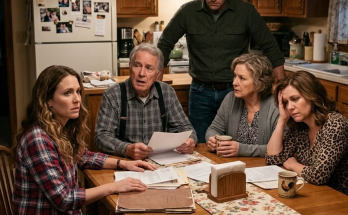
The doorbell rang twenty-five minutes later.
Gabriella entered carrying a leather briefcase.
She was a sharp, composed woman in her early fifties who had handled Anthony’s estate and my financial affairs for more than a decade.
Linda looked her up and down.
“Who is this?”
“My attorney,” I answered.
Gabriella placed her briefcase on the dining table.
“Good evening, everyone.”
She looked at Linda.
“I understand there has been some confusion about the ownership of this property.”
Linda gave a nervous laugh.
“There’s no confusion.”
“Edward and I are living here, so obviously this is our family home.”
Gabriella opened her briefcase.
“It’s Margaret’s home.”
She placed a certified copy of the deed on the table.
“Margaret is the sole legal owner of this property, and no ownership interest has been transferred to her son or daughter-in-law.”
Linda’s cheeks reddened.
“That’s just a technicality.”
“No,” Gabriella replied.
“It’s the law.”
Edward stared at the document.
“Mom, why didn’t you tell me you had all this paperwork?”
I looked at him sadly.
“Because I never imagined I would need to prove to my own family that my home belonged to me.”
Gabriella then removed another folder.
“This is the agreement Mr. Wilson prepared before his death.”
At the mention of Anthony’s name, I felt a familiar ache in my chest.
Before he died, my husband had become increasingly concerned about the financial pressure Edward and Linda were experiencing.
He loved our son, but he had also noticed how often Linda spoke about inheritance, property values, and what would happen to the house after we were gone.
Anthony never accused her of anything.
Instead, he asked Gabriella to prepare a legal arrangement that would protect my right to live in my own home and preserve the property for the future.
The agreement did not give me the power to throw anyone out arbitrarily.
It clarified my ownership, documented the boundaries of any temporary family arrangement, and established the legal steps I could take if someone attempted to claim the property or interfere with my rights.
Gabriella explained that Edward and Linda had no ownership claim simply because they lived there.
She also explained that any future decisions about the property would be made by me, according to the law and the estate documents.
Linda stared at the papers.
Then she laughed.
“So what? You called your lawyer to remind us that you’re the owner?”
“No,” I said.
“I called her because you told me to leave my own dining table.”
Gabriella closed the folder.
“Margaret has been extraordinarily generous by allowing you to stay here without rent. That arrangement depends on everyone respecting her home and her boundaries.”
Linda’s expression changed.
For the first time, she seemed to understand that her behavior had consequences.
But she wasn’t ready to admit she was wrong.
She turned toward Edward.
“Are you going to let your mother threaten us?”
Edward looked at the papers.
Then at me.
Then at his wife.
“Linda, Mom isn’t threatening us.”
“She is trying to control everything!”
“No,” he said quietly.
“She owns the house.”
Linda stared at him as though he had betrayed her.
Then Gabriella reached into her briefcase and placed one final document on the table.
“There’s something else you should know,” she said.
“Anthony anticipated that a family member might eventually need temporary housing, so he asked Margaret to establish a written occupancy arrangement before anyone moved in.”
I frowned.
I remembered signing the document, but I hadn’t expected it to become relevant so quickly.
Gabriella continued.
“Under that arrangement, guests may stay with Margaret temporarily, provided they respect the household rules and do not claim ownership or attempt to remove her from her home.”
She looked directly at Linda.
“If those conditions are not met, Margaret may end the arrangement by following the notice requirements set out in the agreement and applicable law.”
Linda’s face went pale.
She turned toward me.
“You wouldn’t make your own son homeless.”
I looked at Edward.
I thought about the little boy who used to run through this house in muddy sneakers.
I remembered the feverish nights when I sat beside his bed, the school lunches I packed, and the way he used to reach for my hand whenever he was afraid.
“No,” I said softly.
“I would never want my son to be homeless.”
Then I looked at Linda.
“But I will not be treated like a guest in my own home.”
Gabriella gathered her papers.
“Margaret doesn’t have to make any immediate decision tonight. But everyone needs to understand the arrangement.”
After she left, the dining room became painfully quiet.
Linda sat down.
Edward remained standing.
And I returned to my dinner, which had gone cold.
I thought the worst of the evening was over.
Then Dylan appeared in the doorway holding a folded sheet of paper.
“Grandma?”
I looked up.
“What is it, sweetheart?”
He glanced nervously toward his parents.
“I found something in Mom’s bag when I was looking for my school charger.”
He placed the paper on the table.
It was a printed real estate listing for my house.
At the top was an estimated market value.
Beneath it, someone had written a number in blue ink.
$725,000.
And beside that number were three words that made my stomach tighten.
Sell it quickly.
PART 3 — The Decision That Changed Our Family Forever
Nobody moved.
Linda stared at the paper.
Edward looked as though he had suddenly forgotten how to breathe.
I picked up the listing and examined it carefully.
It wasn’t a completed sale agreement, and it didn’t prove that anyone had sold my house.
But it was clear that someone had been discussing its value and considering what might happen to it.
I turned toward Linda.
“Would you like to explain this?”
She reached for the paper.
“It’s just research.”
I moved it out of reach.
“Research for what?”
“We were looking at property prices!”
“In my neighborhood?”
“Edward and I were discussing our future!”
I looked at my son.
“Edward, did you know about this?”
He shook his head.
“No, Mom.”
Linda spun toward him.
“Don’t pretend you weren’t part of the conversation!”
Edward went silent.
I waited.
Finally, he rubbed his face and admitted that Linda had been talking about selling their apartment lease, finding a larger property, and using the money they hoped to save to purchase a home.
She had repeatedly suggested that my house would eventually belong to Edward.
He had never agreed to sell it.
But he had failed to challenge her assumptions.
And that failure had allowed Linda to believe that she could make decisions about my property without my permission.
I felt a sadness deeper than anger.
“Edward, why didn’t you tell me?”
He looked down.
“Because I didn’t want another argument.”
I nodded slowly.
“That seems to have become your favorite reason for allowing someone else to hurt me.”
His eyes filled with tears.
“Mom, I’m sorry.”
I believed that he was sorry.
But I had learned that an apology mattered only when it was followed by a change in behavior.
I turned toward Linda.
“I helped you because I wanted my family to have a safe place to stay.”
“I never asked you to love me like your own mother.”
“I never expected you to agree with every decision I made.”
“But I expected basic respect.”
Linda’s expression hardened.
“So what happens now?”
I took a deep breath.
“Now, we establish some boundaries.”
I told Edward that he could continue staying in the house temporarily while he searched for work, provided we followed a written agreement.
Linda would have to stop claiming ownership, respect the household rules, and participate in a realistic plan for moving into a place of their own.
We would discuss the arrangements calmly, with Gabriella’s guidance, and make sure Dylan’s schooling and well-being remained a priority.
If Linda refused those conditions, I would end the living arrangement through the proper legal process.
I wasn’t going to throw anyone onto the street in the middle of the night.
But I was no longer going to surrender my home to avoid an uncomfortable conversation.
Linda looked at me in disbelief.
“You’re choosing a house over your family.”
I shook my head.
“No, Linda.”
“I’m choosing to protect my family without sacrificing myself.”
For a long moment, nobody spoke.
Then Edward walked around the table and stood beside me.
“Mom, I should have defended you tonight.”
I looked at him.
“Yes, you should have.”
He began to cry.
“I was embarrassed about losing my job, and I kept telling myself that if I stayed quiet, things would eventually settle down.”
I squeezed his hand.
“Your father and I didn’t raise you to stay quiet when someone is being mistreated.”
He nodded.
“I know.”
“Then start showing it.”
Over the following weeks, Edward began looking for work and attending interviews.
He also started taking responsibility for household chores, helping with groceries, and spending time with Dylan instead of leaving everything to Linda.
Linda remained angry for a while.
She complained that I was making her feel unwelcome and accused me of using my attorney to frighten her.
But I refused to argue.
I simply repeated the boundaries we had agreed upon.
Eventually, Edward found a new job.
He and Linda began saving money and looking for a home they could afford independently.
Their relationship remained strained, but I made it clear that I would never use Dylan as a weapon in a dispute between adults.
He could visit me whenever we agreed on a time, and he would always have a place in my heart.
Three months after that terrible dinner, Edward came to my kitchen while I was preparing another pot of beef stew.
“Mom,” he said, “Linda and I found an apartment.”
I turned off the stove.
“Have you?”
He nodded.
“It’s smaller than we wanted, but it’s affordable, and we’re going to make it work.”
I hugged him.
“I am proud of you.”
He held me tightly.
Then he whispered, “I’m sorry I let you sit at that table alone.”
I closed my eyes.
That was the apology I had been waiting for.
Not because it erased what had happened, but because he finally understood what his silence had cost me.
The following weekend, Edward, Linda, and Dylan moved their belongings out of my house.
Linda barely spoke to me while carrying the last boxes to the car.
At the front door, she paused.
“Margaret, I hope you understand that I was under a lot of pressure.”
I looked at her.
“I understand that life can be difficult.”
She waited.
“But difficulty doesn’t give any of us permission to humiliate someone who has helped us.”
She lowered her eyes.
For the first time, she didn’t argue.
I didn’t demand another apology.
I simply wished them well and watched the car disappear down the street.
That evening, I sat alone at my dining table.
The house was quiet again.
The curtains were back where I wanted them.
My kitchen cupboards were organized the way Anthony and I had arranged them decades earlier.
And beside my plate was a photograph of my husband, smiling in his old armchair.
I picked up the telephone and called Gabriella.
“It’s done,” I told her.
She asked whether everything had gone smoothly.
“Not exactly,” I said with a small laugh.
“But it ended the way it needed to.”
After we hung up, I poured myself a cup of tea and looked around the room.
For months, I had believed that loving my family meant making room for everyone else’s needs, even when those needs pushed me into a corner.
Now I understood something Anthony had tried to teach me years earlier.
A home should be a place where people feel safe.
That includes the person whose name is on the deed.
And kindness is not a promise to tolerate disrespect forever.
Sometimes, the most loving thing you can do for your family is to stop rescuing them from the consequences of their own choices.
I still loved my son.
I still welcomed my grandson.
And I hoped that one day Linda and I could build a more respectful relationship.
But I no longer confused love with surrender.
I had spent thirty-two years paying for that house.
I had spent a lifetime caring for my family.
And at sixty-eight, I finally understood that I was allowed to care for myself, too.
The night my daughter-in-law ordered me to eat outside, she thought she was taking control of my home.
Instead, she taught me the most important lesson of my life: the people who love you should never require you to disappear so they can feel powerful.