PART 1 — THE BANK TELLER TOLD MY 84-YEAR-OLD GRANDFATHER TO “STICK TO THE ATM” BECAUSE HIS MUDDY OVERALLS DIDN’T BELONG IN HER BANK—THEN HE QUIETLY ASKED IF THE BANK PRESIDENT STILL HAD HIS CORNER OFFICE…
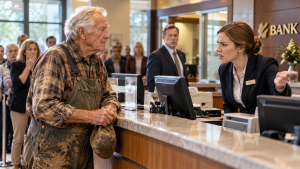
My grandfather walked into the bank wearing muddy overalls and work boots, carrying his old feed-store cap in both hands.
The young teller looked him up and down as if he had wandered in from the wrong side of town.
“Good morning, miss,” Grandpa said politely.
“I’d like to withdraw two thousand dollars.”
She barely glanced at his face before staring at the mud covering his boots.
“Do you have an account here, sir?”
“Sixty-one years,” he answered.
She typed something into her computer, frowned, and asked for identification.
Grandpa handed over his driver’s license and Medicare card without a word.
She examined his license under the light, then looked back at him suspiciously.
“Two thousand dollars is quite a lot of cash,” she said.
“I need a part for my tractor.”
The woman behind us in line chuckled.
The teller smiled in a way that made my stomach tighten.
“Sir, people in your situation usually find the ATM much easier. You know, less paperwork.”
Grandpa glanced at the machine near the entrance.
“The ATM won’t give me two thousand dollars.”
“Then perhaps you don’t need that much.”
I felt my face grow hot.
Grandpa had spent sixty years working the land, paying his bills, and raising a family without asking anyone for a handout.
And now this woman was treating him like he had no right to stand at a bank counter.
“He’s asking for his own money,” I said.
The teller ignored me and picked up her phone.
“Rick, could you come to window three? I have a customer who’s becoming difficult.”
Difficult?
Grandpa hadn’t raised his voice once.
When the security guard approached, his hand resting on his belt, Grandpa simply stepped aside.
Then he looked past the teller, past the waiting customers, and toward a glass-walled office at the back of the bank.
“Miss,” he asked calmly, “does Tom Callahan still have the corner office?”
The teller actually laughed.
“Mr. Callahan is the bank president. He doesn’t personally handle withdrawals.”
“Would you tell him Earl Doyle is here?”
She sighed dramatically.
“Sir, I really don’t have time for games.”
But Grandpa didn’t argue.
He simply stood there, holding his cap, waiting.
Finally, the teller picked up the phone again.
“Mr. Callahan? There’s an Earl Doyle here who claims he knows you.”
She covered the receiver and smirked at me.
“I suppose we’ll see how important your grandfather really is.”
Ten seconds later, the door to the corner office flew open so hard that it struck the wall.
The bank president came rushing out.
And when he saw my grandfather standing beside the security guard, his expression changed completely.
He stopped dead in the middle of the lobby.
Then he looked at the teller and asked one question that made the woman in line stop laughing.
“Do you have ANY idea who you just humiliated?”
PART 2 — THE BANK PRESIDENT WALKED STRAIGHT PAST HIS OWN EMPLOYEES AND GREETED MY GRANDFATHER LIKE A MAN WHO HAD JUST RETURNED FROM THE DEAD—THEN HE ASKED EVERYONE IN THE LOBBY TO LISTEN…
For a moment, nobody moved.
The bank president, Tom Callahan, stood in front of Grandpa with his mouth slightly open.
Then, to everyone’s astonishment, he reached out and grabbed Grandpa’s hands.
“Earl Doyle,” he said, his voice thick with emotion. “I can’t believe it’s really you.”
Grandpa gave him a small smile.
“Morning, Tom. Looks like you’ve been keeping busy.”
Tom laughed, but his eyes were already turning red.
“Busy? Earl, you disappeared from town for years. I thought you were never coming back.”
“I didn’t disappear. I just got old enough to enjoy staying home.”
A few people laughed nervously.
The teller looked between them, her smile fading with every passing second.
Tom finally noticed the mud on Grandpa’s clothes and the security guard standing nearby.
Then he looked down at the muddy trail stretching across the bank’s spotless carpet.
“What happened here?” he asked.
The teller jumped in immediately.
“Mr. Callahan, this gentleman was demanding an unusually large withdrawal, and I was simply following procedure. He became suspicious when I asked questions, and—”
“Did he threaten anyone?” Tom interrupted.
“No, but—”
“Did he refuse to provide identification?”
“No, but I thought—”
“Did he ask you to do anything outside our normal banking procedures?”
She hesitated.
“He wanted two thousand dollars in cash.”
Tom stared at her.
“From his own account?”
The teller swallowed.
“Yes.”
“And you called security?”
“I thought it was the safest thing to do.”
Tom slowly turned toward Grandpa.
“Earl, I’m sorry. You should never have been treated this way.”
Grandpa shrugged.
“It’s all right, Tom. Maybe she hasn’t met many farmers.”
That simple answer seemed to make Tom even more uncomfortable.
He turned back toward the teller.
“Do you know why this bank has been standing on this street for more than a century?”
She shook her head.
“Because people like Earl trusted us with their money when we were nothing more than a little office with two desks and a leaky roof.”
The lobby became completely silent.
Tom continued.
“When my father was alive, he used to tell me that this man saved our bank from closing.”
The woman who had laughed in line suddenly took a step toward the exit.
But Tom wasn’t finished.
“Sixty-one years ago, when this bank was struggling to survive, Earl Doyle did something that my family has never forgotten.”
He looked directly at Grandpa.
“And I think it’s time everyone here learned what that was.”
Grandpa’s face changed.
“Tom,” he said quietly, “you don’t need to bring all that up.”
But Tom shook his head.
“No, Earl. I think I do.”
Then he turned to the teller and asked her to bring up Grandpa’s account history.
What appeared on the screen made her go completely still.
Because the account she had treated like an inconvenience wasn’t just an ordinary checking account.
And the name beside the oldest record was the same name that appeared on a document hanging inside the president’s office.
Earl Doyle.
PART 3 — THE TELLER THOUGHT MY GRANDFATHER WAS JUST AN OLD FARMER WHO DIDN’T BELONG IN HER BANK—UNTIL THE PRESIDENT REVEALED THE ONE THING HER TRAINING HAD NEVER TAUGHT HER ABOUT THE MAN STANDING IN FRONT OF HER…
Tom asked the teller to step away from her computer.
Then he motioned for Grandpa and me to follow him into the corner office.
The security guard lowered his hand from his belt.
Nobody in the lobby said a word.
Inside the office, Tom pointed to two chairs, but Grandpa remained standing.
“I only came for the tractor part,” Grandpa reminded him.
“I know,” Tom said. “And you’re going to get your money. But first, there’s something I want you to understand.”
He opened a drawer and removed an old framed photograph of the bank’s original building.
I leaned closer.
The building was tiny, with wooden doors and a hand-painted sign above the entrance.
Tom pointed to a young man standing beside his father.
“That was my dad,” he explained. “And the man next to him was Earl.”
I stared at my grandfather.
He had never told me any of this.
Tom continued.
“Back then, the bank was on the verge of shutting down. Several businesses had failed, loans weren’t being repaid, and my father was running out of options. He’d spent his life building this place, and he was about to lose everything.”
Grandpa looked at the photograph.
“Your father was a stubborn man,” he murmured.
Tom smiled sadly.
“He was. And he was too proud to ask anyone for help.”
Then Tom told me what had happened.
My grandfather had been a young farmer at the time.
He wasn’t wealthy, and he didn’t have influential friends.
But he had saved every spare dollar he could for years, hoping to buy more land and leave something behind for his children.
When he learned the bank might close, he went to see Tom’s father.
He deposited his savings there and persuaded several local farmers to keep their money in the bank instead of withdrawing everything in panic.
He also agreed to help the bank through a difficult period by keeping his farm business accounts there and encouraging other small businesses to do the same.
It wasn’t a miracle.
It wasn’t a fortune handed over by a millionaire.
It was something more ordinary, and perhaps more meaningful.
A man who believed his community deserved a chance to survive.
The bank recovered.
Tom’s father kept it open.
And the small institution eventually grew into the modern bank standing on Main Street.
“My dad used to say that Earl didn’t just help save the bank,” Tom said. “He reminded us who we were supposed to serve.”
Grandpa rubbed the brim of his cap.
“I didn’t do anything special. People helped each other back then.”
Tom shook his head.
“You never asked for recognition. That’s exactly why I remember.”
I glanced at Grandpa, struggling to reconcile the quiet old farmer beside me with the young man in the photograph.
Then Tom stood up.
“Now, let’s get you those two thousand dollars.”
He called the teller into the office.
She entered with her eyes lowered.
Tom didn’t shout at her.
He didn’t insult her clothes or question her intelligence.
Instead, he said, “You were right to verify a transaction when you had concerns. That’s part of your job. But you were wrong to judge a customer by his appearance, suggest he didn’t need access to his own money, and call security when he had done nothing to threaten anyone.”
The teller’s eyes filled with tears.
“I’m sorry, Mr. Doyle,” she whispered. “I shouldn’t have spoken to you that way.”
Grandpa studied her for a moment.
“Everyone makes mistakes,” he said. “The important thing is what you do after you realize you’ve made one.”
He accepted his withdrawal receipt, tucked the cash safely into his pocket, and put his cap back on.
Then he turned toward the door.
Tom followed us into the lobby.
“Earl, if you ever need anything, you call me directly.”
Grandpa stopped and looked back.
“I already have everything I need, Tom. A working tractor, a little land, and people who still know how to say good morning.”
He walked out into the sunshine as if nothing unusual had happened.
On the drive home, I finally asked him why he’d never told me about helping save the bank.
He kept his eyes on the road.
“Because I didn’t help them so they’d owe me something,” he said. “I helped because they needed it.”
Then he glanced at me.
“Remember this, son. A man’s clothes tell you what kind of work he’s been doing. They don’t tell you what kind of man he is.”
That afternoon, Grandpa fitted the new belt onto his combine, and we finished harvesting the north field before sunset.
He never mentioned the bank again.
But the next time we drove into town, I noticed something different.
The teller was standing near the entrance, greeting customers as they came through the door.
When she saw Grandpa, she stepped forward immediately.
“Good morning, Mr. Doyle,” she said warmly.
Grandpa tipped his cap.
“Morning, miss.”
And this time, she looked him in the eyes.
Because the greatest lesson that day wasn’t about how much money my grandfather had—or what he’d done for the bank decades earlier.
It was about how easily we mistake worn-out clothes for a worn-out life, and how much we can lose when we decide someone’s worth before we’ve even learned their name.