PART 1 — MY CHILDREN WARNED ME THAT HE WANTED MY MONEY
My name is Winona, and at 64, I never imagined I would fall in love again after losing my husband.
For two years, I lived with an emptiness that no amount of busywork, family visits, or comforting words could fill.
Then I met Wendell, a 66-year-old widower who treated me with a tenderness I thought I would never experience again.
He remembered how I liked my coffee, fixed little things around my house without asking for anything in return, and listened to my stories as if every word mattered.
For the first time in years, I found myself smiling for reasons that had nothing to do with pretending to be okay.
But there was one strange thing about him.
He never invited me to his house.
Whenever I asked, he smiled and said, “Just give me a little more time, Winnie. I promise there’s a reason.”
At first, I respected his privacy.
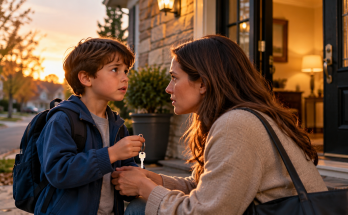
But when weeks turned into months, my son Zach began planting doubts in my mind.
“Mom, you’ve never even seen the inside of his house. Doesn’t that strike you as suspicious?”
“He’s working on something,” I explained.
Zach shook his head.
“Or he’s hiding another woman. Have you ever considered that he might be after Dad’s life insurance money?”
His words cut deeper than I wanted to admit.
I had spent my entire life believing that honesty and kindness were enough to recognize a good person.
What if loneliness had made me careless?
What if Wendell was simply pretending to love me?
Then Zach threatened to stop bringing my grandchildren to visit if I continued seeing him.
Suddenly, my happiness felt like something I had to defend.
When Wendell arrived that evening with a bouquet of wildflowers, he immediately noticed that something was wrong.
“Winnie, sweetheart, what’s happened?”
I almost asked him to explain everything.
Instead, I smiled weakly and told him I was tired.
He sat beside me, held my hand, and didn’t pressure me to say another word.
Somehow, his gentleness made my suspicions hurt even more.
Three days later, I found his address tucked inside an old kitchen drawer.
I stared at it for several minutes before making a decision that might destroy the relationship I had come to cherish.
I would visit his house without warning.
I needed the truth, even if it broke my heart.
And when I finally reached his property on a quiet country road, I saw his pickup parked beside the garage.
The garage door was wide open.
I stepped out of my car, expecting to discover something that would confirm my son’s warnings.
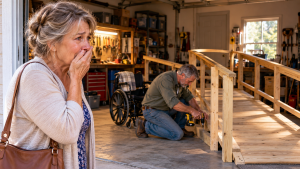
Instead, I saw a long wooden ramp with carefully finished handrails leading from the garage toward the house.
I stopped breathing for a moment.
Because the ramp wasn’t built for Wendell.
It was built for someone whose knees had been giving her trouble for years.
Someone who had once joked about needing a wheelchair someday.
Someone who had told him, almost in passing, that she missed the cheerful yellow kitchen of her childhood.
Someone like me.
And then I noticed the cans of buttercup-yellow paint beside his workbench.
My eyes filled with tears.
What was Wendell preparing inside that house?
And why had he gone to such extraordinary lengths to keep it a secret?
I walked toward the half-open doorway, my hands trembling.
Then I saw a small wooden sign hanging beside it.
The words carved into the wood made my heart stop.
Because they weren’t the words of a man preparing to deceive me.
They were words that suggested he had been planning something far more meaningful than I could ever have imagined.
PART 2 — THE SECRET BEHIND HIS LOCKED DOOR
I stood in the garage, staring at the unfinished ramp.
Every detail told a story.
The smooth handrails.
The carefully measured boards.
The pale-yellow paint that reminded me of my mother’s kitchen.
Wendell hadn’t simply thrown together a home improvement project.
He had been paying attention to the smallest things I had ever told him.
I remembered one evening when I complained about my aching knees after climbing my front steps.
“I suppose getting older means making peace with things becoming harder,” I had joked.
Wendell had looked at me thoughtfully.
“Maybe it means finding better ways to make things easier.”
At the time, I hadn’t thought much about his answer.
Now, standing outside his garage, I understood that he might have meant every word.
I approached the little wooden sign.
It read:
“A place where you never have to pretend you’re not hurting.”
I covered my mouth with both hands.
For years, I had been the person everyone depended on.
As an emergency-room nurse, I had comforted frightened strangers, held the hands of dying patients, and reassured families during the worst moments of their lives.
As a wife and mother, I had spent decades making sure everyone else was okay.
After my husband died, I became very good at telling people I was fine.
But Wendell had noticed the pain I tried to hide.
He had noticed when standing too long made me uncomfortable.
He had noticed how I hesitated before climbing steps.
He had even remembered the little kitchen I described from my childhood.
I stepped toward the doorway and called his name.
“Wendell?”
The radio inside continued playing softly.
No answer came.
I pushed the door open.
And what I saw made my knees nearly buckle.
The room beyond the garage wasn’t a secret bedroom or evidence of another relationship.
It was a small, unfinished living space.
The walls were painted buttercup yellow.
White cabinets lined one side of the room, and a wide window overlooked the pecan tree in the backyard.
There was a sturdy wooden table near the window, with enough space underneath for someone to sit comfortably without struggling.
The doorways were wider than ordinary doorways.
The floors were level.
And every corner seemed designed with care for someone who might one day need a little extra help moving around.
I stepped inside slowly.
On the kitchen counter lay a notebook filled with measurements, sketches, and lists of materials.
Beside it was a handwritten note.
I recognized Wendell’s handwriting immediately.
It said:
“For the woman who spent her life helping everyone else feel safe.
I hope she knows she deserves a place where someone takes care of her, too.”
My tears fell before I could stop them.
Then I heard a truck door slam outside.
“Winnie?”
Wendell’s voice came from the driveway.
He appeared in the doorway carrying a bag of supplies.
When he saw me standing in the middle of the room, he froze.
For the first time since I had known him, he looked genuinely frightened.
“Oh, sweetheart,” he whispered.
I turned toward him, unable to speak.
He set the bag down.
“You weren’t supposed to see this yet.”
“Why didn’t you tell me?” I finally managed.
He lowered his eyes.
“Because I wasn’t sure how you’d feel.”
“Feel about what?”
He looked around the room.
“About me making plans that might involve you.”
I stared at him.
Then he took a deep breath and explained.
His late wife, Eleanor, had struggled with mobility during the final years of her life.
He had watched her become frustrated by ordinary things—steps, narrow doorways, and rooms that made it difficult to move around comfortably.
After she passed away, he had promised himself that if he ever loved someone again, he would never take that person’s independence for granted.
When I told him about my aching knees and my childhood kitchen, he began wondering whether he could build a place that felt welcoming rather than limiting.
He wanted to create a comfortable space where we could spend time together without me having to worry about climbing steps or hiding my discomfort.
“But I didn’t want to assume you wanted that kind of future with me,” he said quietly.
“So I kept working. I wanted to show you when it was ready.”
I looked at the ramp outside.
Then I looked back at the man standing before me.
For weeks, I had imagined betrayal.
I had imagined lies, manipulation, and someone waiting for an opportunity to take advantage of my trust.
Instead, I had found a man who remembered things I had almost forgotten saying.
But just as I reached for his hand, my phone began ringing.
It was Zach.
I answered with trembling fingers.
“Mom, where are you?”
“I’m at Wendell’s house.”
His voice sharpened immediately.
“I knew it! Get out of there. You have no idea what he’s planning.”
I looked at Wendell, who stood silently beside the yellow kitchen counter.
For the first time, I wondered whether my son was protecting me—or whether he had become so convinced that he knew what was best for me that he could no longer see what I wanted for myself.
Then Zach said something that changed the entire conversation.
“Mom, there’s something about your money you need to know. I was going to tell you this weekend.”
My heart began pounding.
“What are you talking about, Zach?”
He hesitated.
And in that silence, I realized the secret I had driven there to uncover might not be Wendell’s at all.
PART 3 — THE TRUTH MY OWN SON DIDN’T WANT ME TO DISCOVER
I stepped outside the house, still holding my phone.
“Zach, tell me what you mean.”
He sighed impatiently.
“Mom, you don’t understand how complicated your finances are. I’ve been helping you manage everything since Dad died.”
“I know you’ve helped me.”
“Then you should trust me when I say Wendell isn’t a good idea.”
I looked back through the open doorway.
Wendell had returned to his workbench, giving me privacy rather than demanding that I defend him.
That small gesture told me more than any argument could.
“Zach, what does my money have to do with this?”
He hesitated again.
Then he said, “I think we need to discuss your accounts in person.”
“No. I want you to explain now.”
His tone changed.
“Mom, I’m trying to protect what Dad left you. You don’t want to make a mistake you’ll regret.”
I had heard those words before.
Every time I questioned his decisions, he called it protection.
Every time I wanted to make my own choice, he reminded me that I was getting older.
And every time I pushed back, he made me feel as though I were being unreasonable.
“Zach,” I said carefully, “I am still capable of making decisions about my own life.”
“Not if you’re letting a man manipulate you!”
I closed my eyes.
Then I asked the question I should have asked months earlier.
“Have you seen anything that proves Wendell wants my money?”
He said nothing.
“Has Wendell ever asked you for money? Has he asked me for money? Has he requested access to my accounts?”
“No,” Zach admitted. “But that doesn’t mean—”
“Then stop treating your suspicions as facts.”
I ended the call before he could turn the conversation into another argument.
My hands were shaking, but for the first time in weeks, I felt certain about one thing.
I needed to separate my own judgment from everyone else’s fears.
That evening, Wendell and I sat at the little kitchen table.
He didn’t ask me to move in.
He didn’t ask me to pay for the renovations.
He didn’t ask me to promise him anything.
He simply told me that the space was an idea, not an obligation.
“If you don’t want this, Winnie, I’ll understand,” he said. “I never wanted you to feel as if I were deciding your future for you.”
I reached across the table and held his hand.
“You built all of this because you remembered what I told you?”
He smiled sadly.
“I built it because I listened.”
That was the moment I realized what love at our age could look like.
Not grand promises.
Not expensive gifts.
Not someone telling you that you were too old to understand your own life.
Sometimes, love was a man measuring a doorway twice because he wanted someone he cared about to move through it comfortably.
Sometimes, it was remembering a color from a childhood story.
And sometimes, it was making room for another person’s future without demanding that they choose it.
But I still had one difficult conversation ahead of me.
The following morning, I called my bank and arranged to review my accounts independently.
I discovered that Zach had been helping me with online banking, but I wanted to understand every account, every authorization, and every decision myself.
I asked the bank to explain my options and confirm exactly what access he had.
I also contacted an independent financial adviser to help me review my arrangements.
I wasn’t accusing my son of stealing.
I simply wanted to know that my money and my decisions remained under my control.
Then I called Zach and asked him to meet me at my house.
When he arrived, I was sitting at the kitchen table.
“I love you,” I told him. “But you don’t get to decide whom I can love.”
He looked stunned.
“Mom, I’m your son. I’m supposed to protect you.”
“And I appreciate your concern. But protecting me doesn’t mean frightening me into doing what you want.”
He glanced toward the paperwork on the table.
“What is all that?”
“My financial review. I’m making sure I understand everything myself.”
His expression tightened.
I couldn’t tell whether he was embarrassed, worried, or simply angry that I had taken control of a decision he had been making for me.
But I knew what I needed to say next.
“You can disagree with my relationship. You can ask questions. You can tell me when something worries you. But you cannot threaten to keep my grandchildren away because I choose to see someone.”
For a long moment, neither of us spoke.
Finally, he looked down.
“I thought you were going to get hurt.”
“Then talk to me like someone you love, Zach. Don’t treat me like someone who can’t think for herself.”
He didn’t apologize immediately.
Real life isn’t always that simple.
But he stopped arguing, and we agreed to talk again when we were both calmer.
A week later, Wendell invited me back to his house.
The wooden ramp was finished.
The kitchen cabinets were installed, and the buttercup-yellow walls glowed in the afternoon sunlight.
He had placed a small vase of wildflowers on the table.
I walked slowly through the doorway, taking in the room he had created.
Then I turned toward him.
“Wendell, I don’t know what the future holds for us.”
He nodded.
“Neither do I, sweetheart.”
“But I want to find out.”
His eyes filled with tears.
He reached for my hand, and we stood together in the little kitchen.
I didn’t move into his house that day.
I didn’t need to.
I had something more important: the freedom to choose my own future, and the chance to discover whether our love could grow without fear or pressure.
Months later, Zach began to understand that his mother could love again without forgetting his father.
Our relationship wasn’t magically perfect, and trust took time to rebuild.
But I kept seeing Wendell.
We cooked Sunday dinners, listened to old country songs, and slowly turned his little kitchen into a place filled with laughter.
One afternoon, I stood at the top of the wooden ramp and watched Wendell plant flowers beside the railing.
He looked up and smiled.
“Everything all right, Winnie?”
I smiled back.
“For the first time in a long time, I think it is.”
At 64, I had believed that losing my husband meant the most beautiful part of my life was behind me.
I was wrong.
I had spent so much time worrying about whether someone might take advantage of my loneliness that I nearly allowed fear to take away my chance at happiness.
And I learned something I wish every family understood:
Protecting someone you love should never mean taking away their right to choose.
Because growing older doesn’t mean we stop needing love.
It means we deserve a love that listens, respects our independence, and makes room for who we are becoming.
And sometimes, the most extraordinary declaration of love isn’t a diamond ring or a promise whispered beneath the stars.
Sometimes, it’s a wooden ramp built by a man who remembered your aching knees, a kitchen painted the color of your childhood, and a quiet message that says:
“You don’t have to face the future alone.”