PART 1 — They Humiliated Her for Saving a Patient’s Life—Then Two Black Hawks Landed and a Four-Star Admiral Asked, “Where Is My Surgeon?”
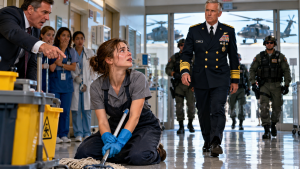
At 7:42 a.m., my coworkers were laughing at me while I scrubbed the hospital floor.
“Careful, Elise,” Kayla Thorne said, holding up her phone to record me.
“You might accidentally save somebody’s life with that mop.”
The nurses behind her burst into laughter.
I kept my eyes on the wet tiles and pushed the mop forward.
Three weeks earlier, I had worn the same navy-blue scrubs as the nurses standing around the reception desk.
Back then, patients called me Nurse Maddox.
Now, the hospital director had reassigned me to cleaning duty because I had refused to approve a medication dose that could have killed a patient.
I was thirty-two years old, and I had learned that some people would rather protect their authority than admit they were wrong.
Commander Russell Dane, the hospital’s operations director, had made that painfully clear.
“You embarrassed a senior physician in front of his staff,” he had told me.
“I prevented a potentially fatal overdose,” I replied.
“That was not your decision.”
“The patient’s life was at risk.”
Dane leaned back in his leather chair.
“Perhaps thirty days of cleaning floors will teach you the difference between following orders and questioning them.”
I had looked at the disciplinary form for several seconds before signing it.
I did not beg.
I did not explain my past.
And I certainly did not tell him why I had recognized the dangerous dosage before the physician had finished speaking.
Some secrets were safer when they stayed buried.
Since that morning, Kayla had made me the hospital’s favorite joke.
She filmed me emptying trash cans, cleaning the nurses’ station, and wiping fingerprints from the glass doors.
Every video came with another cruel caption.
The other nurses laughed because they were afraid of becoming her next target.
Only Dana Whitlock occasionally looked uncomfortable.
“Kayla, put the phone away,” Dana said that morning.
Kayla rolled her eyes.
“What? I’m documenting the incredible career of our newest janitor.”
I kept mopping.
Then I noticed a stainless-steel tray sliding off a nearby counter.
A young nurse had bumped it while rushing past.
Before anyone could react, I caught it with one hand.
The instruments remained perfectly balanced.
For one brief second, the hallway fell silent.
Kayla lowered her phone.
“Lucky,” she muttered.
I returned the tray to the counter and continued working.
Dana watched my hands.
She had noticed something strange about them before.
Whenever I was alone, my fingers sometimes trembled when I pulled on my cleaning gloves.
But the moment an emergency occurred, the trembling disappeared.
At 8:16 a.m., the windows began to vibrate.
A deep, rhythmic thudding rolled across the hospital grounds.
The coffee in Kayla’s hand rippled.
Tyler Brooks looked toward the glass entrance.
“What on earth is that?”
I stopped pushing my cart.
I knew that sound.
I had heard it in deserts, on remote airfields, and during nights when the only light came from a helicopter’s landing lamps.
“Black Hawks,” I whispered.
Outside, two military helicopters descended onto the hospital’s landing area.
Security personnel hurried toward the entrance.
Patients turned their heads.
Doctors abandoned their conversations.
Then a rear admiral in immaculate white uniform strode through the doors, followed by a team of military medics.
Commander Dane rushed forward with a smile.
“Admiral Keene. Welcome to our facility. How may we assist you?”
The admiral barely acknowledged him.
“Two wounded servicemen are coming through those doors. One has internal bleeding. The other needs immediate surgical intervention.”
Dane straightened.
“Our trauma department is among the finest in the region.”
“I didn’t ask about your department.”
The admiral looked directly at him.
“I need Combat Surgeon Kestrel.”
Dane blinked.
“I’m sorry?”
“Kestrel Actual. The surgeon assigned to this facility.”
Dane’s smile vanished.
“We don’t have anyone by that name.”
The admiral took one deliberate step closer.
“I personally approved her assignment.”
He paused.
“Find her. Now.”
Across the lobby, my hand tightened around the mop handle.
I had spent three years trying to make sure nobody ever connected that call sign to my real name.
Three years of sleepless nights.
Three years of memories I could never explain to ordinary people.
And now, two helicopters had brought my past directly to the hospital where I was being punished for doing the right thing.
The admiral turned toward the emergency entrance.
Then his eyes passed over me.
For a fraction of a second, we recognized each other.
I gave him the smallest possible shake of my head.
Please.
Not here.
Not in front of them.
He looked away.
But Dana had seen the exchange.
And for the first time since my punishment began, I realized the secret I had protected might not remain a secret much longer.
Because the next sound I heard was a paramedic shouting from the entrance.
“Move! We’re losing him!”
And the admiral’s voice cut through the entire lobby.
“Where is Kestrel?”
PART 2 — The Wounded Soldier Recognized the Woman Everyone Called a Janitor
The emergency doors burst open.
Two military stretchers rolled into the trauma bay.
The first carried Sergeant Major Calvin Redd, whose blood pressure was dropping rapidly.
The second carried Staff Sergeant Caleb Frost, a young soldier struggling to remain conscious.
Blood soaked through the dressing around Redd’s abdomen.
The trauma team rushed into position.
Dr. Owen Hadley, the senior trauma physician, began issuing orders.
“Get him to imaging. Prepare the operating room. I want a complete assessment before we intervene.”
One of the military medics shook his head.
“He’s deteriorating too quickly.”
Hadley frowned.
“We need the scan.”
“No,” a quiet voice said from the doorway.
Everyone turned.
I stood there in my navy scrubs, holding a cleaning cloth in one hand.
“He won’t survive the trip to the scanner,” I said.
Hadley stared at me.
“Why are you here?”
“Because you’re about to lose him.”
His face hardened.
“You’re not assigned to this department anymore.”
“I can see that.”
“Then return to your duties.”
I looked at the monitor.
I recognized the pattern of deterioration.
I recognized the way Redd’s breathing had changed.
And I recognized the expression on the medic’s face.
I had seen it too many times before.
“His condition is changing by the minute,” I said. “You need to reassess him immediately.”
Hadley turned back toward the bed.
“I don’t need instructions from environmental services.”
Then the wounded soldier opened his eyes.
His gaze moved past the doctors, past the nurses, and toward me.
He stopped breathing for a moment.
“Doc?”
The entire room went quiet.
His voice was weak, but the recognition in it was unmistakable.
“Kestrel?”
I walked toward him.
“I’m here, Calvin.”
His eyes filled with relief.
“Thought you were gone.”
“Not today,” I whispered.
His fingers reached for my sleeve.
“Don’t let them send me to the scanner.”
I placed my hand over his.
“I won’t let you face this alone.”
The admiral appeared behind the trauma team.
“Commander Dane,” he said, “I believe you’ve found your surgeon.”
Dane stood frozen in the doorway.
“That is Nurse Maddox.”
“No,” the admiral replied. “That is Lieutenant Commander Elise Maddox, United States Navy, a combat surgeon whose record includes hundreds of emergency procedures under conditions most physicians never experience.”
Kayla’s phone slipped slightly in her hand.
Dana stared at me as if she were seeing a stranger.
The admiral continued.
“She was temporarily assigned here following her recovery from an overseas deployment. Her clinical assignment was supposed to remain confidential.”
Dane looked genuinely confused.
“Why wasn’t I informed?”
“Because the assignment was restricted.”
The admiral’s gaze hardened.
“And because someone apparently decided that humiliating a decorated medical officer was an appropriate response to a patient-safety dispute.”
Dane’s face reddened.
I did not look at him.
Redd’s monitor sounded again.
The numbers were worsening.
I turned toward Hadley.
“Doctor, we can discuss my job title later. Right now, he needs a surgeon.”
Hadley hesitated.
He was the senior physician.
He was accustomed to giving orders.
But he was also a doctor who understood what it meant when a patient was running out of time.
Finally, he stepped aside.
“Tell me what you need.”
I moved into position and began directing the emergency team.
My voice was calm.
My instructions were precise.
I asked for the equipment needed for an immediate bedside assessment, assigned specific tasks, and coordinated the team while the attending physician prepared for definitive treatment.
The room transformed.
The jokes disappeared.
The whispers stopped.
Even Kayla lowered her phone completely.
As the team worked, Redd managed to speak again.
“Doc, you remember the mountain?”
I swallowed.
“I remember.”
“You carried me when I couldn’t walk.”
“I remember that, too.”
He gave the faintest smile.
“Never told them who you were.”
“You didn’t have to.”
The admiral stood silently near the door.
He knew the story behind those words.
Three years earlier, during a dangerous overseas operation, I had been the only available surgeon at a temporary medical station when a convoy arrived with multiple casualties.
There had been no fully equipped operating room.
No convenient backup.
No time to wait for someone else to arrive.
Redd had been among the wounded.
I had helped save his life that night.
But the experience had cost me more than I had ever admitted to my colleagues.
After returning home, I had asked for a quiet assignment.
I wanted to heal.
I wanted to work in a hospital where the loudest sound was a monitor alarm, not an aircraft approaching a landing zone.
I had wanted to be Elise again.
Not Kestrel.
Not the person people called when every other option had failed.
Just a nurse who could help people without carrying the weight of her past into every room.
Instead, Commander Dane had mistaken my silence for weakness.
And now the very people who had laughed while I mopped the floor were watching me take command of an emergency they could barely comprehend.
The treatment team stabilized Redd enough to move forward with urgent care.
The second soldier, Frost, still needed immediate attention.
I turned toward his stretcher.
“Caleb,” I said, meeting his eyes. “I’m going to need you to stay with us.”
He managed a weak nod.
Behind me, Dane whispered to the admiral.
“This has all been a misunderstanding.”
The admiral did not answer.
Because at that moment, Dana approached me with tears in her eyes.
“Elise,” she said softly, “why didn’t you tell us?”
I looked at her.
“Would it have changed anything?”
She opened her mouth.
Then closed it again.
Neither of us needed to say another word.
Across the room, Kayla’s phone buzzed.
Her earlier video had already begun spreading through the hospital staff group.
But she had no idea that the footage she had posted to humiliate me had captured the exact moment the admiral arrived and demanded Kestrel.
And what happened next would make that video impossible for anyone in the hospital to ignore.
PART 3 — The Admiral Watched Her Finish the Mission, Then Ordered the Director to Answer One Question
The next several hours passed in a blur of controlled urgency.
I remained with the medical team as they treated both servicemen.
Hadley worked beside me, asking questions when he needed clarification and making decisions based on the patients’ changing conditions.
Nobody mentioned the mop.
Nobody called me the cleaner.
For the first time in three weeks, I was being treated according to what I could contribute rather than the punishment attached to my name.
Eventually, Redd was stable enough for continued intensive care.
Frost was transferred for the surgical treatment he needed.
The military medics thanked the team.
One of them shook my hand.
“Good to have you back, Kestrel.”
I managed a tired smile.
“Take care of your people.”
When I finally stepped into the hallway, my knees felt weak.
I leaned against the wall and closed my eyes.
The adrenaline was fading.
My hands began to tremble again.
Dana found me beside the supply room.
She had brought a bottle of water.
I accepted it without speaking.
After a moment, she said, “I laughed at Kayla’s jokes.”
I looked at her.
“I know.”
“I told myself I was staying out of trouble.”
She wiped her eyes.
“But I knew it was wrong.”
I took a slow breath.
“Then remember that the next time someone is being treated like they don’t matter.”
Dana nodded.
“I will.”
A few minutes later, Commander Dane summoned me to his office.
The admiral was already waiting there.
So was the hospital’s chief medical officer.
Dane stood beside his desk, looking as though he had aged several years in a single morning.
“Elise,” he began, “I believe we should resolve this matter professionally.”
I remained standing.
“Which matter?”
He hesitated.
“Your reassignment.”
“You mean the punishment for refusing to approve a dangerous medication order?”
“The situation was complicated.”
“Was the dose safe?”
Silence.
The chief medical officer placed a folder on the desk.
An internal review had confirmed that the prescribed dose exceeded the intended amount and could have caused severe harm.
The patient had survived.
The error had been corrected.
And my original warning had been justified.
Dane looked down at the paperwork.
“I was attempting to maintain order within the department.”
The admiral finally spoke.
“Order is not the same thing as obedience.”
Dane stiffened.
The admiral continued.
“A medical professional who raises a legitimate safety concern should have that concern investigated. Assigning her to humiliating duties does not make a dangerous order safer.”
“I never intended to humiliate her.”
The admiral glanced at the window overlooking the lobby.
“Your staff filmed her cleaning floors while laughing at her. Did you believe that was an appropriate outcome?”
Dane had no answer.
Then the chief medical officer opened another document.
The hospital would review the disciplinary decision, investigate how the medication concern had been handled, and examine the conduct of everyone involved.
Dane’s authority would not protect him from that review.
The admiral turned toward me.
“Lieutenant Commander Maddox, your temporary clinical assignment has been restored. You may return to your medical duties if you choose.”
If you choose.
Those three words mattered more than he knew.
For three weeks, other people had decided what I was allowed to do.
Now, for the first time, I was being offered a choice.
I looked through the office window.
Beyond the glass, a cleaner was replacing a full trash bag.
A nurse hurried past without noticing him.
I thought about the patient whose life had nearly been endangered.
I thought about Redd calling my name.
And I thought about how easily a uniform, a title, or a humiliating assignment could change the way people treated another human being.
“I’ll return to patient care,” I said. “But I want the safety investigation completed, and I want staff to understand that reporting a dangerous order is not misconduct.”
The chief medical officer nodded.
“Agreed.”
The admiral offered his hand.
“Welcome back, Kestrel.”
I shook it.
“Thank you, sir.”
Then he surprised me.
“There’s one more thing.”
He took out his phone and showed me Kayla’s video.
The clip had been shared repeatedly.
Thousands of people had already watched me mop the floor beneath the hospital’s honor banner.
But the final seconds showed the two helicopters landing, the admiral entering the lobby, and my expression changing when I heard the call sign.
The video had become something Kayla never intended.
A record of the moment the person everyone mocked became the person a military emergency team had been searching for.
“I didn’t post that video,” I said.
“I know,” the admiral replied.
Outside the office, Kayla was waiting.
Her face was pale.
She had finally realized that the joke she had made at my expense was no longer under her control.
“Elise,” she began, “I was just trying to be funny.”
I studied her for a moment.
“You thought it was funny because you believed I couldn’t do anything about it.”
She looked down.
“I’m sorry.”
I did not tell her that everything was forgiven.
An apology could be a beginning.
It could not erase what had happened.
“Take the video down,” I said. “And next time you see someone being humiliated, don’t become part of the crowd.”
She nodded and walked away.
Later that afternoon, I returned to the ward in clean navy scrubs.
Nobody applauded.
Nobody needed to.
A young nurse approached me with a medication chart.
“I have a question about this order,” she said. “Something doesn’t look right.”
I pulled up a chair beside her.
“Show me what you found.”
She explained her concern.
We reviewed the order together, checked the relevant information, and contacted the prescribing physician to clarify the discrepancy before proceeding.
The issue was resolved.
The patient received the appropriate care.
And the young nurse walked away knowing that she had done the right thing by speaking up.
That was the moment I understood what I had really come back for.
Not recognition.
Not revenge.
Not even the restoration of my rank.
I had returned because a hospital should be a place where people can raise concerns without fearing humiliation—and where the smallest voice in the room can still protect a life.
As I passed the reception desk, Dana looked up from her work.
“Welcome back, Nurse Maddox.”
I smiled.
“It’s good to be back.”
Behind the glass doors, the two Black Hawks were preparing to depart.
Their rotors began turning again.
I paused for a moment and listened.
For years, that sound had meant danger, sacrifice, and memories I wanted to leave behind.
Today, it meant something different.
Someone had needed help.
And I had been there.
The hospital had called me a cleaner.
The admiral had called me Kestrel.
But the only title that mattered was the one I had never stopped earning: the person who would speak up when a life was on the line.