PART 1 — The Laptop
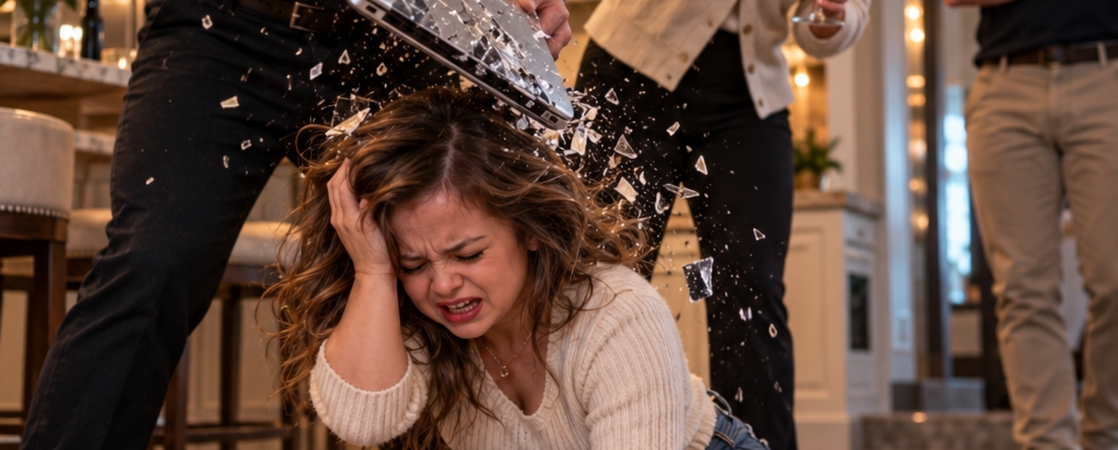
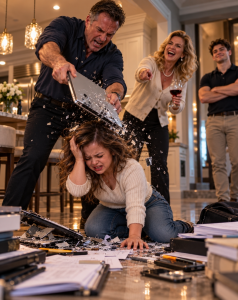
The laptop hit my temple hard enough to make the kitchen lights blur.
For several seconds, I couldn’t hear anything except the ringing in my ears.
My final thesis defense was nine hours away.
My father stood over me, breathing heavily.
“Your future?” he said coldly. “That’s a joke.”
The shattered laptop lay across the kitchen floor.
My mother looked at the broken screen, then at the blood near my hairline.
Instead of helping me, she laughed.
“You don’t deserve a future,” she said. “You’re just a leech.”
I was twenty-six years old and finishing a master’s degree in structural engineering.
For six years, I had worked nights, attended classes during the day, and paid nearly all my own expenses.
I even sent my parents $800 every month because Dad constantly claimed his construction company was struggling.
But somehow, in their minds, I had accomplished nothing.
My father pointed toward the broken laptop.
“Maybe now you’ll stop wasting your time with school and come work for me.”
I stared at him.
“You destroyed my thesis.”
He shrugged.
“Then I guess you’re finished.”
Mom folded her arms.
“Your brother understands family loyalty. Ryan stayed and helped his father.”
Of course he did.
Ryan had been given a company truck, a generous salary, and a management position despite having almost no engineering experience.
Dad wanted me to do the same.
But I had refused.
Because I knew what was happening inside his company.
For eighteen months, I had been researching structural failures in inexpensive commercial renovations.
My original thesis focused on falsified material certifications, altered inspection reports, and dangerous substitutions made during construction.
And one company kept appearing in my research.
My father’s company.
At first, I thought the similarities were accidental.
Then I found an invoice.
Then an altered inspection report.
Then photographs.
Then emails.
Eventually, I realized something terrifying.
Several buildings had been renovated using materials that did not match the approved specifications.
And someone had changed the documentation to make the work appear legitimate.
I had quietly copied everything.
Every invoice.
Every photograph.
Every email.
Every suspicious document.
I stored everything in four encrypted locations.
My parents thought they had destroyed my thesis.
They had destroyed one laptop.
They had no idea I had prepared for exactly this kind of situation.
I walked upstairs.
Locked my bedroom door.
Cleaned the cut on my forehead.
Then I pulled an old tablet from the back of my closet.
At 2:13 a.m., I sent one message to my thesis adviser.
Professor Hale, I need the emergency protocol we discussed.
His response arrived less than a minute later.
Are you safe?
I stared at the screen.
Then typed:
Not completely. But I have copies of everything.
Three dots appeared.
Then his response came.
Do not return to your parents’ company. Bring the evidence to campus security and the university ethics office first thing in the morning.
I looked at the clock.
4:47 a.m.
My thesis defense was scheduled for 9:00.
Then my phone buzzed again.
This time, it wasn’t Professor Hale.
It was an unknown number.
The message contained only one sentence:
Your father knows about the backup drive.
My blood went cold.
Because I had never told anyone about that drive.
PART 2 — The Backup
I didn’t sleep.
At 6:10 a.m., I left through the back door carrying nothing except my tablet, my backpack, and the smallest encrypted drive.
I didn’t tell my parents where I was going.
I didn’t tell Ryan.
And I certainly didn’t tell them that the university already had copies of my research.
When I arrived on campus, Professor Hale was waiting outside the engineering building.
The moment he saw the injury on my forehead, his expression changed.
“What happened?”
“My father.”
He didn’t ask anything else.
He simply opened the door.
Inside were the department chair, the university legal adviser, and an investigator from the university’s research-integrity office.
I placed the encrypted drive on the table.
“I need you to verify the timestamps before anyone claims these documents were created after the fact.”
The investigator nodded.
They began examining everything.
Within an hour, they found something I hadn’t noticed.
One of the inspection reports had been digitally modified.
The original file was still buried inside the metadata.
The original date was almost eight months earlier.
The original document contained a warning from an engineer:
STRUCTURAL COMPONENT DOES NOT MEET APPROVED SPECIFICATION. DO NOT AUTHORIZE INSTALLATION.
The final version said:
COMPONENT APPROVED FOR INSTALLATION.
Someone had changed the report.
Professor Hale looked at me.
“Do you know who authorized the change?”
I swallowed.
“My father.”
The room became silent.
Then the university investigator asked:
“Do you have evidence connecting him directly to the modification?”
I opened another folder.
“Yes.”
Inside was an email.
My father had written:
Change the report before the inspector sees it. We can’t afford another delay.
Below it was the reply from the project manager:
Understood.
The timestamp was from two years earlier.
I sat back.
For eighteen months, I had believed I was building a thesis.
I realized I had actually been building a case.
At 8:55, I entered the lecture hall.
My parents were already there.
Dad sat proudly in the front row.
Mom sat beside him.
Ryan was smiling.
They had come expecting to watch me fail.
My father leaned toward me as I passed.
“You should have stayed home.”
I said nothing.
The defense began.
For twenty minutes, I presented my research.
Then came the final section.
I displayed a case study involving a fictional construction company.
My father immediately recognized the documents.
His smile disappeared.
I continued.
“During this investigation, I discovered evidence suggesting that safety certifications had been altered after inspection.”
The room became completely silent.
My father stood.
“This is academic misconduct.”
Professor Hale calmly interrupted.
“Please sit down.”
Dad pointed toward me.
“She stole confidential company information.”
I looked at him.
“No.”
Then I clicked the next slide.
“I obtained these documents legally through records available to me while working with the company.”
The investigator entered the room.
Behind him were two attorneys.
My mother suddenly stopped smiling.
Then the investigator spoke.
“Mr. Carter, we need to speak with you.”
My father stared at him.
“About what?”
The investigator placed a folder on the table.
“Several construction projects.”
Dad’s face changed.
Ryan stood.
“What is this?”
The investigator didn’t answer him.
Then my phone vibrated.
A message appeared from an unknown number.
Your father wasn’t the only person changing those reports.
A second message followed.
Ask your brother about the warehouse fire.
I looked across the room at Ryan.
For the first time, he wasn’t smiling.
He was staring at me.
And I realized there was an entire chapter of this story that I hadn’t discovered yet.
PART 3 — The Truth They Never Expected
After the hearing began, the university investigator contacted state authorities.
My father’s company was placed under formal review.
Several construction projects were examined.
Then something unexpected happened.
A former employee came forward.
He had worked for my father for nearly ten years.
And he brought boxes of documents.
He told investigators that employees had been pressured to alter records whenever a project exceeded budget.
But the warehouse fire was different.
Three years earlier, a storage building owned by one of my father’s clients had suffered a devastating fire.
My father had blamed an electrical fault.
The insurance company had accepted the explanation.
But the former employee had kept a copy of the original inspection.
It showed something else.
A structural component had been installed incorrectly.
The same type of component that appeared in my thesis.
The same type of substitution my father had ordered.
Then another witness came forward.
A former supervisor.
He testified that Ryan had personally delivered several altered documents to the project office.
Ryan denied everything.
Until investigators showed him the security footage.
His story changed immediately.
He admitted helping his father alter paperwork.
But then he said something that stunned everyone.
“Dad told me she knew.”
Everyone turned toward me.
The investigator asked:
“You?”
Ryan nodded.
“He said she was collecting documents because she wanted to destroy the company.”
I stared at him.
That wasn’t true.
But suddenly I understood why my father had destroyed my laptop.
He wasn’t trying to stop my thesis.
He was trying to destroy the evidence.
And when that failed, he had tried to destroy my future instead.
Months later, the investigation concluded.
Several falsified records were discovered.
Multiple projects were reviewed.
And my father’s company lost several major contracts.
Ryan resigned.
My mother stopped speaking to me.
My father never apologized.
But something unexpected happened.
My thesis received the highest evaluation in my department.
Professor Hale told me:
“You didn’t just finish your degree. You produced research that may protect people from the exact failures you documented.”
I graduated that spring.
At the ceremony, my parents were nowhere in the audience.
I didn’t care.
My life was finally mine.
A year later, I stood inside a newly completed engineering laboratory at my university.
My name was engraved on a small plaque near the entrance.
Not because I came from a powerful family.
Not because someone gave me an opportunity.
But because I had refused to let someone else’s cruelty determine my future.
Sometimes I think about that night.
The broken laptop.
The blood on my fingers.
My mother’s laughter.
My father’s words:
“You don’t deserve a future.”
He was wrong.
Because they destroyed the laptop.
They tried to destroy my confidence.
They tried to destroy my career.
But they never understood the one thing that mattered most.
They had spent eighteen months teaching me exactly how to prove them wrong.