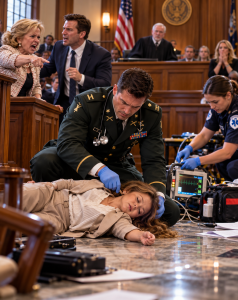
PART 1 — “She’s Faking It”
My mother-in-law pointed directly at me.
“She’s faking it.”
The courtroom went silent.
My husband, Daniel, sat beside his attorney with an expression that made my stomach turn.
He smiled.
Then he told the judge:
“She does this whenever she doesn’t get her way.”
I stood near the witness box, gripping the wooden railing because the room wouldn’t stop spinning.
For months, Daniel had been telling everyone I was unstable.
Every dizzy spell became “attention-seeking.”
Every blackout became “another performance.”
Every emergency-room visit became evidence that I couldn’t be trusted with our seven-year-old daughter.
The problem was that I didn’t know what was wrong with me either.
I’d seen doctors.
I’d had blood tests.
I’d had scans.
Some results were normal.
Others were inconclusive.
And every time the doctors said they couldn’t identify the cause, Daniel used it against me.
“She has no diagnosis,” his attorney said that morning. “There is no objective evidence that my client’s wife is medically incapable of caring for their daughter.”
My attorney had withdrawn two weeks earlier after Daniel emptied our joint account.
So I was standing there alone.
Trying to explain why Lily had begun crying before going to her father’s house.
Trying to explain why she had started hiding her backpack whenever Daniel came to pick her up.
Then the judge asked me to describe the most recent incident.
I took a breath.
“Last Tuesday, I woke up on the kitchen floor.”
Daniel quietly laughed.
His mother shook her head.
“She probably fainted because she wanted attention.”
I looked toward the judge.
“I don’t know why it happened.”
Patricia immediately interrupted.
“Because she exaggerates everything.”
The judge raised his hand.
“Mrs. Carter, please allow her to finish.”
I nodded.
But suddenly, the courtroom lights seemed too bright.
The walls appeared to move.
My fingers tightened around the railing.
I couldn’t hear properly.
“Your Honor…”
Daniel whispered something to his attorney.
Then he smiled again.
“Here we go.”
I looked at him.
“I’m not feeling well.”
Patricia sighed dramatically.
“She always says that.”
My knees weakened.
I tried to hold onto the railing.
It slipped from my hand.
The last thing I remember before hitting the floor was hearing Daniel say:
“She does this all the time.”
Then another voice cut through the courtroom.
“Move back.”
A man from the rear benches was already kneeling beside me.
He wore a dark military uniform.
He checked my pulse.
Then looked at the monitor attached to my wrist from a previous medical evaluation.
His expression changed.
“Ma’am, can you hear me?”
I opened my eyes.
Barely.
The man looked toward the judge.
“I’m Colonel Aaron Carter, U.S. Army Medical Corps.”
Daniel stood.
“She’ll be fine.”
The colonel looked at him.
“No.”
His voice was calm.
“She may not be.”
He checked my pulse again.
Then his expression became serious.
“Call an ambulance.”
Patricia scoffed.
“She isn’t actually sick.”
The colonel didn’t even look at her.
“Call 911.”
The bailiff immediately reached for the phone.
Daniel’s face changed.
For the first time that morning, he looked afraid.
And before the paramedics arrived, Colonel Carter said something that made the entire courtroom fall silent.
“Her pulse is dangerously slow.”
PART 2 — The Monitor
I woke up in a hospital room.
There were wires attached to my chest.
A monitor beside the bed displayed a constantly changing rhythm.
A nurse checked my blood pressure.
Then a cardiologist entered.
“I’m Dr. Priya Shah.”
She pulled a chair beside my bed.
“You’ve been experiencing fainting episodes?”
I nodded.
“For months.”
“Dizziness?”
“Yes.”
“Sudden weakness?”
“Yes.”
She looked at the monitor.
“And sometimes you feel your heart racing?”
I stared at her.
“Yes.”
Dr. Shah nodded slowly.
“That combination is important.”
She explained that the initial tests I had received could have appeared normal because my symptoms weren’t happening continuously.
But the hospital monitor had captured several abnormal episodes.
My heart rate had suddenly slowed dramatically.
Then returned toward normal.
Then slowed again.
Dr. Shah showed me the recording.
I didn’t understand every detail.
But I understood enough.
Something real was happening.
Something physical.
Something that had nothing to do with being dramatic.
Then she asked:
“Has anyone ever told you that your symptoms were caused by anxiety?”
I laughed bitterly.
“Almost everyone.”
She shook her head.
“We need to investigate this properly before making assumptions.”
For the first time in months, someone had said those words.
Investigate.
Not dismiss.
Not accuse.
Not judge.
Investigate.
The next morning, Colonel Carter visited me.
He had stayed long enough to provide a witness statement to the court.
“I hope you’re doing better.”
“I am.”
He smiled.
“Good.”
I looked at him.
“Why did you know something was wrong?”
He thought for a moment.
“Because you weren’t behaving like someone pretending to collapse.”
He paused.
“And because your pulse was telling me something.”
I thanked him.
Then I asked the question that had been haunting me.
“What happened in court?”
He gave me a careful smile.
“The judge postponed the hearing.”
“What about Daniel?”
“He was told not to contact you directly.”
My heart finally relaxed.
Then my phone rang.
It was Daniel.
I didn’t answer.
A few seconds later, a voicemail appeared.
I played it.
His voice sounded different.
No confidence.
No sarcasm.
Just fear.
“I didn’t know.”
I stared at the phone.
Then another message arrived.
This one was from Patricia.
You are destroying this family.
I deleted it.
The next day, Dr. Shah returned with more information.
“We found something.”
I sat up.
“What?”
“We believe the episodes are related to an electrical problem with your heart rhythm.”
She explained that further testing was needed to determine the exact cause and the appropriate treatment.
Then she said something I hadn’t expected.
“Your symptoms may have been progressing for quite some time.”
I thought about every time Daniel had called me dramatic.
Every time Patricia had laughed.
Every time I had apologized for needing help.
And suddenly, another question came to mind.
“How dangerous was it when I collapsed?”
Dr. Shah didn’t exaggerate.
She simply answered honestly.
“It was serious enough that I’m glad you weren’t alone.”
I looked away.
Because I understood what that meant.
If Colonel Carter hadn’t been in that courtroom…
I might have fallen without anyone recognizing what was happening.
Then Dr. Shah handed me a folder.
Inside was a preliminary medical report.
I read the first page.
Then stopped.
There was something else in the report.
A note from an emergency physician who had reviewed my previous records.
It said my earlier symptoms had been documented repeatedly.
But several of the referrals had never been completed.
I stared at the page.
“Why weren’t these tests done?”
Dr. Shah looked at me.
“That is something you may want to discuss with your previous providers.”
I closed the folder.
But then I remembered something.
Daniel had always handled my appointments.
He had always insisted on driving me.
He had always said paperwork was too confusing.
And suddenly, I wondered whether my medical care had been neglected for reasons I had never understood.
PART 3 — The Truth Came Out
Two weeks later, I returned to court.
This time, I wasn’t standing alone.
My attorney had returned after the judge ordered temporary financial protections.
My medical records were organized.
The hospital had provided documentation.
And Colonel Carter had submitted his witness statement describing exactly what happened when I collapsed.
Daniel looked nervous.
Patricia wouldn’t look at me.
The judge reviewed the medical records carefully.
Then he looked toward Daniel.
“Mr. Carter, you previously characterized your wife’s episodes as fabricated.”
Daniel swallowed.
“Yes.”
“Do you still maintain that position?”
He didn’t answer.
The judge waited.
Finally, Daniel said:
“No.”
The room became silent.
My attorney presented the hospital findings.
The court was also shown the school records documenting Lily’s distress.
Then something unexpected happened.
Lily’s school counselor provided a statement.
She had noticed that Lily became frightened whenever custody exchanges approached.
She had also documented several conversations in which Lily said she was afraid her father would become angry if she asked to stay with me.
Daniel’s attorney tried to challenge the statement.
But the judge ordered further evaluation before making any permanent custody decision.
For the first time, the case wasn’t about whether I was “dramatic.”
It was about evidence.
Medical evidence.
School records.
Witness statements.
And documented behavior.
After the hearing, Daniel approached me in the hallway.
“I was wrong.”
I looked at him.
“You called me a liar.”
“I know.”
“You told your family I was pretending.”
He looked down.
“I know.”
“And you used my medical uncertainty against me.”
He didn’t answer.
Because there was nothing he could say.
I wasn’t interested in revenge.
I wanted something much simpler.
Safety.
For myself.
And for Lily.
My doctors continued investigating my condition, and I followed their treatment plan carefully.
Over time, my episodes became more manageable.
Lily began seeing a counselor.
The custody arrangement was changed while the court continued evaluating what would be safest for her.
And Patricia stopped calling me dramatic.
Not because she suddenly understood me.
Because the evidence no longer allowed her to pretend she didn’t.
Months later, I returned to the same courtroom for another hearing.
I stood in the exact place where I had collapsed.
But this time, I didn’t need to hold onto the railing.
The judge looked at me.
“Are you ready to proceed?”
I took a breath.
“Yes, Your Honor.”
Across the room, Daniel lowered his eyes.
I looked toward the back of the courtroom.
Colonel Carter was there.
He had come simply because he wanted to know how I was doing.
I smiled at him.
Then I faced the judge.
For months, my family had treated my unexplained symptoms as proof that I was weak.
They had mistaken uncertainty for dishonesty.
They had mistaken illness for attention.
And they had mistaken my silence for surrender.
But the moment I collapsed in that courtroom, everything changed.
A stranger saw what the people closest to me refused to see.
Not drama.
Not manipulation.
Not weakness.
A medical emergency.
And sometimes, the person who finally believes you isn’t the person who knows you best.
Sometimes, it’s the person who simply takes the time to look closely enough to see the truth.