Part 1 — “You Don’t Deserve Both Babies”
The first thing I heard after waking from my C-section was my daughter crying.
Then my son.
Two tiny voices.
Two tiny lives.
Leo and Luna had arrived only hours earlier, and despite the pain running through my abdomen, I couldn’t stop smiling.
I had spent months imagining this moment.
Then the door to my recovery suite suddenly opened.
My mother-in-law, Margaret Sterling, marched inside wearing an expensive fur coat and carrying a leather folder.
She didn’t congratulate me.
She didn’t even look at Luna.
Her eyes immediately went to the two bassinets.
“So these are the twins.”
I pulled the blanket higher around myself.
“Yes.”
She opened the folder.
“Good. Then we can finally solve the problem.”
I stared at her.
“What problem?”
She placed a document on my bedside table.
“Parental relinquishment.”
My heart stopped.
“What?”
“Give Leo to Karen.”
Karen was her daughter.
She had struggled with infertility for years, and Margaret had apparently decided that my newborn son was the solution.
“You can keep the girl,” she said casually. “Karen deserves a child, and you clearly aren’t prepared to handle two.”
I stared at her in disbelief.
“They’re my children.”
“They’re my grandchildren.”
“That doesn’t give you the right to take them.”
Margaret’s expression hardened.
“You’ve never had a proper career. You don’t contribute enough financially. My son works constantly while you sit here pretending to be important.”
She had no idea how wrong she was.
For years, my husband’s family had believed I was unemployed.
I had allowed them to believe it.
Not because I was ashamed.
Because my work required privacy.
I was a senior judge in the state judicial system.
My courtroom appearances, security arrangements, and professional relationships were not something I discussed with people who constantly invaded our private lives.
My husband knew.
My mother-in-law did not.
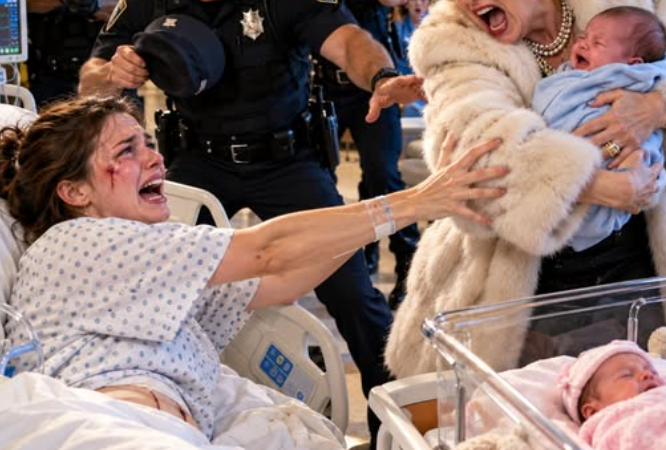
Margaret reached toward Leo’s bassinet.
I immediately pressed the call button.
“Don’t touch my son.”
She ignored me.
“I’ve already arranged everything.”
She lifted Leo from the bassinet.
He began crying.
I pushed myself upright despite the pain.
“Put him down.”
Margaret turned toward me.
“You’re being hysterical.”
Then she made the mistake that changed everything.
She raised her hand toward me.
I froze.
She didn’t strike me.
Instead, she pointed toward the hallway.
“Security will remove you if you keep causing trouble.”
I looked at the emergency button beside my bed.
Then at my son in her arms.
I pressed it.
The alarm sounded throughout the corridor.
And within seconds, footsteps came rushing toward my room.
Part 2 — The Chief Walked Through the Door
Four hospital security officers entered.
Margaret immediately changed her expression.
She began crying.
“Help me!”
The officers stopped.
Margaret pointed toward me.
“My daughter-in-law is unstable. She attacked me because I tried to protect the baby.”
I couldn’t believe what I was hearing.
One officer stepped toward me.
“Ma’am, please remain calm.”
Margaret smiled triumphantly.
Then the hospital security chief entered.
His name was Michael Carter.
He looked at Margaret.
Then at me.
His entire expression changed.
He stopped walking.
“Judge Vance?”
The room went silent.
Margaret’s smile disappeared.
“What did you call her?”
Chief Carter slowly removed his cap.
“Your Honor.”
The security officers immediately straightened.
I looked at Margaret.
She was staring at me as though she had suddenly discovered she didn’t know me at all.
“You’re… a judge?”
I nodded.
“Yes.”
Chief Carter looked toward Leo.
“Is that your newborn?”
“Yes.”
He immediately instructed the officers to secure the room and document everything.
Margaret began protesting.
“This is a family matter!”
Chief Carter shook his head.
“Not anymore.”
Margaret insisted that she had legal authority to take the baby.
She produced the document she had brought.
But the chief refused to let her leave.
Then hospital administration arrived.
So did the neonatal nurse.
And within minutes, the room became crowded with people asking Margaret exactly what authority she believed she possessed.
She had none.
The document wasn’t a court order.
It wasn’t signed by me.
It wasn’t signed by a judge.
And it certainly didn’t give her custody of my child.
Margaret became furious.
“You’re humiliating me!”
I looked at her calmly.
“You came into my recovery room and tried to take my newborn.”
She pointed at me.
“You have no idea what you’re doing to this family!”
I almost laughed.
“I know exactly what I’m doing.”
Then the door opened again.
My husband walked in.
He looked from Margaret to me.
Then to Leo.
“What happened?”
Margaret immediately rushed toward him.
“Your wife has completely lost control. She attacked me and called hospital security.”
My husband stared at her.
Then he looked at me.
He knew immediately that something was wrong.
“Mom,” he said quietly.
Margaret interrupted.
“I was only trying to help Karen.”
He looked horrified.
“You tried to take our son?”
Margaret’s face hardened.
“Karen deserves a baby.”
My husband stared at her.
“That’s enough.”
For the first time, Margaret looked frightened.
But she still didn’t understand what was coming.
Because I had already made another call.
To my judicial security liaison.
And within an hour, someone arrived at the hospital carrying a sealed file.
Part 3 — The Secret She Never Knew
The visitor was my chief security officer.
He handed me the file.
“Your Honor, we’ve documented the incident and preserved the hospital security footage.”
Margaret stared at him.
“Why does she have a security officer?”
My husband finally answered.
“Because she’s a judge.”
Margaret looked at him.
Then back at me.
“You never told me.”
“You never asked.”
She suddenly became defensive.
“I was only trying to help.”
I opened the file.
Inside were copies of Margaret’s messages to Karen.
Messages she had apparently believed were private.
One read:
“Once the twins arrive, I’ll handle the mother. She won’t be able to fight us after surgery.”
Another said:
“We’ll convince everyone she can’t manage two babies.”
Margaret’s face turned pale.
My husband read the messages.
Then another document appeared.
A recording from the hospital’s hallway camera showed Margaret entering the maternity wing with the adoption paperwork before ever speaking to me.
She hadn’t come to visit.
She had come with a plan.
The hospital administrator informed her that she was no longer permitted to remove either child from the maternity unit.
Then the police arrived to take statements.
Margaret began crying.
“Please don’t do this.”
I looked at her.
“You made your decision when you walked into this room.”
She lowered her voice.
“I am their grandmother.”
“And I’m their mother.”
She looked toward Leo and Luna.
For the first time, she seemed to understand that neither child belonged to her.
My husband stood beside my bed and took my hand.
“I should have stopped this sooner,” he whispered.
I squeezed his fingers.
“Yes.”
He looked down.
“I will.”
Margaret was escorted from the hospital.
Karen never came inside.
And the adoption papers were placed into the evidence file.
Several weeks later, I returned to my courtroom.
The case before me had nothing to do with my family.
I walked through the doors in my judicial robes, took my seat, and looked out at the courtroom.
For months, Margaret had believed I was powerless.
She thought my quietness meant weakness.
She thought my decision to keep my career private meant I had nothing.
She was wrong.
That evening, when I returned home, Leo and Luna were sleeping peacefully.
My husband stood beside their cribs.
“You know,” he whispered, “my mother thought you didn’t deserve a VIP hospital room.”
I smiled.
“I didn’t need a VIP room.”
I looked down at my twins.
“I only needed a locked door, a panic button, and people who understood the law.”
He laughed softly.
Then Luna opened her eyes.
I gently picked her up.
And for the first time since the twins were born, the house was completely quiet.
No arguments.
No threats.
No family demands.
Just two sleeping babies…
and the knowledge that nobody would ever decide their future for them again.