MY 12-YEAR-OLD DAUGHTER SOLD HER ONLY BICYCLE TO BUY GROCERIES FOR AN ELDERLY JANITOR AT HER SCHOOL. THE NEXT MORNING, TWO POLICE OFFICERS ARRIVED AT OUR HOUSE AND ASKED TO SPEAK TO HER. I THOUGHT SHE WAS IN TROUBLE—UNTIL ONE OFFICER HANDED ME AN OLD PHOTOGRAPH AND SAID, “MA’AM, YOUR DAUGHTER HAS NO IDEA WHAT SHE JUST STARTED.”
PART 1 — THE BICYCLE THAT DISAPPEARED
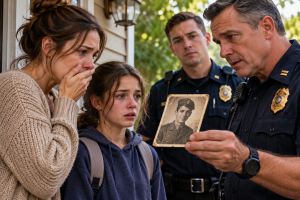
At 7:15 on a Wednesday morning, two police officers knocked on my front door.
“Are you Mrs. Parker?” the taller officer asked.
I nodded, tightening the robe around my shoulders.
“We need to speak with your daughter, Lily.”
My stomach dropped.
Lily was twelve years old. She had never been in trouble at school, never received a disciplinary warning, and had always been the kind of child who apologized when someone else accidentally bumped into her.
“What happened?” I asked. “Is she okay?”
The officer exchanged a glance with his partner.
“Ma’am, we’d prefer to speak with her directly. There’s something important we need to tell your family.”
I called Lily downstairs.
When she saw the uniforms, her face immediately changed.
“Mom, I didn’t do anything bad,” she whispered.
I reached for her hand.
“Then we’ll find out what’s happening together.”
But before the officers could explain, I remembered what had happened the previous afternoon.
Lily’s bicycle had disappeared.
It wasn’t an ordinary bicycle.
Her grandfather had given it to her on her tenth birthday, shortly before he passed away. He had spent weeks repairing it himself, replacing the brakes, polishing the handlebars, and painting her initials onto the frame.
Lily had loved that bicycle more than almost anything she owned.
Every weekend, she rode it around the neighborhood.
Sometimes she would spend an entire afternoon cleaning it, even when there wasn’t a speck of dirt on it.
So when I discovered the empty space in our garage, I immediately knew something was wrong.
“Lily, where’s your bicycle?”
She stood near the kitchen doorway, holding her backpack.
For several seconds, she said nothing.
Then she whispered, “I sold it.”
I stared at her.
“You did what?”
She lowered her eyes.
“I sold Grandpa’s bicycle, Mom.”
I felt a strange mixture of confusion and frustration.
“Why would you do something like that without asking us?”
Lily swallowed.
“It was for Mr. Henry.”
Mr. Henry was the elderly janitor at her school.
He had worked there for almost twenty years. He was a quiet man who always greeted students by name and stayed late to repair broken desks, clean classrooms, and make sure the children had everything they needed.
I had met him several times during school events.
He always wore the same faded blue jacket and carried an old lunchbox.
“What happened to him?” I asked.
Lily sat down.
“His apartment building had a water leak last week. Everything in his kitchen got ruined.”
She explained that Mr. Henry had been staying with a friend while trying to repair the damage.
But his situation was worse than she realized.
He had recently lost his wife, and his pension barely covered his rent and medication.
“He comes to school every morning even when he’s sick,” Lily said. “Sometimes he doesn’t eat lunch because he says he isn’t hungry.”
My heart tightened.
“How do you know that?”
“Because I saw him giving his sandwich to another student who forgot lunch.”
She paused.
“Yesterday, I asked him if he had eaten anything. He said he was fine, but I saw him looking at the food in the cafeteria.”
Lily’s eyes filled with tears.
“I asked if someone could help him, but he said he didn’t want anyone feeling sorry for him.”
“So you sold your bicycle?”
She nodded.
“I found someone who buys used bicycles. I got $280. I used most of it to buy groceries, cleaning supplies, and some things for his apartment.”
I looked at my daughter.
She had given away something that had belonged to her grandfather.
Something she could never replace.
“Sweetheart, you should have told me. We could have helped him together.”
“I know.”
She wiped her cheek.
“But Mom, he always helps everybody else. I thought someone should help him for once.”
I pulled her into my arms.
I was proud of her.
But I was also concerned that she had made such a big decision alone.
Then I asked her one question.
“Did Mr. Henry know you sold your bicycle?”
Lily shook her head.
“No. I left the groceries outside his apartment. I didn’t want him to know it was me.”
I hugged her again.
“Next time, we’ll do these things together.”
She nodded.
I thought that was the end of the story.
Until the next morning, when two police officers arrived at our front door.
The taller officer looked at Lily.
“Are you the young lady who left several bags of groceries outside an apartment on Maple Street?”
Lily went pale.
“Yes.”
The officer slowly smiled.
“Well, there’s someone who has been looking for you since yesterday.”
He reached into his folder and removed an old photograph.
It showed a young man standing beside a little girl on a bicycle.
The little girl looked remarkably like Lily.
I turned the photograph over.
On the back was a handwritten message:
For the little girl who gave away her bicycle. Your kindness has brought someone home.
I looked at the officer.
“Who wrote this?”
He took a deep breath.
“That’s what we’d like to explain. But first, there’s someone waiting outside who desperately wants to meet your daughter.”
PART 2 — THE MAN WHO HAD BEEN SEARCHING FOR YEARS
A few minutes later, an elderly man stepped out of a police vehicle.
He was wearing a dark brown coat and holding a small wooden box.
The moment Lily saw him, she covered her mouth.
It was Mr. Henry.
But he looked different.
His eyes were red, and he was holding the wooden box as if it contained something priceless.
“Mr. Henry?” Lily whispered.
He walked toward her.
“Young lady, I’ve been trying to find you all night.”
Lily looked frightened.
“Did I do something wrong?”
Mr. Henry shook his head.
“No, sweetheart. You did something wonderful.”
He explained that he had discovered the groceries outside his apartment after returning from a medical appointment.
At first, he assumed they were a delivery mistake.
Then he found a handwritten note.
It said:
You always take care of everyone at school. Please let someone take care of you this time. You deserve it.
There was no name.
But inside one of the grocery bags, he found a small piece of paper with a drawing of a bicycle.
He recognized it.
Lily had drawn the same bicycle on a thank-you card she had given him at school months earlier.
He contacted the school, but nobody knew what had happened.
Then he called the police because he was worried that the child might have sold something valuable without her family’s permission.
The officer smiled.
“Mr. Henry was concerned about you, Lily. He didn’t want you getting into trouble.”
I looked at the wooden box.
“What is inside?”
Mr. Henry slowly opened it.
Inside was a photograph album, several old letters, and a small silver medal.
He picked up the photograph of the little girl on the bicycle.
“That’s my daughter, Grace.”
I looked at the photograph again.
The little girl was wearing a yellow dress and sitting on a red bicycle.
“She passed away when she was eleven,” he continued. “Many years ago.”
His voice trembled.
“She was the kindest child I ever knew. She used to save her allowance to buy food for people who needed help.”
He looked at Lily.
“When I found your note, I remembered her.”
Then he showed us another photograph.
It was of a young man standing beside Grace.
“That’s my son, Daniel.”
Mr. Henry explained that Daniel had left home when he was nineteen after a terrible argument.
He and his father had disagreed about money, family responsibilities, and the future.
They exchanged angry words.
Daniel left.
And for nearly twenty years, they barely spoke.
Mr. Henry had spent years trying to find him.
But every address he had was outdated.
Every phone number had been disconnected.
Then, three days before Lily delivered the groceries, something extraordinary happened.
A man had visited the school office asking for Mr. Henry.
He introduced himself as Daniel.
He had returned to town after learning that his father was struggling financially.
But he hadn’t known how to approach him.
He was ashamed of the way he had left.
He had asked the school principal whether his father was still working there.
The principal told him Mr. Henry had recently been having a difficult time.
Daniel wanted to help, but he was afraid his father would refuse.
Then he heard about the groceries.
Someone had shown him the note Lily left.
And suddenly, he realized something.
His father was still the same man who had raised him.
A man who would rather go hungry than ask someone for help.
Daniel had finally found the courage to visit him.
But there was one problem.
Mr. Henry had left the school before Daniel arrived.
They had missed each other by minutes.
The police officers had been helping locate Daniel because he had asked them to assist in finding his father safely.
Mr. Henry looked at Lily.
“Your little act of kindness gave me something I thought I had lost forever.”
Lily’s eyes filled with tears.
“Did you find your son?”
Mr. Henry nodded.
“Yes, sweetheart.”
He looked toward the police vehicle.
A younger man stepped out.
He had dark hair, a tired face, and a small scar above his eyebrow.
Mr. Henry stood completely still.
“Daniel?”
The younger man walked toward him.
“Dad.”
For a moment, neither spoke.
Then they embraced.
I watched Lily wipe her eyes.
She had sold her bicycle to buy groceries for an old janitor.
And somehow, those groceries had helped a father and son find each other again.
But the story wasn’t over.
Because Daniel suddenly turned toward Lily.
He held out a small envelope.
“There’s something I need to give you.”
Inside was a photograph of Lily’s grandfather.
I recognized him immediately.
But what Daniel said next made my knees weak.
“Your grandfather saved my life when I was a teenager. And he told me that if I ever met a little girl with his eyes, I should give her something.”
PART 3 — THE GIFT HER GRANDFATHER LEFT BEHIND
I stared at Daniel.
“My father?”
He nodded.
He explained that twenty years earlier, when he was nineteen, he had been working at a small mechanic’s garage.
One evening, a serious accident left him injured and unable to pay his medical bills.
He had no savings.
His father was already struggling financially.
And Daniel had no idea where to turn.
A man named Robert Dawson had stepped forward.
My father.
He had paid for Daniel’s emergency treatment and helped him find a stable job.
But he had never told our family about it.
Daniel had been embarrassed and had promised to repay him.
My father refused.
Instead, he told Daniel something he never forgot.
“One day, when you’re in a position to help someone else, don’t wait for them to ask.”
Daniel had kept those words with him for twenty years.
Then he looked at Lily.
“Your grandfather gave me a second chance. When I saw what you did for my father, I knew exactly who you were.”
I began crying.
My father had died three years earlier.
He had never told me about Daniel.
I looked at the photograph again.
It showed my father standing beside a young Daniel outside the old garage.
On the back was another handwritten message.
If kindness ever comes back to this family, let it keep going.
Daniel handed me the envelope.
Inside was a letter written by my father.
He had apparently given it to Daniel before his death and asked him to deliver it to his granddaughter when the time was right.
I unfolded it carefully.
“My dear Lily,
If you are reading this, it means you have already learned something I spent my entire life trying to teach.
The most valuable things we own are not the things we can put in a box or lock away.
They are the things we give to others when nobody is watching.
I hope you never measure your worth by what you own.
And I hope you never believe that one small act of kindness is too small to matter.
Love, Grandpa.”
I pressed the letter against my chest.
Lily stood beside me.
“Mom, I didn’t know Grandpa knew him.”
I shook my head.
“Neither did I, sweetheart.”
Then Daniel revealed something else.
He had spent the past several years building a successful bicycle repair and manufacturing business.
He now owned three shops and had recently started a community program providing free transportation equipment to families who couldn’t afford it.
He wanted to help Mr. Henry.
But after hearing about Lily’s sacrifice, he had decided to do something bigger.
He offered to establish a school assistance fund in Grace’s memory.
The fund would help students whose families were struggling with essential expenses.
And Lily would be invited to help choose the first students who received support.
But Lily had one request.
“Can we help other people get bicycles, too?”
Daniel smiled.
“Absolutely.”
Within two months, the program had provided bicycles to twenty-seven children who needed transportation to school.
Mr. Henry returned to work part-time, but this time Daniel visited him every afternoon.
They began rebuilding their relationship one conversation at a time.
And on Lily’s next birthday, something arrived at our front door.
A large package.
Inside was a brand-new bicycle.
It was beautiful.
But underneath it was a smaller box.
I opened it.
Inside was Lily’s original guitar-shaped bicycle bell, which had been attached to her old bicycle.
Daniel had found it when the secondhand bicycle dealer told him about the little girl who had sold her beloved bike.
There was also a note.
To Lily: You gave away something you loved to help someone else. Now let us give something back to you. Never stop being the person you are.
Lily hugged the bell and began crying.
But the biggest surprise came several weeks later.
The school principal invited our family to a small ceremony.
A local newspaper had written about Lily’s story.
The school had received hundreds of messages from people offering to support the new assistance fund.
Some donated money.
Others offered bicycles, school supplies, and transportation equipment.
When the principal asked Lily to say a few words, she walked to the microphone.
She looked at the audience.
Then she said:
“I didn’t think selling my bicycle would do anything important. I just didn’t want Mr. Henry to feel alone.”
The room became silent.
She continued.
“I think people sometimes wait until they have a lot of money before they help someone. But I only had one bicycle. So I gave what I had.”
Everyone stood and applauded.
I watched my daughter standing there, holding her grandfather’s letter.
And I finally understood why the police officers had come to our house that morning.
They hadn’t come to arrest her.
They had come because a twelve-year-old girl had unknowingly brought an entire family back together.
As we drove home that evening, Lily looked out the window.
“Mom?”
“Yes, sweetheart?”
“Do you think Grandpa knew this would happen?”
I smiled through my tears.
“I think he knew exactly what kind of person you would become.”
Then she looked down at the old bicycle bell in her lap.
And whispered:
“I wish I could tell him.”
I reached over and held her hand.
“Maybe you just did.”