PART 1 — THE QUESTION THE DOCTOR ASKED
My name is Rebecca Lane.
Three months before my son was born, my husband, Andrew, ended our marriage.
He didn’t yell.
He didn’t cry.
He simply placed the divorce papers on the dining table and said:
“I think we’ve both known this was over.”
I stared at him.
Then I placed my hand over my stomach.
“You know I’m pregnant.”
He adjusted the cuff of his shirt.
“I know.”
“And you’re still doing this?”
“Yes.”
His mother, Margaret, was sitting behind him.
She gave a sympathetic smile that didn’t feel sympathetic at all.
“You need to be realistic, Rebecca.”
I looked at her.
“Realistic about what?”
“Andrew has responsibilities.”
I almost laughed.
“He has a child.”
Margaret shook her head.
“Don’t make this emotional.”
Within days, my access to our joint accounts was limited.
Then my health insurance was canceled.
Andrew moved out.
And somehow, within two weeks, a rumor began circulating among people we knew.
Apparently, I had become “difficult.”
Apparently, I had “trapped Andrew with a pregnancy.”
Apparently, I was trying to take his money.
None of it was true.
So I stopped defending myself.
I found work.
I edited contracts online.
I worked evenings at a small office.
I sold unused furniture.
I cut every unnecessary expense.
And while Andrew thought I was too distracted by pregnancy to notice anything else, I began reviewing our old financial records.
Something didn’t add up.
There were transfers from one of his private accounts into a company I had never heard of.
Then I found emails between Andrew and his mother.
They weren’t talking about the divorce.
They were discussing custody.
Once the baby is born, she won’t have the resources to fight us.
I saved the email.
Then another appeared.
Make sure she never sees the old family records.
Old family records?
I had no idea what that meant.
I kept collecting everything quietly.
Then labor began.
It was three weeks early.
I drove myself to the hospital before sunrise.
My sister was out of town.
My friends were working.
Andrew didn’t answer.
I called twice.
Then five times.
Then I stopped.
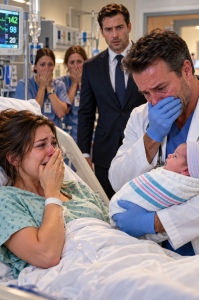
Twenty hours later, my son was born.
I named him Noah.
A nurse placed him in my arms.
I cried so hard I could barely see his face.
He was tiny.
Healthy.
Perfect.
I spent the next hour holding him while the hospital staff checked everything.
Then a pediatrician came in.
Dr. Elias Warren.
He smiled at first.
“Congratulations.”
“Thank you.”
He examined Noah.
Then he looked at his face.
His expression changed.
He checked again.
Then he looked at me.
“Rebecca…”
“Yes?”
“Who is the father?”
I hesitated.
“Andrew Lane.”
The doctor’s hands stopped moving.
He looked at Noah again.
Then at me.
“Are you certain?”
I frowned.
“Yes.”
He slowly stepped backward.
“This is impossible.”
My heart raced.
“What is?”
Before he could answer, the door opened.
Andrew walked in.
Perfect suit.
Perfect hair.
No flowers.
No apology.
Just a controlled expression.
“I came to see my son.”
Dr. Warren turned toward him.
The color disappeared from the doctor’s face.
Andrew stopped.
The doctor stared at him for several seconds.
Then whispered:
“You told me your son died.”
My blood went cold.
Andrew’s face changed instantly.
“Doctor…”
I looked from one man to the other.
“What does he mean?”
Neither answered.
I pulled Noah closer.
Andrew looked at the baby.
Then at me.
And for the first time since our divorce began, he looked genuinely afraid.
Dr. Warren reached for a folder.
An old paper folder.
Andrew’s name was written across it.
The doctor opened it.
Inside was a photograph.
A little boy.
A hospital bracelet.
And a date from fourteen years earlier.
Andrew stared at the page.
I looked at him.
“Who is that?”
The doctor answered before he could.
“His first son.”
And suddenly, the story I thought I knew about my husband was no longer the story at all.
PART 2 — THE SON HE NEVER TOLD ME ABOUT
Andrew sat down.
He looked at the old photograph as though it belonged to someone else.
I couldn’t stop staring.
“You had another child?”
He didn’t answer.
Dr. Warren did.
“Fourteen years ago, Andrew brought his wife and newborn son here.”
I looked at Andrew.
“Wife?”
He finally spoke.
“She was my first wife.”
I felt sick.
“You told me you’d never been married.”
“I was young.”
“You lied.”
“Yes.”
But that wasn’t the worst part.
Dr. Warren turned another page.
The old records showed the baby had been born with a rare heart condition.
Andrew’s first wife had wanted aggressive treatment.
Andrew had opposed it.
They fought.
Then, shortly afterward, Andrew signed paperwork declaring that the child had been transferred to another facility.
But Dr. Warren remembered something.
“The transfer never happened.”
I stared at him.
“What happened to the baby?”
The doctor looked at Andrew.
“He was taken out of the hospital.”
Andrew closed his eyes.
“My father handled it.”
“Where did he go?”
Andrew didn’t answer.
Dr. Warren said quietly:
“We believed the child died.”
I looked at the photograph.
Then at Noah.
My son had the exact same small crescent-shaped mark near his left ear as the baby in the photograph.
I pointed toward Noah.
“Is that why you thought this was impossible?”
Dr. Warren nodded.
“That mark is rare.”
Andrew stood abruptly.
“We need to stop this conversation.”
“No.”
I held Noah closer.
“You’re going to tell me everything.”
Andrew looked at me.
Then at Dr. Warren.
Finally, he sat again.
He told me the truth.
His father had wanted the first child hidden because the family was involved in a business merger and didn’t want the medical condition becoming public.
Andrew was twenty-three.
He was frightened.
And instead of fighting his father, he went along with the lie.
He was told the baby had died.
He never saw him again.
Years later, Andrew had convinced himself it was all in the past.
Then he met me.
He never told me about his first marriage.
Never told me about the child.
Never told me about the records.
But there was another secret.
One I hadn’t expected.
The baby hadn’t died.
A private caregiver had taken him to another hospital.
He had survived.
And the old records showed that someone had continued paying for his treatment.
Someone connected to Andrew.
I looked at Andrew.
“You knew?”
He shook his head.
“I didn’t.”
“Then who was paying?”
Dr. Warren showed me the account.
The payments came from an account controlled by Andrew’s father.
For years.
I felt dizzy.
“So your father knew the child was alive.”
“Yes.”
“And you didn’t?”
“I swear.”
I didn’t know whether to believe him.
But there was more.
The caregiver’s name appeared in the records.
Clara Mason.
Investigators found her living in another state.
She agreed to speak.
Clara told us she had been hired years ago to care for the baby.
She had been instructed never to contact Andrew.
“But eventually,” she said, “I couldn’t keep the secret anymore.”
She had discovered the child’s identity through medical records.
The boy had grown up under another surname.
His name was Ethan.
He was fourteen.
And he was alive.
I looked at Andrew.
“Where is he?”
Clara gave us an address.
Andrew didn’t say a word.
We went there with investigators.
A teenager opened the door.
He had Andrew’s eyes.
The resemblance was unmistakable.
Andrew froze.
Ethan stared at him.
Neither moved.
Then Ethan said quietly:
“Are you my father?”
Andrew couldn’t answer.
He started crying.
Ethan didn’t hug him.
He simply stepped back.
“I’ve waited fourteen years to ask that.”
Andrew lowered his head.
“I was told you were dead.”
Ethan looked confused.
“Who told you?”
Andrew looked at me.
“My father.”
I understood immediately.
The missing child wasn’t the only secret.
Someone had spent fourteen years controlling the story.
And when investigators reopened the old records, they found something even more disturbing.
Andrew’s father had deliberately falsified the transfer paperwork.
He wanted Ethan hidden because Ethan stood to inherit shares of the family company.
If Ethan had been legally recognized, his inheritance rights would have complicated the family’s plans.
I looked at Andrew.
“So that’s why they wanted custody of Noah.”
He nodded slowly.
“They wanted another child under their control.”
The old emails suddenly made sense.
My pregnancy hadn’t been an inconvenience.
It had been an opportunity.
They wanted control over my son before I knew what their family had done before.
And then I remembered the message:
Make sure she never sees the old family records.
Those records were the key.
They proved Ethan had survived.
And they proved someone had hidden him.
But there was one final document.
A legal agreement dated only six weeks before my divorce.
Andrew had signed it.
The agreement would transfer control of Noah’s future inheritance to Andrew’s family if I lost custody.
I stared at the signature.
Andrew whispered:
“I never understood what I was signing.”
I looked at him.
“That doesn’t make it disappear.”
He nodded.
Then Dr. Warren said:
“There is still one thing we don’t know.”
“What?”
“Who told the hospital that Ethan had died?”
Everyone went silent.
Because that person had signed the original death paperwork.
And investigators now believed the signature belonged to someone very close to Andrew.
PART 3 — THE TRUTH THAT FINALLY CAME HOME
The investigation lasted months.
The old medical records were examined.
The signatures were compared.
Bank transfers were traced.
The falsified paperwork was uncovered.
And eventually, the person who had reported Ethan’s death was identified.
Andrew’s father.
He had arranged for the child to disappear from the family records.
He had convinced Andrew that the baby had died.
And he had continued funding Ethan’s care from a hidden account because he wanted control over the boy’s identity and inheritance.
It had worked for fourteen years.
Until Noah was born.
The moment Dr. Warren recognized the family resemblance, the old secret began unraveling.
Andrew’s father was forced to explain everything.
The inheritance documents were reviewed.
Ethan’s legal identity was restored.
The hidden accounts were uncovered.
And the agreement meant to control Noah’s future was voided.
But none of that repaired the years Andrew had lost with Ethan.
That was something money couldn’t fix.
One afternoon, I visited Ethan.
He was sitting outside reading.
I sat beside him.
“How are you doing?”
He shrugged.
“I don’t know.”
I nodded.
“You don’t have to decide anything right away.”
He looked at me.
“Are you angry?”
“At whom?”
“Dad.”
I thought about it.
“Yes.”
He looked surprised.
“But you’re still letting him see me?”
“He’s your father.”
“Does that mean you forgive him?”
“No.”
He nodded.
“Okay.”
I looked at him.
“Forgiveness isn’t something I can give you on his behalf.”
He smiled faintly.
“I like you.”
I laughed.
“Thank you.”
Then he asked:
“Can I meet Noah?”
I brought my son the next weekend.
Ethan sat beside him.
Noah grabbed his finger.
Ethan laughed.
That was the first time I saw him look like a teenager instead of someone carrying fourteen years of questions.
Andrew came too.
He sat across the room.
He didn’t try to force anything.
He simply watched.
For the first time, he was doing the one thing he should have done years earlier.
Letting his son choose.
Our marriage ended.
Not because Andrew had a child before me.
Not because his father had lied.
Because Andrew had allowed secrets to become more important than trust.
I moved into a small home with Noah.
Andrew had visitation.
He had to rebuild his relationship with Ethan.
He had to confront what he had done.
And he had to learn that being a father isn’t about controlling a story.
It’s about showing up when the truth becomes uncomfortable.
Years later, I still remember the moment Dr. Warren opened that old folder.
A photograph.
A hospital bracelet.
A fourteen-year-old secret.
And suddenly, the baby in my arms wasn’t just my newborn son.
He was the person who had accidentally reopened a family history everyone had tried to bury.
Noah grew up knowing Ethan.
They became close.
Brothers in every way that mattered.
Andrew eventually apologized to both of them.
Not once.
Many times.
Because some mistakes can’t be repaired with one sentence.
They have to be repaired through years of actions.
As for me, I learned something too.
When Andrew first filed for divorce, I thought he had taken away my future.
He hadn’t.
He had simply forced me to build a future based on truth instead of promises.
I stopped measuring my life by whether people believed me.
I started measuring it by whether I believed myself.
And I never again ignored that feeling in my stomach when something didn’t make sense.
Because the day my husband walked into the hospital room and saw our newborn son, he didn’t recognize a stranger.
He recognized a family secret.
A secret that had survived fourteen years.
A secret that had been protected by money, paperwork, silence, and fear.
Until one baby made it impossible to hide.
Sometimes the truth doesn’t arrive with a confession.
Sometimes it arrives with a tiny face.
A familiar mark.
A frightened doctor.
And one question nobody wants to answer.
“Who is the father?”
That question changed everything for me.
It gave one teenager the family he had been denied.
It gave my son a brother.
And it finally forced a man to face the consequences of the secrets he had inherited.
The greatest surprise wasn’t that Andrew had a hidden past.
It was discovering that the newborn I thought was beginning my family’s story…
was the baby who finally ended someone else’s lie.
And from that day forward, I never looked at Noah’s little face the same way again.