# My Son-in-Law Told Me I Was a Guest Who Had Forgotten to Leave on Christmas Eve—So I Packed My Bags Before Dessert, and My Daughter Finally Had to Face What She Had Allowed to Happen
## PART 1 — The Night I Became a Stranger in My Daughter’s Home
Christmas Eve was supposed to be a happy occasion.
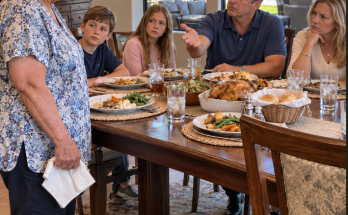
The dining table was the same one I had built with my own hands thirty years earlier. The ham sat in the center, its glaze shining beneath the warm dining-room lights. I had spent three days trying to get the recipe right, following the notes my late wife, Carol, had left behind in her old cookbook.
She used to make that ham every Christmas.
Since she died, I had tried to preserve the little traditions that made our family feel like a family. I thought my daughter would appreciate the effort. I thought my grandchildren would remember these evenings someday and smile.
The candles flickered. My nine-year-old grandson, Tyler, laughed at something his six-year-old sister, Brooke, whispered into his ear. For a few minutes, everything felt almost normal.
Then my son-in-law, Derek, put down his fork.
He cleared his throat and looked directly at me.
“Walter, we need you to find somewhere else to stay after the new year.”
The laughter stopped.
Derek folded his napkin and continued in the same calm voice someone might use to explain a change in insurance coverage.
“You’ve been here long enough. We need our space back. Our own routines. Our own family time.”
He paused, then delivered the sentence that would stay with me long after Christmas.
“You’re a guest who forgot to leave.”
I looked around the table.
Tyler stared at his plate. Brooke’s smile disappeared. My daughter, Melissa, studied the wine in her glass as though she might find something important at the bottom.
She was thirty-six years old, the same little girl I had once carried on my shoulders through crowded county fairs. The same girl I had driven up and down the East Coast to visit colleges. The same daughter I had helped financially when she moved to Atlanta for her first job.
And now she couldn’t look me in the eye.
I waited for her to say something.
She didn’t.
I turned back to Derek.
For thirty-one years, I had worked as a structural engineer for Caldwell County. My job required me to recognize weaknesses before they became disasters. I learned to pay attention to details, document important decisions, and never assume that silence meant agreement.
That evening, I recognized something I had been refusing to see for months.
This conversation hadn’t begun when Derek put down his fork.
It had begun long before Christmas.
I folded my napkin carefully and placed it beside my plate.
“Understood,” I said.
Derek blinked. He had clearly expected an argument, perhaps a lecture about respect or a reminder of everything I had done for this family.
Instead, I pushed back my chair.
I kissed Brooke gently on the top of her head and told Tyler I’d see him soon.
Then I walked upstairs.
I didn’t wait for dessert.
My name is Walter Briggs. I was sixty-four years old that Christmas, and I had spent most of my life believing that if you worked hard, treated people fairly, and showed up for the people you loved, you could count on them to do the same for you.
My wife, Carol, had understood that belief better than anyone.
We had been married for thirty-seven years when pancreatic cancer took her from me two and a half years earlier. The diagnosis came with almost no warning. By the time we understood how serious it was, our time together had already begun slipping away.
After the funeral, our house in Clover Hill became unbearably quiet.
Melissa called me every night for the first two weeks. Then the calls became less frequent. A few times a week turned into once a week, and eventually our conversations became brief exchanges about groceries, weather, and the children’s school activities.
I understood that she had her own life. She had a husband, two children, and a household to manage.
Still, I missed hearing her voice.
One evening, she suggested that I sell my house and move in with them in Fairfield.
“You shouldn’t be alone out there, Dad,” she told me. “Come stay with us while you figure out your next chapter. It’ll be good to have you close.”
I remembered the phrase while you figure out your next chapter, but I didn’t give it much thought.
I was grieving. Every room in Clover Hill reminded me of Carol. Her gardening gloves remained in the shed. Her favorite mug sat in the kitchen cupboard. The workshop where I had built bookshelves, chairs, and the dining table still smelled faintly of sawdust.
I convinced myself that moving would make life easier for everyone.
So I sold the house.
Thirty-two years of mortgage payments, weekends spent landscaping the yard, and evenings working in my workshop were reduced to boxes, paperwork, and a closing appointment.
I moved into Melissa and Derek’s guest room in March.
At first, things seemed fine. I helped with school pickups, fixed a loose cabinet door, and repaired a section of the backyard fence. I cooked dinner when Melissa worked late and watched the children when Derek had meetings.
I tried to be useful without being intrusive.
Whenever I noticed Derek growing impatient, I told myself that sharing a house was difficult for anyone. Whenever Melissa seemed distracted, I reminded myself that raising two children was exhausting.
I made excuses because I wanted the arrangement to work.
By Christmas, I had begun to feel like someone who was always taking up too much room.
Derek complained about the kitchen being occupied when I cooked. He mentioned that the children needed consistency. He spoke about how important it was for a young couple to maintain their independence.
None of those statements sounded unreasonable by themselves.
But together, they formed a message I hadn’t wanted to hear.
I simply hadn’t expected him to deliver it over Christmas dinner.
Upstairs, I opened my suitcase on the bed.
The guest room was neat and impersonal, except for one thing: Carol’s reading lamp on the nightstand. I had brought it from Clover Hill because its soft light helped me sleep.
I wrapped it carefully in a sweater and placed it between my folded shirts.
Outside, red and green Christmas lights blinked along the street. Somewhere nearby, a family was singing carols. The temperature had dropped to twenty-two degrees.
I was fastening the second suitcase when Melissa appeared in the doorway.
She leaned against the frame and crossed her arms.
For a moment, she looked so much like her mother that I had to look away.
“You don’t have to leave tonight, Dad,” she said quietly. “It’s Christmas Eve.”
I straightened and faced her.
“Did you know Derek was going to say that at dinner?”
She opened her mouth, then closed it.
She didn’t answer.
And I didn’t need her to.
## PART 2 — The Suitcases by the Front Door
I had spent thirty-six years raising Melissa to understand that actions mattered more than promises.
I had taught her to stand up for people who couldn’t defend themselves, to keep her word, and to tell the truth even when it was uncomfortable.
Yet, standing in that doorway, she couldn’t manage a single sentence in my defense.
I didn’t shout at her. I didn’t ask why she had allowed Derek to humiliate me in front of her children.
I simply closed the suitcase.
“I’m not going to argue with you on Christmas Eve,” I said.
“Dad, that’s not what I meant.”
“What did you mean, Melissa?”
She looked down at the carpet.
“I just don’t want you making a decision while you’re upset.”
I almost smiled, though there was nothing funny about the situation.
“Your husband told me I had to leave. I’m making arrangements to do exactly what he asked.”
“He didn’t mean it the way it sounded.”
I looked at her.
“Then how did he mean it?”
Again, silence.
For thirty-one years, I had worked around people who preferred vague language when a clear answer might make them uncomfortable. I knew how to read a carefully worded report. I knew how to distinguish an honest mistake from a problem someone was trying to avoid documenting.
My daughter was doing something similar now.
She wanted me to soften the moment for her. She wanted me to pretend Derek’s words were less cruel than they had been, because acknowledging their meaning would require her to admit that she had allowed them to be spoken.
I picked up my suitcase.
“Good night, Melissa.”
She stepped aside.
I carried both bags downstairs myself.
The living room television was on. Derek sat on the sofa, watching a holiday program as if nothing unusual had happened. He glanced at me when I passed.
“Walter,” he called, “we can talk about the logistics after Christmas.”
I stopped beside the front door.
“There’s nothing to discuss. You said you need the house to yourselves. I’ll respect that.”
He shifted in his seat.
“I wasn’t trying to make this personal.”
I looked at him for a moment.
“You told me I was a guest who had forgotten to leave. I can’t imagine how you could have made it more personal.”
He didn’t respond.
I opened the front door and placed my suitcases outside. Cold air rushed into the hallway.
Then I remembered the things I had left in the hall closet.
My toolbox.
My accordion folder of financial records.
I had kept that folder organized since my engineering days. Tax documents, bank statements, insurance papers, receipts, and other important records were arranged in labeled sections. I had always believed that a person should know exactly where his important documents were, especially when circumstances changed unexpectedly.
I returned to the closet and took out the folder.
Derek watched me from the living room.
“What’s all that?” he asked.
“My paperwork.”
He nodded and turned back to the television.
I carried the toolbox to the door, then returned to the kitchen one last time.
The Christmas ham remained on the table. The candles had burned lower, and the plates were still scattered around the place settings. One of Brooke’s napkins had fallen to the floor.
I picked it up and placed it beside her plate.
It was such a small thing to do, but I couldn’t bring myself to leave the room untidy. Some habits survive even when the heart has been hurt.
On the counter sat the old cookbook I had used to prepare the ham.
Carol had written her recipes in the margins, adding little notes whenever she discovered a better way to make something. Beside the ham recipe, she had written, Walter likes a little extra glaze.
I ran my fingers along the edge of the book.
For thirty-seven years, Carol had made our house feel like a place where everyone belonged. She had known how to welcome people without making them feel indebted. She had understood that family wasn’t about how much space someone occupied but about whether there was room for them in your heart.
I closed the cookbook and left it on the counter.
When I returned to the front door, Melissa was standing there again.
“Where are you going to go?” she asked.
“I’ll find somewhere.”
“It’s Christmas Eve.”
“You mentioned that already.”
Her face tightened.
“Dad, please don’t do this.”
I studied her expression. She looked frightened now, but I couldn’t tell whether she was afraid for me or afraid of what my departure would mean for her.
“I’m not doing anything to you, Melissa. I’m leaving because that’s what your husband asked me to do.”
She glanced toward the living room.
Derek had turned up the television.
For the first time that night, I felt sorry for my daughter. Not because I thought she was helpless, but because she seemed to have convinced herself that avoiding a difficult conversation was the same as keeping the peace.
It wasn’t.
Sometimes silence protects the person who is causing the harm.
Sometimes it simply leaves the person being hurt to deal with it alone.
I zipped my coat, lifted my suitcase, and stepped onto the porch.
The cold stung my face. Across the street, a family had gathered around a brightly lit Christmas tree visible through their front window. A little boy pressed his hands against the glass while an older man waved at him from inside.
I stood there for several seconds.
Then I carried my bags to the car.
I had sold the house in Clover Hill, so there was no familiar driveway waiting for me, no workshop I could retreat to, no bedroom where Carol’s absence would at least be familiar.
For the first time in decades, I didn’t know exactly where I would sleep.
But I knew one thing.
I would not beg to remain in a home where my presence had become an inconvenience.
I placed the suitcases in the trunk, set my toolbox beside them, and slid the accordion folder onto the passenger seat.
Before starting the engine, I sat quietly in the darkness.
My phone vibrated.
A message from Melissa appeared on the screen.
Please let me know when you get somewhere safe.
I read it twice.
There was concern in those words, perhaps even love. But there was no apology, no acknowledgment of what had happened at the table, and no indication that she intended to challenge the decision that had driven me outside on Christmas Eve.
I typed a brief reply.
I’ll be fine. Merry Christmas, Melissa.
Then I put the phone away.
I had spent months telling myself that moving in with my daughter was the beginning of a new chapter.
I was beginning to understand that it might have been the end of one instead.
What I didn’t yet know was how much of my future would depend on the paperwork sitting beside me.
For now, I turned the key, eased away from the curb, and drove into the cold December night.
## PART 3 — The Things I Had Learned Never to Leave Unwritten
I didn’t drive far that night.
There was a small hotel near the main road in Fairfield, the kind of place business travelers used when they needed a bed and a quiet room. I checked in shortly before midnight and carried my belongings upstairs.
The room smelled faintly of detergent. A heater rattled beneath the window, and a small artificial Christmas tree stood beside the reception desk downstairs.
I set Carol’s reading lamp on the bedside table.
Its familiar shape made the room feel a little less temporary.
I unpacked enough clothes for the next few days, then placed my toolbox and accordion folder beside the desk.
I couldn’t sleep.
Every time I closed my eyes, I saw the dining room again: the golden ham, the flickering candles, Tyler staring at his plate, Brooke falling silent, and Melissa looking away.
I kept returning to the same question.
How long had my daughter known that her husband wanted me gone?
Had she agreed with him weeks earlier? Had they discussed it while I was upstairs, believing I was part of their family? Had she simply decided that it was easier to let him speak than to risk a fight?
I had no answers.
By three in the morning, I stopped trying to invent them.
Instead, I opened my accordion folder and began reviewing the documents inside. It was a habit I had developed during my engineering career. When a situation became uncertain, I gathered the facts first.
I checked my bank statements, my tax records, my insurance policies, and the documents connected to the sale of my house.
Everything was where it should have been.
The folder reminded me of something important: I had not spent thirty-one years building a stable life only to become incapable of managing one because I was grieving.
I was sixty-four, not helpless.
I had experience, savings, professional contacts, and the ability to make careful decisions. I could find a place to live. I could rebuild a routine. I could decide what the next chapter of my life would look like without asking permission from anyone.
That realization didn’t erase the hurt.
But it gave me something solid to stand on.
The next morning, I made coffee in the hotel room and sat beside the window.
Fairfield was waking up. Cars moved through the intersection, and people hurried along the sidewalk with shopping bags and travel mugs. Somewhere, children were opening presents.
I wondered whether Tyler and Brooke had asked where I was.
I wondered what Melissa had told them.
Most of all, I wondered whether she understood that I had not left because I no longer loved her.
I had left because loving someone should not require you to pretend you haven’t been wounded.
My phone rang just after eight.
Melissa’s name appeared on the screen.
I let it ring once before answering.
“Dad?”
“Good morning.”
“Where are you?”
“I’m safe.”
“That’s not what I asked.”
“And I answered what you needed to know.”
She exhaled sharply.
“Derek says you left in the middle of dinner and made everything worse.”
I looked at the untouched coffee in front of me.
“I left after he told me I had overstayed my welcome.”
“He was trying to explain that we need some boundaries.”
“Then he could have spoken to me privately. He could have discussed a reasonable timeline. He could have treated me like a person instead of embarrassing me in front of your children.”
She didn’t respond.
I continued, keeping my voice level.
“Melissa, I’m not asking you to choose between your husband and your father. I’m asking you to recognize that what happened was wrong.”
“I know you were hurt.”
“That’s not the same as saying it was wrong.”
The line went quiet.
I could almost picture her standing in the kitchen, perhaps beside the counter where Carol’s cookbook still lay.
Finally, she said, “I don’t know what you expect me to do.”
It was the most honest thing she had said since Christmas Eve.
“I expect you to think about what you want your children to learn from this,” I told her. “They watched their grandfather being told he didn’t belong, and they watched their mother say nothing. You don’t have to agree with every decision I make, but you should understand what that silence teaches them.”
“Dad, please.”
“I love you, Melissa. That hasn’t changed. But I’m not coming back to that house simply to make everyone comfortable.”
I heard her begin to cry.
For a moment, I wanted to take back every word. I wanted to tell her that everything was fine, that I understood, that we could forget the whole thing and start again.
That would have been easier.
It also would have allowed us to repeat the same mistake.
So I let the silence remain.
Eventually, Melissa whispered, “I’m sorry.”
I closed my eyes.
It was the first apology I had heard from her since the dinner.
But an apology, I knew, was a beginning rather than a solution.
“Thank you,” I said. “We’ll talk again when we’re both ready.”
After we hung up, I returned to the desk and looked at the folder I had brought from the house.
For years, I had used documents to protect buildings, budgets, and projects from uncertainty. Now they reminded me that my own life deserved the same careful attention.
I began making a list.
First, I would find a place to live. Somewhere modest, comfortable, and close enough that I could see my grandchildren without having to negotiate my right to exist under someone else’s roof.
Second, I would review my finances and determine exactly what I could afford. I would not make another major decision out of loneliness or guilt.
Third, I would give Melissa time to decide what kind of relationship she wanted with me.
I wasn’t going to punish her. I wasn’t going to disappear from my grandchildren’s lives to prove a point.
But I would no longer confuse being needed with being loved.
That afternoon, I found a small furnished apartment available for a short-term rental. It had two bedrooms, a narrow balcony, and enough room for my toolbox. The owner agreed to let me move in the following day.
It wasn’t Clover Hill.
It wasn’t the house where Carol and I had raised our daughter, planted our garden, and built a life together.
But it was mine to enter without asking whether I had overstayed my welcome.
Over the following weeks, I settled into a routine. I bought groceries, unpacked my belongings, and found a corner of the apartment where I could work on small projects. I placed Carol’s reading lamp beside my bed and arranged my financial records in a desk drawer.
Melissa called occasionally.
Our conversations were awkward at first. She asked about the apartment and whether I needed anything. I asked about the children and listened as she told me about Tyler’s school and Brooke’s latest fascination with animals.
We did not pretend Christmas Eve had never happened.
Nor did we solve everything in a single conversation.
There were still difficult things to discuss, and I knew that rebuilding trust would require more than a few phone calls.
But I was no longer sitting in a guest room waiting for someone else to decide how much space I was allowed to occupy.
One Sunday afternoon, Melissa asked whether she could bring the children to visit.
I told her they were welcome.
When the doorbell rang, I opened the door to find Brooke standing in front with a handmade card clutched in both hands. Tyler stood beside her, trying to look grown-up.
Brooke rushed forward and wrapped her arms around my waist.
“Grandpa, I missed you.”
I held her close.
“I missed you too, sweetheart.”
Tyler looked past me into the apartment.
“Is this your new house?”
“For now,” I said. “It’s where Grandpa lives.”
He nodded, apparently satisfied with the explanation.
Melissa stood behind them, her eyes moving over the small living room. For a moment, neither of us knew what to say.
Then she looked at me.
“Dad, can we talk?”
I stepped aside to let them all in.
“Yes,” I said. “We can talk.”
It wasn’t forgiveness, not yet. It wasn’t a promise that everything would return to the way it had been before Christmas.
It was simply an open door.
And this time, I understood the difference between leaving that door open out of love and leaving it open because I was afraid of losing my family.
I had already lost my wife. I had sold the house where we had spent thirty-two years building a life. I had learned, painfully, that even the people you love most can make you feel like a stranger.
But I had not lost myself.
I was still Walter Briggs. I was still the man who documented what mattered, who built things carefully, and who believed that a strong structure depended on a sound foundation.
Family was no different.
Love could survive disappointment. Relationships could recover from painful mistakes. But neither could stand forever if only one person was expected to carry the weight.
That Christmas Eve, my son-in-law had told me I was a guest who had forgotten to leave.
I had taken him at his word.
And in doing so, I had finally begun to understand that I didn’t need to earn a place in my daughter’s life by making myself smaller.
I only needed to remember that I deserved a place where I was welcome.