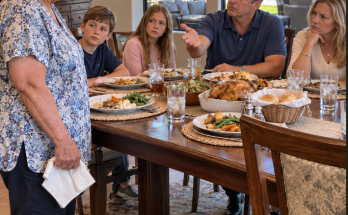
The moment my husband shoved me toward the boiling pot, his mother didn’t scream for help.
She smiled.
“Maybe now she’ll finally learn to listen,” Evelyn said, sitting calmly at the kitchen table.
I was on the floor, clutching the counter as pain tore through my arm and shoulder. My husband, Julian, stood over me, furious because I had refused to sign away the one thing my late father had left me: his beautiful old house.
“Sign the sale agreement, Elena!” he shouted. “That property is worth a fortune. You have no right to keep it from this family!”
I could barely speak.
“My father left it to me,” I whispered. “I’m not selling it.”
Julian’s face hardened.
“Then don’t blame me for what happens next.”
Those words would haunt me for months.
When the ambulance arrived, Julian told the paramedics I had slipped while cooking. His mother repeated the same story to the police. They stood beside my hospital bed, pretending to be concerned while quietly warning me not to make trouble.
“You know how people will see this,” Evelyn whispered when the nurse stepped away. “A wife accusing her husband of hurting her? You’ll destroy your own reputation.”
I turned my face toward the window.
I had spent four years trying to be the perfect wife. I had defended Julian when he lost jobs, covered his debts, and believed every promise he made.
Now I lay in a hospital bed, wondering whether the man I married had ever loved me at all.
For days, I said very little. The doctors treated my burns, and the nurses carefully documented my injuries. Julian visited twice, each time complaining that the hospital bills were becoming expensive.
Then, three weeks after the incident, he arrived carrying a brown envelope.
“Divorce papers,” he announced.
I stared at him.
He glanced at my healing injuries and shook his head with disgust.
“I didn’t marry a damaged woman, Elena. I married someone who could help me build a future.”
My heart broke—not because he wanted a divorce, but because he said it as though my suffering were an inconvenience.
“And the house?” I asked quietly.
“I’m selling it. You can either cooperate or spend years fighting me in court.”
He placed the papers on my bedside table.
I signed only to acknowledge that I had received them.
Then I looked him directly in the eyes.
“Do whatever you think you need to do, Julian.”
He smiled, believing he had finally broken me.
He had no idea my father had prepared for this possibility long before his death.
That evening, I called Sarah Vance, the attorney who had handled my father’s estate.
“Sarah,” I whispered, “I need you to protect the house. And I need you to find the recording equipment Dad installed.”
There was a long silence.
Then Sarah asked, “Elena, are you certain you want to pursue this? Once we begin, there may be no going back.”
I looked at the bandages covering my arms.
“Yes,” I answered. “I’m certain.”
Two days later, Sarah called me with news that made my hands tremble.
The visible kitchen camera had been damaged.
But my father had installed a second recording system in the garage, and its files had been backed up remotely.
The footage showed Julian entering the kitchen before the incident.
It showed his mother watching.
And it captured a conversation neither of them knew had been recorded.
Sarah played me the audio.
Julian’s voice came through first.
“If she refuses to sign, we’ll make the accident look like her fault.”
Then Evelyn replied with six words that changed everything.
“Make sure she can’t stop us.”
I closed my eyes as tears rolled down my cheeks.
My husband hadn’t simply lost control.
He and his mother had discussed how to force me out of my inheritance.
But the recording contained something else—something my father’s attorney had discovered while checking the property records.
A suspicious loan had been taken out against a business I had never heard of.
And Julian’s signature appeared on the application.
Sarah lowered her voice.
“Elena, I don’t think this was only about the house.”
“What do you mean?”
“Your husband may have been planning this for much longer than we realized.”
I looked at the papers beside my bed and felt the last of my fear turn into determination.
Julian believed I was too weak to fight him.
He had forgotten one important thing.
My father had taught me to keep the truth—even when everyone else wanted it buried.
And the truth was about to follow Julian into court.
PART 2 — The Secret Behind the House
Six weeks later, I walked into Sarah’s office wearing a long-sleeved dress that covered my healing scars.
I was still recovering, but I had stopped crying every night.
For the first time since the attack, I had a plan.
Sarah spread several documents across her desk. Beside them sat a laptop containing copies of the recovered recordings.
“Your father was more careful than either of them understood,” she explained.
Before his death, Dad had discovered that Julian was struggling financially. He had offered to help him once, but Julian refused to explain where the money had gone.
Dad then placed the house in a properly documented estate arrangement designed to prevent an unauthorized sale.
The property could not be transferred simply because Julian wanted it.
But that did not stop him from trying.
Sarah showed me a series of loan applications, forged authorization forms, and bank statements. Someone had used my personal information to guarantee debts I had never agreed to.
The total was staggering.
Julian had accumulated hundreds of thousands of dollars in obligations. He had apparently expected to sell my father’s house, settle some of those debts, and keep whatever remained.
When I refused, he had escalated his threats.
“Can we prove he forged my signature?” I asked.
“The bank is investigating. A handwriting examiner has identified significant inconsistencies, and we have requested the original documents.”
“And the recording?”
“It supports your account of the incident. The detective is reviewing it alongside the medical records and the witness statements.”
For the first time, I allowed myself to imagine a future in which Julian could no longer control my life.
Then Sarah handed me one final document.
It was an email recovered from an old account belonging to Evelyn.
The message had been sent months before the attack.
Its subject line read: The house sale—our final opportunity.
I read it twice.
Evelyn had written that Julian needed to secure the property before creditors discovered his financial situation. She had also suggested that I might be declared emotionally unstable if I resisted.
My stomach twisted.
They had not merely expected me to obey.
They had discussed how to discredit me if I refused.
That afternoon, Detective Harris called.
“We have enough to proceed with several parts of the investigation,” he said. “But I need to ask you something. Did your husband ever threaten your father directly?”
I thought about Dad’s final months. Julian had visited more often than usual, always asking about documents and property values.
“He once told Dad that the house would be worth more in the hands of someone who knew how to use it,” I said.
The detective paused.
“Do you remember when?”
I gave him the date as best I could.
“That helps,” he replied. “We found a message from that same week. Your husband was asking someone how quickly an elderly homeowner could be declared legally incapable of managing property.”
My hands went cold.
Dad had been sharp-minded until the end. But Julian had apparently been researching ways to challenge his authority before he died.
I left the detective’s office feeling sick—not because I doubted what Julian had done, but because I finally understood how far back his plans might reach.
That night, my phone rang.
Julian.
I almost ignored it, but Sarah had advised me to keep records of any contact.
I answered and placed the call on speaker.
“You’ve been talking to lawyers,” he said.
“I have.”
“You’re making a terrible mistake. We can settle this privately.”
“You mean I should give you the house?”
“I mean you should stop ruining my life.”
I took a breath.
“You tried to make me believe the attack was my fault. You tried to take my inheritance. You used my name to secure loans.”
“You can’t prove any of that!”
His voice cracked on the final word.
I looked at the recording light on my phone.
“I don’t need to argue with you, Julian. The investigators can examine the evidence.”
He went silent.
Then he said something that made my blood run cold.
“Your father should have stayed out of our business.”
The call ended.
I immediately sent the recording to Sarah and Detective Harris.
The next morning, Sarah called with an update.
“The court has scheduled a hearing on the property restrictions. Julian’s attorney has also requested that the recording be excluded.”
“Can they do that?”
“They can challenge it. The judge will decide what evidence is admissible.”
I looked at the scar visible above my wrist.
For months, Julian had controlled the story. He had told everyone I was careless, unstable, and ungrateful.
Now, for the first time, he was the one scrambling to explain himself.
But I still had one question.
Why had Evelyn been so certain that selling the house would solve everything?
Sarah’s answer came after she reviewed the latest bank records.
“Because the house wasn’t the only asset they were trying to reach.”
She turned the laptop toward me.
A second property had been listed as collateral on one of the suspicious loans.
My father’s old workshop.
The workshop where he had kept his business records—and where he had stored the original documents for the family estate.
Someone had recently tried to enter it.
The alarm company had recorded the attempted access.
And the person on the footage was not Julian.
It was Evelyn.
PART 3 — The Evidence They Never Expected to See
The morning of the hearing, I stood outside the courthouse with Sarah beside me.
My hands were shaking beneath my coat.
Not from fear of Julian.
From the knowledge that I was about to face the two people who had watched me suffer and then tried to convince the world that I was the problem.
Julian arrived with an expensive lawyer and a confident smile. Evelyn followed in a cream-colored suit, looking every inch the respectable mother she had pretended to be in front of the police.
When she saw me, she leaned close.
“You should have accepted the divorce and walked away,” she whispered. “Now you’re going to lose everything.”
I said nothing.
Inside the courtroom, Julian’s attorney argued that the property dispute was a private family matter and that the recordings were unreliable.
He described the incident as an unfortunate accident.
He called my financial allegations speculative.
He even suggested that my injuries had clouded my judgment.
For a moment, I felt the old fear returning.
Then Sarah stood.
“Your Honor, we are asking the court to consider the documented property transfers, the disputed loan applications, the medical records, and the evidence obtained by investigators.”
The judge reviewed the submitted materials.
A court-approved forensic specialist explained the discrepancies in the signatures. The bank’s representative confirmed that the loan applications were under investigation. Detective Harris described the steps taken to preserve the recording files and verify their origin.
Julian’s smile began to disappear.
Then the judge permitted a portion of the recording to be played, subject to the court’s evidentiary ruling.
The courtroom fell silent.
Julian’s voice came through the speakers.
“If she refuses to sign, we’ll make the accident look like her fault.”
Evelyn’s reply followed.
“Make sure she can’t stop us.”
My mother-in-law’s face drained of color.
“That’s taken out of context!” she protested.
The judge ordered her to remain quiet.
But the most devastating moment came next.
Detective Harris approached the witness stand carrying a sealed evidence bag. Inside was a small storage device recovered during the investigation.
He explained that investigators had obtained it lawfully and had arranged for a digital forensic examination.
The device contained copies of financial records and messages relating to the disputed loans.
One message, sent by Julian to Evelyn, read:
“Once the house is sold, the creditors won’t be able to trace where the money went.”
Another message showed Evelyn asking whether the workshop records had been removed.
Julian had not only tried to take my inheritance.
The evidence suggested that he had been working to conceal the movement of money while using my property and identity to secure further credit.
His attorney leaned toward him and whispered urgently.
Julian shook his head, but the confidence had vanished from his face.
Then the judge turned to him.
“Mr. Mercer, do you wish to respond to the evidence presented today?”
Julian stood.
For a moment, he looked at me as though he expected me to rescue him, as I had done so many times during our marriage.
“Elena,” he said, his voice suddenly soft, “we can still fix this. We’re family.”
I stared at the man who had once promised to protect me.
“No,” I replied. “You used that word whenever you wanted me to surrender.”
His expression hardened.
“You’ll regret this.”
I held his gaze.
“I already regret trusting you. I won’t regret telling the truth.”
The judge issued an order preventing the disputed property from being sold or transferred while the legal proceedings continued. The court also directed that the relevant financial records be preserved and referred the appropriate allegations to the authorities for further action.
It was not the end of the case.
But it was the end of Julian’s belief that he could simply take what he wanted.
Outside the courtroom, Evelyn tried to approach me.
“Your father would be ashamed of you,” she said.
I stopped walking.
“My father would be ashamed that you watched me get hurt and called it a lesson.”
For once, she had no answer.
I returned to my father’s house that evening. The rooms were quiet, and the kitchen still carried memories I was not ready to face.
I stood beside the old wooden table and touched the photograph Dad had left on the mantel.
“I kept the house,” I whispered. “And I told the truth.”
Months of recovery still lay ahead. The legal case would take time, and healing would not happen in a single dramatic moment.
But I was no longer hiding.
I had begun rebuilding my life, one careful decision at a time.
Julian had believed my scars made me weak.
He had mistaken pain for surrender.
The greatest victory was not watching him lose control. It was realizing that he no longer had control over me.
And when I finally unlocked the front door of my father’s house, I understood something he had tried to take from me:
A home is more than a property deed.
Sometimes, it is the place where you find the courage to begin again.
What would you have done in Elena’s place—would you have forgiven Julian, or would you have let the law take its course? Share your thoughts in the comments.