PART 1 — The Marriage I Never Expected
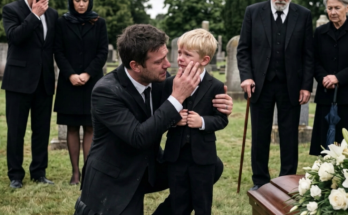
The day after my wealthy husband’s funeral, his lawyer arrived at my door with a sealed envelope.
I was thirty-nine years old, raising a six-year-old daughter, and still grieving the man who had given us a home when we had nowhere else to go.
I expected to hear about his will.
Instead, the lawyer looked at me with an expression I couldn’t understand and said, “Richard knew you would fall for it. He knew you’d agree to marry him.”
My heart began pounding.
“What are you talking about?”
He placed the envelope on the table.
“Unfortunately, the will leaves you nothing from his estate. But your husband left you something else. Something he made certain you would receive after his death.”
I stared at the envelope.
Then the lawyer added six words that made my blood run cold.
“You never really knew who he was.”
To understand why those words frightened me, you need to know how I became Richard’s wife.
My name is Laura, and I grew up in foster care.
I never knew what it felt like to have parents who would come running when I was frightened. I moved from one home to another, learning not to become too attached to anyone because I never knew when I would be sent away.
I was twenty-three when I finally met someone who made me believe I could build a family of my own.
His name was Daniel.
He worked as a mechanic, and I was a cashier at a grocery store. We didn’t have much money, but we had something I had never experienced growing up.
We had each other.
We rented a small apartment, cooked inexpensive meals, and dreamed about the future.
When our daughter, Emily, was born, Daniel cried while holding her.
“She’ll never have to wonder whether she’s wanted,” he whispered.
I believed him.
For a while, life was good.
Then Daniel was diagnosed with cancer.
We spent the next year fighting for his life. We tried the treatments the doctors recommended, borrowed money, and emptied our savings.
Nothing worked.
Daniel died when Emily was only one year old.
I was twenty-nine, widowed, buried in debt, and terrified of raising my daughter alone.
I worked whenever I could find work. I cleaned houses, stocked shelves, and took evening shifts, but the bills kept arriving faster than I could pay them.
Then Emily became seriously ill with a respiratory infection.
The medication and appointments consumed what little money I had left.
Around the same time, my landlord told me I had thirty days to leave because I was behind on rent.
I begged him to give me another month.
He refused.
One night, after Emily finally fell asleep, I sat on the kitchen floor and cried into my hands.
I had survived years of being unwanted as a child.
I couldn’t bear the thought of my daughter growing up with the same uncertainty.
That was when I found a job advertisement for a housekeeper at a large estate outside the city.
The owner was Richard Whitmore, a seventy-two-year-old widower who lived alone.
I applied immediately.
Richard was nothing like I expected.
He was wealthy, reserved, and particular about how he liked his home arranged. But he never spoke to me disrespectfully. He remembered my daughter’s name and always asked whether she was feeling better.
When he learned that I was struggling to find childcare, he allowed me to bring Emily to the estate on days when I couldn’t find someone to watch her.
Emily adored him.
She would sit at the kitchen table drawing pictures while I worked. Sometimes Richard would join her and ask her to explain every detail.
One afternoon, I found them playing chess in the library.
Emily was moving the pieces randomly, while Richard pretended to be deeply troubled by every move.
“You’re a very dangerous opponent,” he told her.
She giggled.
“You’re losing!”
“I know. I suspect you’re cheating.”
For the first time since Daniel died, I heard my daughter laugh without a trace of sadness.
And for the first time in months, I felt grateful to someone other than myself.
But kindness couldn’t pay my rent.
My wages covered only a portion of our expenses, and I was still drowning in debt.
Then Emily’s illness worsened again, and I faced another medical bill I couldn’t afford.
I didn’t know how I would keep us housed, fed, and safe.
One afternoon, Richard asked me to sit with him in the garden.
He seemed unusually nervous.
“Laura,” he began, “I know I’m much older than you. I know you may think this is ridiculous.”
I waited.
“But I’ve grown deeply attached to you and Emily. My house has been empty for a long time, and you’ve brought life back into it.”
He looked directly at me.
“I would like to ask you to marry me.”
I thought I had misunderstood.
“Marry you?”
He nodded.
“I know what people might say. I know you have every reason to question my intentions. But I’m being honest with you.”
I looked toward the house, where Emily was coloring at the kitchen table.
I was thirty-four years old.
Richard was seventy-two.
I didn’t love him the way I had loved Daniel.
But he was kind to my daughter, he treated me with respect, and he offered a future where we wouldn’t have to fear losing our home.
I thought about the eviction notice sitting in my handbag.
I thought about Emily’s medication.
And I made a decision that would change both our lives.
I said yes.
We married quietly a few weeks later.
People whispered that I had married for money. Some called me a gold digger. Others said Richard was too old to understand what he was doing.
I tried to ignore them.
Richard never demanded that I pretend to be someone I wasn’t. He gave me space, respected my grief for Daniel, and never pressured me to become a wife in ways I wasn’t ready for.
Over time, something unexpected happened.
I grew to love him.
Not with the desperate intensity of my first marriage, but with a gentler affection built through ordinary days.
I learned how he liked his coffee.
He learned which bedtime stories Emily wanted to hear repeatedly.
When he developed trouble walking, I helped him into his wheelchair and took him outside whenever the weather was pleasant.
When he became frightened by his declining health, I sat beside him and held his hand.
For five years, we became a family.
Emily began calling him Grandpa Richard, and he loved every second of it.
Then, one quiet morning, Richard died peacefully in his sleep.
I was devastated.
I had lost another person I loved.
But I was grateful for the five years we had shared.
I assumed that, as his wife, I would inherit at least part of his estate. Richard had no children, and I knew of no close relatives.
I wasn’t expecting a fortune.
I simply believed we would have enough to care for Emily and preserve the home Richard had given us.
Then his lawyer arrived.
He explained that the will left me nothing from Richard’s estate.
I stared at him in disbelief.
“But I was his wife.”
“I understand.”
“He asked me to marry him. We spent five years together. I cared for him until he died.”
The lawyer lowered his eyes.
“I know, Mrs. Whitmore.”
“Then why would he leave me nothing?”
He slid the envelope toward me.
“Because Richard wanted you to understand something before you learned the truth.”
My fingers trembled as I opened it.
The first line was written in Richard’s handwriting.
My dearest Laura,
If you’re reading this, then I’ve finally run out of time.
Before you decide whether to hate me, please read everything I’ve left for you.
I looked at the lawyer.
“What did my husband do?”
He took a deep breath.
“Mrs. Whitmore, the man you married was not quite the man you believed him to be.”
And as I continued reading Richard’s letter, I discovered that the most important thing about our marriage had been hidden from me from the very beginning.
PART 2 — The Truth Hidden Behind His Wealth
I read Richard’s letter slowly, stopping several times because my hands were shaking.
Laura,
You may remember that when I first asked you to marry me, I told you I had grown attached to you and Emily.
That was true.
But it was not the whole truth.
I looked up at the lawyer.
“Did Richard have another family?”
The lawyer shook his head.
“Please keep reading.”
I returned to the letter.
Many years ago, before I became wealthy, I made a mistake that changed someone’s life forever.
I was young, ambitious, and so determined to succeed that I convinced myself I could fix everything later.
I was wrong.
The letter continued with a story I had never heard.
Before Richard owned his estate, he had worked as a young apprentice in a small repair shop. His family had little money, and he spent years taking whatever jobs he could find.
During that time, he had become close to a woman named Margaret.
They were not married, but they had planned a future together.
Then Margaret became pregnant.
Richard was terrified.
He had just been offered an opportunity to join a business venture that could change his financial circumstances. He believed a child would prevent him from taking the opportunity.
Instead of standing beside Margaret, he left.
He told himself he would return once he had built a stable life.
But he never did.
He eventually became successful, bought businesses, and accumulated a fortune.
Years passed.
He tried to find Margaret, but she had moved away. The trail eventually went cold.
Richard never married again until he met me.
I stared at the page.
“Did he have a child?”
The lawyer nodded.
“That is what Richard spent much of his later life trying to establish.”
I continued reading.
For years, I told myself that Margaret had moved on and that my absence no longer mattered.
Then I learned that she had died.
I also learned that she had raised a daughter.
I have spent years trying to discover whether that daughter was mine.
My heart pounded.
I thought about the photographs in Richard’s study, the boxes of old documents I had seen in his office, and the times he had gone quiet whenever someone mentioned family.
I had assumed he was simply lonely.
Now I wondered whether he had been carrying a lifetime of regret.
The lawyer opened his briefcase.
“Richard commissioned an investigation several years ago. He wanted to learn what had happened to Margaret’s daughter.”
He placed a folder on the table.
Inside were copies of records, old photographs, and correspondence with a private investigator.
The documents showed that Margaret had indeed raised a daughter.
Her name was Susan.
She had grown up in another state, married, and eventually had a little girl of her own.
But the story didn’t end there.
Susan had struggled financially for years. After her marriage collapsed, she worked several jobs to support her daughter.
Then, when her daughter was still young, Susan died unexpectedly.
Her child entered foster care.
I stopped reading.
My mouth went dry.
“Where is the child now?”
The lawyer looked at me for a long moment.
“Laura, the child was you.”
I felt the room tilt.
“No.”
He nodded gently.
“Richard believed there was a strong possibility that you were his granddaughter. He commissioned a DNA test, and the results confirmed the relationship.”
I stared at him, unable to speak.
I had spent my entire childhood wondering why nobody wanted me.
I had moved from one foster home to another, never knowing who my grandparents were or why no relative had come looking for me.
And now I was being told that the wealthy man who had married me had been trying to discover whether I was his granddaughter.
“Did he know before he married me?”
The lawyer hesitated.
“Yes.”
I pushed my chair backward.
“No. He couldn’t have.”
“Richard discovered the connection shortly before he proposed. He was trying to find the right way to tell you.”
I covered my mouth.
My husband had known.
The man who had asked me to marry him had known that I might be the granddaughter he had abandoned before she was even born.
I felt sick.
“Why didn’t he tell me?”
The lawyer handed me another page.
It was a note Richard had written in his own hand.
When I first learned who Laura might be, I was ashamed.
I had spent decades building a fortune while the child of the daughter I never knew existed grew up without a family.
I wanted to tell her the truth immediately.
But I was afraid she would see me only as the man who had abandoned her family before she was born.
Then I met Emily.
I watched Laura struggle to give her daughter the security she had never known herself.
And I realized that if I approached her as a wealthy stranger offering money, she might never trust me.
I wanted to know her as a person before I asked her to understand what I had done.
Tears blurred the page.
I thought about every moment I had spent with Richard.
The chess games with Emily.
The afternoons in the garden.
The nights I had helped him when he was ill.
Had he been trying to make up for the past?
Had he married me because he wanted a family?
Or had he genuinely fallen in love with the woman I had become?
The lawyer seemed to read the questions on my face.
“Richard understood that you might never forgive him. He also understood that the way he approached you was complicated and potentially hurtful.”
I looked at him.
“Then why did he leave me nothing?”
The lawyer took another document from his briefcase.
“Because he wanted to make sure that what he left you could never be mistaken for payment for your marriage.”
I stared at him.
“What does that mean?”
He opened the final section of the folder.
Richard’s will had established a trust for Emily’s education and future needs. It also contained a separate provision for me, but the provision was not a direct inheritance from his estate.
Instead, Richard had arranged for the trust to provide housing and financial support under specific conditions, with independent trustees responsible for managing the funds.
The arrangement was designed to protect Emily’s future and prevent anyone from claiming that I had married Richard simply to obtain his fortune.
But there was something else.
The lawyer handed me a final envelope.
“This is the letter Richard asked me to give you after you understood the family connection.”
My hands shook as I opened it.
Laura,
I did not marry you because I wanted to buy your affection.
I married you because I had grown to love you and Emily.
But I also knew that I had been given an opportunity I never deserved: the chance to become part of the family I had failed before I even knew it existed.
I cannot undo what happened to your mother.
I cannot give you back the childhood you should have had.
And I cannot ask you to forgive me simply because I am sorry.
But I can make certain that Emily never grows up believing she has nobody.
I lowered the letter.
For the first time since Richard’s death, I understood why his lawyer had looked at me with such sadness.
Richard had left behind more than money.
He had left me the truth about the family I had never known.
But I still had one question.
If Richard had known I was his granddaughter, why had he let me believe he was simply a wealthy widower who had fallen in love with his housekeeper?
The lawyer closed the folder.
“Because Richard was afraid that if he told you the truth, you would never allow him to become part of your life.”
I looked down at the letters.
Then I saw something written on the back of the final page.
It was an address.
And beneath it, Richard had written:
If Laura wants to understand everything, she must meet the woman who helped me find her.
PART 3 — The Family I Never Knew I Had
The address led to a small office across town.
I expected another lawyer.
Instead, I found an elderly woman named Helen, who had worked with Richard for years.
She was the person who had helped him trace Margaret’s daughter and eventually locate me.
When I entered the room, she stood and offered me a chair.
“Richard told me you might come,” she said.
I sat down.
“Did you know he was my grandfather?”
“Yes.”
“Why didn’t anyone tell me?”
Helen sighed.
“Because Richard was afraid of losing you before he had the chance to know you.”
I shook my head.
“He could have told me the truth.”
“Yes,” she replied. “He could have. And I believe he regretted not doing so every day.”
She explained that Richard had initially intended to reveal the family connection before proposing marriage.
But he had watched how frightened I was about losing my home and how desperately I was trying to care for Emily.
He feared that if he revealed the truth, I would believe his offer of marriage was nothing more than a financial arrangement.
He wanted me to have the freedom to decide whether I wanted him in my life.
But by keeping the truth from me, he had taken away part of that freedom anyway.
I couldn’t deny it.
I was angry that he had hidden something so important.
But I also remembered the man who had sat beside my daughter when she was sick, who had stayed awake with me during her fevers, and who had treated us with patience when we had little to offer him.
I asked Helen about my mother.
She opened a box containing photographs and documents Richard had collected over the years.
Inside was a photograph of a young woman standing beside a little girl.
I recognized the woman from the old family records.
It was my mother, Susan.
And the little girl beside her was me.
I touched the photograph with trembling fingers.
“I don’t remember this.”
“You were very young,” Helen said softly.
I stared at my mother’s face.
For most of my life, I had known almost nothing about her. I had grown up believing that the people who had brought me into the world were just names on documents.
Now I could see her smile.
I could see the way she held me close.
And I could finally imagine that I had once been loved by someone who wanted me.
Helen gave me a letter my mother had written years earlier.
It was addressed to Richard, but it had never been sent.
Richard,
I don’t know whether you will ever read this.
I have thought about contacting you many times, but I don’t know whether you would want to hear from me.
I have a daughter now.
Her name is Laura.
She has your eyes.
I sometimes wonder whether you would love her if you met her.
I hope that one day she will have a family that never makes her question whether she belongs.
I couldn’t stop crying.
My mother had tried to reach him.
She had wanted him to know I existed.
And he had never received the letter.
Helen explained that Richard had discovered it only years later, when he began searching through old records.
By then, my mother was gone.
Richard had spent the remainder of his life trying to find me.
But when he finally did, he had made another mistake by keeping the truth hidden.
I looked at the photograph again.
“Did he love me?”
Helen’s eyes filled with tears.
“Yes, Laura. He did. But he was a flawed man who waited too long to do the right thing.”
I sat quietly for a long time.
Then I asked about Emily’s trust.
Helen explained that the arrangements were designed to provide for my daughter’s education, housing stability, and future needs. Independent trustees would manage the funds, and the provisions would be administered according to the legal documents.
I would not suddenly become a billionaire.
But Emily would have opportunities I had never imagined possible.
She could attend college without carrying the same financial fear that had shaped my life.
She could grow up knowing that her future was protected.
And I would no longer have to worry that one unexpected bill could leave us homeless.
For the first time since Daniel died, I felt that the ground beneath my feet might finally be steady.
Before I left, Helen handed me one final letter.
Richard had written it shortly before his death.
My dearest Laura,
I know you may be angry with me.
You have every right to be.
I asked you to marry me before I told you the most important truth about my life. I cannot defend that decision.
I wanted to be part of your life, but I was afraid you would reject me if you knew who I was.
I spent my youth running away from responsibility. I spent my later years trying to convince myself that success could make up for the people I had failed.
It cannot.
When I met you, I saw a woman who had endured more hardship than most people could imagine and still found the strength to make her daughter feel safe.
I admired you.
I loved you.
And I wanted Emily to grow up knowing that she had someone who would never willingly abandon her.
I hope you will remember the good years we shared, even if you cannot forgive the way I began them.
You were never a debt I was trying to repay.
You were never a mistake.
You were my family.
And I am sorry I waited so long to tell you.
I pressed the letter against my chest and cried.
I was angry with Richard.
I was grateful to him.
And I was heartbroken that he had died before we could have the conversation we should have had while he was alive.
When I returned home, Emily ran to the door.
“Mommy! Where were you?”
I knelt and hugged her.
“I was learning something about our family, sweetheart.”
She looked at me curiously.
“Do we have more family?”
I smiled through my tears.
“Yes. We do.”
Over the following months, I began learning about my mother, my grandmother, and the relatives I had never known.
I kept Richard’s photographs in a special box and showed Emily the pictures when she was old enough to understand them.
I told her about the chess games, the garden walks, and the old man who had pretended to lose because he loved hearing her laugh.
I also told her the truth.
Richard had made mistakes.
He had hidden something important from me.
But he had tried, in the final years of his life, to take responsibility for a family he had once abandoned.
I never pretended his money made everything right.
It didn’t.
No amount of money could give me back my childhood or bring my mother home.
But it could give Emily something I had never possessed.
Security.
Choice.
And the knowledge that she did not have to face every hardship alone.
Years later, I still think about the day Richard’s lawyer arrived at my door.
I remember the shock of hearing that I had been left nothing from the estate.
I remember wondering whether the five years we had shared had meant anything at all.
Now I understand that the truth was more complicated than I could have imagined.
Richard had not simply been a wealthy widower who rescued a struggling housekeeper.
He had been a man trying to confront the consequences of a mistake he had made long before I was born.
He loved me, but he was afraid.
And that fear led him to keep a secret that should never have been his alone to carry.
I cannot change how our story began.
But I can decide how it continues.
I can raise Emily to know that she is loved, that her history matters, and that she never needs to earn the right to belong.
And I can remember Richard honestly—not as a perfect man, and not as a villain, but as someone who finally tried to make peace with the past.
Because sometimes, the greatest inheritance isn’t a fortune. It’s discovering where you came from, understanding the truth about the people who shaped your life, and making sure the next generation never has to grow up wondering whether they are wanted.