PART 1 — THE PHOTOGRAPH THAT CHANGED EVERYTHING
My seven-year-old daughter was accused of bringing something inappropriate to school.
But when the principal examined the photograph her teacher had confiscated, his face suddenly went pale.
He ordered every child to remain seated.
Then he locked the classroom door.
“Mrs. Parker,” he said quietly, “do you have any idea who this man is?”
Her confident expression disappeared.
I stood beside my daughter, Sophie, holding an old newspaper clipping that I had kept hidden in my bedroom closet for years.
I had no idea that a photograph from her biological parents’ past would turn an ordinary school afternoon into the beginning of a mystery that would change our family forever.
My name is Daniel Miller, and my wife, Rebecca, and I adopted Sophie when she was eleven months old.
She was the brightest little girl I had ever known.
She loved drawing butterflies, collecting colorful stones, and asking questions that sometimes left adults struggling to find the right answers.
But there was one subject we had always handled carefully.
Her biological parents.
Sophie knew she had been born into another family. We had explained that her biological mother and father died in a car accident when she was a baby.
We never wanted her to feel that her past was something shameful.
“You have two families who love you,” Rebecca often told her. “One gave you life, and one gets to watch you grow.”
Sophie always smiled when she heard that.
Still, as she got older, her questions became more specific.
“What did my first mommy look like?”
“Did my first daddy like cartoons?”
“Do you think they would have liked me?”
Every question broke my heart a little.
We answered honestly whenever we could, but the adoption records contained very little information about her biological family.
All we had were a few official documents, a handful of old photographs, and a newspaper clipping about the accident.
I kept everything in a small box on the top shelf of my closet.
I had always intended to show Sophie those memories when she was old enough to understand them.
Then, last Monday, her second-grade teacher assigned a family project.
“Bring a photograph of your family,” Mrs. Parker had told the class. “You can include parents, grandparents, siblings, or anyone who is important to you.”
That evening, Sophie sat on the living-room carpet while Rebecca and I brought out our family albums.
She examined pictures of birthdays, holidays, beach trips, and Christmas mornings.
Then she looked at me.
“Daddy, can I show my class my first family too?”
I hesitated for a moment.
“Of course, sweetheart.”
Her face lit up.
She ran upstairs and returned with the old box.
Before I could stop her, she carefully removed the newspaper clipping and held it against her chest.
“This is them,” she whispered.
The article described the accident that had taken the lives of her biological parents.
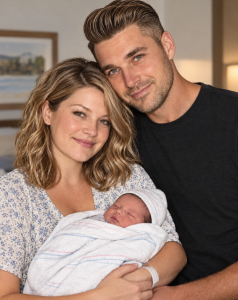
Beside the headline was a photograph of a young woman holding a newborn baby while a man stood beside her.
They were smiling.
They looked happy.
Sophie touched the picture with one small finger.
“Do you think they were happy when I was born?”
Rebecca knelt beside her.
“I believe they loved you very much.”
Sophie hugged the clipping.
“I want my class to know I had a first family, too.”
I wanted to protect her from any questions that might hurt her feelings, but I couldn’t find a reason to tell her no.
So I placed the clipping inside a protective sleeve and put it in her schoolbag.
The following afternoon, the school called me.
The secretary’s voice was unusually serious.
“Mr. Miller, could you come to the school immediately? There’s been a situation involving Sophie.”
My heart dropped.
“Is she hurt?”
“No, sir. But her teacher would like to speak with you.”
I left work and drove straight there.
When I entered the classroom, every student was sitting quietly at their desk.
Sophie sat near the front, her eyes red from crying.
Mrs. Parker stood beside the teacher’s desk, holding the newspaper clipping between two fingers.
“Your daughter brought something completely inappropriate for a second-grade project,” she announced.
I stared at her.
“What are you talking about?”
She held up the photograph.
“This is a newspaper report about a fatal accident. I don’t understand why a child would bring something like this to school.”
I looked at Sophie.
She was staring at her shoes.
“I only wanted to show them my first mommy and daddy,” she whispered.
My anger vanished instantly.
I knelt beside her.
“You didn’t do anything wrong, sweetheart.”
Mrs. Parker folded her arms.
“Children should bring happy family photographs. This kind of material can upset the other students.”
Before I could respond, the classroom door opened.
Principal Harris walked inside.
“What seems to be the problem?”
Mrs. Parker immediately handed him the clipping.
“I’m afraid Sophie has brought a disturbing newspaper article to class.”
He glanced at the headline.
Then he looked at the photograph.
At first, his expression remained neutral.
But as he studied the image more closely, something changed.
He turned the clipping sideways.
Then he examined the bottom corner.
His face lost its color.
“Where did this come from?” he asked.
“My house,” I answered. “It’s a newspaper clipping about the accident that killed Sophie’s biological parents.”
He didn’t respond.
Instead, he took out his phone and photographed a tiny section near the bottom of the page.
It was a portion of another photograph that had been cut off when the article was originally clipped.
Only half of a man’s face remained visible.
Principal Harris stared at it for several seconds.
Then he looked at Sophie.
“Sweetheart, do you know who this man is?”
Sophie shook her head.
“No. I’ve never seen him before.”
The principal turned toward Mrs. Parker.
“Please ask the other staff members to remain nearby.”
Then he walked to the classroom door and locked it.
Every child looked up.
Mrs. Parker frowned.
“Mr. Harris, what are you doing?”
He didn’t answer immediately.
He returned to the photograph and studied the man’s partially visible face.
Finally, he whispered something that made my stomach tighten.
“I haven’t seen this face in twenty years.”
I stared at him.
“What do you mean?”
He looked directly at me.
“Mr. Miller, I need to ask you something about your daughter’s adoption.”
My mouth went dry.
“What does that have to do with this photograph?”
He glanced at Sophie, then lowered his voice.
“Because the man in this picture may be connected to a case that was never properly resolved.”
Before I could ask another question, he reached for his phone again.
And when he made the call, he used a name that I had never expected to hear.
A name that would soon connect Sophie’s past to a secret someone had spent years trying to keep buried.
PART 2 — THE PRINCIPAL RECOGNIZED THE MAN IN THE PICTURE
“Please tell me exactly where you obtained this photograph,” Principal Harris said.
I explained that it had been included in the newspaper clipping given to us with Sophie’s adoption records.
He listened without interrupting.
Then he asked whether we had the original newspaper.
“No. We only have this clipping.”
He nodded slowly.
“I understand.”
Mrs. Parker looked increasingly uncomfortable.
“I’m sorry, but I still don’t see why this requires such a reaction.”
Principal Harris turned toward her.
“Because you assumed this was simply an inappropriate photograph without knowing its history.”
She fell silent.
He then asked the school secretary to escort the other students to the library with another teacher.
Sophie reached for my hand as the classroom emptied.
“Daddy, am I in trouble?”
I squeezed her fingers.
“No, sweetheart. You were trying to share something important about yourself.”
She leaned against me.
I wanted to take her home immediately, but I could see that Principal Harris was struggling with something much bigger than a classroom misunderstanding.
Once the other children had left, he sat down across from us.
“My name is Robert Harris,” he began. “Before I became a principal, I worked in the county’s public records office. For several years, I helped organize archived documents involving unidentified individuals and unresolved cases.”
He picked up the clipping again.
“Twenty years ago, I encountered a photograph of a man who was connected to an investigation involving a missing child.”
My heart began pounding.
“What child?”
He looked at Sophie.
“I don’t know whether the cases are connected. That’s why I need to verify the records before saying anything more.”
He turned the clipping toward me and pointed to the partial photograph.
“This man was never conclusively identified in the file I remember.”
“Could he be Sophie’s biological father?”
Principal Harris shook his head.
“I cannot determine that from this image. We need to establish the identities of the people involved and compare the original records.”
I understood his caution, but the uncertainty was unbearable.
“Then why did you lock the door?”
He looked embarrassed.
“I was concerned the photograph might be connected to confidential records. I wanted to prevent it from being photographed or circulated before we understood what it was.”
I glanced at the clipping.
The tiny image seemed insignificant, yet the principal had recognized something about it immediately.
“What happens now?”
“I’ve contacted the appropriate authorities to ask whether the historical case can be reviewed. I’ll also help you identify the agency that originally handled Sophie’s adoption records.”
Sophie tugged at my sleeve.
“Daddy?”
“Yes, sweetheart?”
“Does this mean my first daddy did something bad?”
My heart broke.
I pulled her close.
“No, Sophie. We don’t know that. A photograph can’t tell us everything about a person.”
She nodded, but I could see the worry in her eyes.
I promised her we would find answers together.
That evening, Rebecca and I sat at the kitchen table after Sophie had gone to bed.
I told her everything.
She listened silently, her hands clasped around a cup of tea.
“Daniel, what if there really is something in her past that nobody told us?”
“Then we’ll find out what it is.”
“And what if it’s painful?”
I reached across the table.
“Then we’ll face it as a family.”
The following morning, Principal Harris called.
The authorities had located an archived case file that might be relevant.
They wanted to examine the original newspaper article and compare it with the historical records.
We delivered the clipping to the appropriate investigator and provided copies of Sophie’s adoption documents.
A few days later, the investigator contacted us again.
The partial photograph had been reproduced in another newspaper article published several years earlier.
That article concerned a man who had provided information during an investigation involving missing records and a disputed identity.
His name was Michael Bennett.
The name meant nothing to me.
But when I searched through our adoption paperwork, I discovered a reference to an old social-services office that had handled part of Sophie’s case.
The investigator explained that the office had since closed, and its records had been transferred to a regional archive.
Some documents were incomplete.
Others required authorization before they could be released.
It took several weeks to establish a timeline.
During that time, Sophie continued asking questions.
I told her what we knew without making promises we couldn’t keep.
One evening, she brought me a drawing.
It showed two adults holding a tiny baby, with Rebecca and me standing beside them.
Across the top, she had written:
MY FAMILY, ALL TOGETHER.
I felt tears sting my eyes.
“You know something, sweetheart? That’s a beautiful picture.”
She smiled.
“I don’t want to forget my first mommy and daddy. But I don’t want to lose you and Mommy either.”
I hugged her tightly.
“You won’t.”
Then, on a Thursday afternoon, the investigator called with an update.
The archive had located an original document bearing the same case reference as the newspaper clipping.
It contained a name that had been omitted from the published report.
And according to the investigator, that name might explain why the partial photograph had been so familiar to Principal Harris.
“Mr. Miller,” he said, “we’d like you and your wife to attend a meeting. There’s something in the file you need to see.”
I looked at Rebecca.
She immediately understood.
“When?”
“Tomorrow morning.”
The following day, we sat in a small conference room while the investigator opened a folder.
He placed three documents on the table.
The first was the original newspaper article.
The second was an old report concerning the accident.
The third was a handwritten statement signed by someone whose name made Rebecca gasp.
It was signed by a woman who had worked at the adoption agency when Sophie was a baby.
The statement mentioned a photograph taken shortly before the accident.
And beside the photograph’s description was a note that had been added years later.
POSSIBLE CONNECTION TO THE BENNETT FILE. VERIFY BEFORE CLOSING CASE.
The investigator looked at us.
“This note was never followed up in the surviving records.”
I stared at the page.
“Does that mean Sophie’s biological parents were involved in the missing-child investigation?”
“Not necessarily. It means someone thought the information deserved further review.”
He turned to the final page.
There was a handwritten message in the margin.
Only one sentence.
If the child is ever identified, contact Michael Bennett before releasing the remaining records.
Rebecca gripped my arm.
“Who is Michael Bennett?”
The investigator closed the folder.
“That’s what we’re trying to determine.”
Then he looked at me.
“Because according to the records we found, Mr. Bennett may have known Sophie’s biological parents personally.”
I felt the room tilt around me.
For seven years, we’d believed the story of Sophie’s early life was tragically simple.
Now it seemed there were pieces of the story that no one had ever put together.
And the next person we spoke to might finally explain why.
PART 3 — THE TRUTH SOPHIE DESERVED TO KNOW
The investigator called us three days later.
They had located Michael Bennett.
He was alive, living in another state, and had agreed to speak with the authorities about the old case.
But he had made one request.
He wanted to see the newspaper clipping before discussing anything about Sophie.
We sent a copy through the investigator.
The following afternoon, the investigator called again.
“Mr. Bennett recognized the photograph,” he said. “He says he knew Sophie’s biological parents.”
Rebecca covered her mouth.
I struggled to speak.
“What did he tell you?”
“He says he can explain why his photograph appeared beside the article. But he wants to meet with you and the relevant authorities present.”
We agreed.
A week later, Rebecca and I sat across from a gray-haired man in a quiet conference room.
Michael Bennett looked older than the partial photograph, but his eyes were unmistakable.
He placed a worn photograph on the table.
It showed three young adults standing outside a small house.
One was Sophie’s biological mother.
Another was her biological father.
The third was Michael.
“I was their friend,” he began. “We knew one another for years.”
He explained that he had worked with Sophie’s biological father on a small business project. The photograph had been taken at a family gathering shortly before the accident.
Then his expression became serious.
“The reason my face appeared in the newspaper clipping was that I had been interviewed during an unrelated investigation around the same time.”
He paused.
“The two stories were printed on the same page. When the article was clipped from the newspaper, part of my photograph remained beside the accident report.”
I stared at him.
“So the photographs weren’t necessarily connected?”
“Not in the way people might assume,” he answered. “The original newspaper layout placed them close together. That alone didn’t establish a connection between the accident and the investigation.”
I felt a wave of relief, followed by confusion.
“Then why did the principal recognize you?”
Michael looked down.
“Because he had seen my photograph in the earlier investigation. He remembered my face, but he didn’t know the circumstances.”
The mystery was beginning to make sense.
But one question remained.
Why had the adoption records referred to his name?
Michael took a breath.
“After the accident, I tried to help the authorities identify the surviving relatives and organize the paperwork. I knew the family, and I wanted to make sure the baby was safe.”
He explained that several people had tried to help during that difficult period.
The adoption process had involved multiple agencies, and some historical documents had been stored separately.
Over time, the paperwork became fragmented.
“I didn’t know where Sophie was placed,” he said. “I wasn’t her relative, and I had no legal right to private information about her adoption. I eventually lost contact with the people handling the case.”
He looked at us.
“When I learned that the child had been adopted, I hoped she would grow up in a loving home.”
Rebecca wiped her eyes.
“She has.”
Michael smiled sadly.
“I’m glad.”
The investigator then explained that the historical records had been reviewed and that there was no evidence establishing a criminal connection between Sophie’s biological parents and the unrelated investigation.
The old note had reflected a question that had never been properly resolved, not proof of wrongdoing.
The newspaper clipping, which had seemed so mysterious, had brought together two stories that were largely unrelated.
The truth was less sensational than we had feared, but it mattered.
It cleared away an uncertainty that had haunted us for weeks.
Still, I wanted Sophie to have something more than a file number and a newspaper article.
I wanted her to know that her biological parents had been real people with friendships, ordinary days, hopes, and dreams.
Michael offered to share the memories he had of them.
He told us that Sophie’s biological mother loved gardening and kept small pots of herbs on her kitchen windowsill.
Her father enjoyed fixing old bicycles and giving them away to children in the neighborhood.
They had been young, imperfect people who had been excited about becoming parents.
“They talked about their daughter constantly,” Michael said. “They had so many plans for her.”
Rebecca began to cry.
I reached for her hand.
Michael continued gently.
“I can’t tell you everything about their lives. But I can tell you that Sophie was wanted, and she was loved.”
Those were the words I had hoped someone would say.
When we returned home, we sat with Sophie at the kitchen table.
We explained that her teacher had misunderstood why she brought the clipping, and that the adults had needed time to check the information carefully.
We also told her about Michael and the memories he had shared.
She listened with wide eyes.
“Did my first mommy really grow plants?”
“Yes,” Rebecca answered. “She liked having herbs in little pots near the kitchen window.”
Sophie smiled.
“Can we grow some too?”
“Of course,” I said.
She thought for a moment.
“Can we grow them for both my families?”
Rebecca pulled her into a hug.
“That’s a wonderful idea.”
The next weekend, we bought small pots, soil, and seeds.
Sophie chose basil, mint, and parsley.
We placed them on the kitchen windowsill, where the sunlight came through every morning.
As she pressed the seeds into the soil, she looked up at me.
“Daddy, I’m glad I brought the picture to school.”
I smiled.
“Even though it caused a little trouble?”
She nodded.
“Because now I know more about them.”
I hugged her.
“You deserve to know your story, sweetheart.”
A few weeks later, the school arranged a meeting with Mrs. Parker.
She apologized for calling Sophie’s photograph inappropriate without first understanding its significance.
She also agreed to let Sophie complete the family project in a way that honored both her biological history and the family raising her.
Sophie chose a new photograph.
It showed Rebecca and me holding her when she was little.
Beside it, she placed a copy of the picture of her biological parents.
Underneath, she wrote:
THE PEOPLE WHO GAVE ME LIFE AND THE PEOPLE WHO HELP ME GROW.
When the project was displayed in the classroom, her teacher stood beside her.
Sophie explained the photographs in her own words.
She told her classmates that families could begin in different ways, and that loving someone didn’t require pretending their past never existed.
I watched from the doorway, my heart full.
The photograph had begun as a source of embarrassment and confusion.
Now it had become something beautiful.
We never discovered a dramatic conspiracy hidden behind the clipping.
What we discovered was something quieter, but just as important: how easily incomplete records and assumptions can turn a family’s history into a mystery, and how much courage it takes to ask questions instead of looking away.
Sophie still keeps the original newspaper clipping in a protective sleeve.
She sometimes takes it out to look at the faces of the two people who gave her life.
And every spring, we plant herbs together on the kitchen windowsill.
When the leaves begin to grow, she tells us stories about what she imagines her first mother might have cooked with them.
I don’t pretend to know what her biological parents would have wanted for her.
But I know this.
She deserves to remember them without feeling guilty for loving us.
And she deserves to love us without feeling that she must forget them.
Because family isn’t a competition between the past and the present.
Sometimes, it’s the courage to make room for both.
THE END.